Hacker News new | ask | show | jobs
by mseebach 3244 days ago
Has it, though? Keep in mind the difference between "expensive" and "a lot of money". Nuclear costs a ton to build and a ton to decommission, but in between is a very long period of nearly constant very high power production.

New-built nuclear costs around €5.3b (Finland[1] and France[2]) to €9.3b (UK[3]) per installed GW, and France, Germany and UK estimates €300m, €1.4b and €2.7b (respectively) pr GW installed to decommission. That's €6-€13b/GW total + operating costs -- and those costs will come down as (if) we start ramping up construction and learn to avoid the cost overruns and get experience decommissioning plants.

New-built offshore wind costs €3-4.7b/GW[4] -- and these prices are set to go up, as the easy sites for installation are running out. Capacity factors are only around 50%, so already there offshore wind is roughly on par with fully loaded nuclear (which has capacity factors of 90+%), and that's without counting decommissioning, extremely high operating expenses and the extra infrastructure and pollution required to deal with the unreliability of wind (typically, gas plants), and, most severely, the expected lifetime of ~25 years[5] compared to 60+ years for nuclear.

1: https://en.wikipedia.org/wiki/Olkiluoto_Nuclear_Power_Plant

2: https://en.wikipedia.org/wiki/Flamanville_Nuclear_Power_Plan...

3: https://en.wikipedia.org/wiki/Hinkley_Point_C_nuclear_power_...

4: https://en.wikipedia.org/wiki/List_of_offshore_wind_farms_in...

5: http://www.windpowermonthly.com/article/1320109/question-wee...

6 comments

Thank you for injecting some great numbers!

One minor quibble though, as offshore construction procedures improve, and get cheaper, it looks as though more sites are becoming "easy." And in the US, off-shore wind construction hasn't even really begun.

Nuclear is also similarly "non-dispatchable" when compared to wind; nuclear has to be run at maximum capacity in order to get to those numbers, just as wind's energy has to be used to get to its numbers, and neither of these follows the demand. So both nuclear and wind require other dispatchable resources.

Though it's gas plants at the moment, it seems very likely that battery storage will take over quite soon from gas plants. In many markets, peaker plants are already more expensive than battery storage. As batteries get cheaper, and more technologies (like flow batteries) mature, gas's days are numbered (except perhaps for combined-cycle gas turbines).

I also can't share your optimism about nuclear construction costs going down. The numbers you are citing already are best-case scenarios, of well-managed projects without huge cost overruns like what happens in the US. The promise of the AP1000 reactors which were just abandoned in South Carolina was that it was a modular, consistent design, implemented around the world. The cost savings for that have not materialized. Meanwhile, the tech curves for wind, solar, and storage technologies have had more than a decade of proof of declining costs. Even in "modular and reusable" designs, every nuclear plant seems to be a one-off, due to the massive scale.

You're welcome :)

> One minor quibble though, as offshore construction procedures improve, and get cheaper, it looks as though more sites are becoming "easy." And in the US, off-shore wind construction hasn't even really begun.

Offshore construction procedures aren't going to improve by a ton. There is half a century of intense offshore experience in the oil sector, and two decades of experience building a lot of off shore wind. Even with that, prices has stabilised at a very high level. Yes, there is low-hanging fruit in the US, that is correct, but the total potential (miles of coast) is very limited.

> Nuclear is also similarly "non-dispatchable" when compared to wind

Strictly speaking, yes, but it's non-dispatchable in the opposite direction, if you will. It's much, much more efficient to have nuclear covering the base load in the grid, and then having some gas to deal with peak loads, whereas for wind or solar, you need alternative sources to cover nearly the whole installed capacity (a cold, cloudy day with little wind). But yes, if you were to get to 100% nuclear, you'd need a good (if smaller) storage solution, as with wind and solar.

> The numbers you are citing already are best-case scenarios, of well-managed projects

Both Olkiluoto and Hinkley Point C have famously and massively overrun their initial estimates. Optimistic numbers would be those for, say, South Korea or China.

> without huge cost overruns like what happens in the US.

That's going to be true (or solved) for any large, complex project, whether wind, solar or nuclear.

>Even with that, prices has stabilised at a very high level. Yes, there is low-hanging fruit in the US, that is correct, but the total potential (miles of coast) is very limited.

Not quite, offshore wind construction is improving, perhaps because they are focusing on improving that rather than just repurposing oil tech.

http://www.telegraph.co.uk/business/2016/09/14/new-record-fo...

>That's going to be true (or solved) for any large, complex project, whether wind, solar or nuclear.

Wind and solar are far far far less complex than nuclear, and do not have similar cost overruns.

> those costs will come down as (if) we start ramping up construction and learn to avoid the cost overruns and get experience decommissioning plants.

Sorry but that's a rather naive expectation. We have plenty of other technologies, which are far more developed than nuclear, and they still end up going over budget quite often.

How long have we been building nuclear reactors? For decades, yet we are nowhere close to "avoid cost overruns", how many decades more of building overpriced and outdated designs do we need to get to that point? And how many Fukushimas, Chernobyls and Three Mile Islands are we prepared to endure until we actually reach this hypothetical point in human history?

We mostly learn from mistakes, but with nuclear, the mistakes are very pricey, not just in economic terms but especially in environmental terms.

> And how many Fukushimas, Chernobyls and Three Mile Islands are we prepared to endure until we actually reach this hypothetical point in human history?

Why are you listing TMI alongside actual nuclear disasters?

There was a reactor meltdown. Containment worked exactly as expected. Not a single person died. If we held the rest of the energy generation industry to such a standard, we'd be living in caves and banging rocks together for warmth.

> Why are you listing TMI alongside actual nuclear disasters?

Because that's where it belongs, just like Kyshtym.

> Containment worked exactly as expected. Not a single person died.

What a convenient claim to make considering the long term effects of the radiation usually show in the form of cancer and a direct correlation can never be made except when doing massive epidemiological studies on the affected populations, which rarely happens.

It's this very same dynamic which allows people to make outrageous claims along the lines of "Nobody died from Chernobyl radiation, it was all just naturally occurring cancer!"

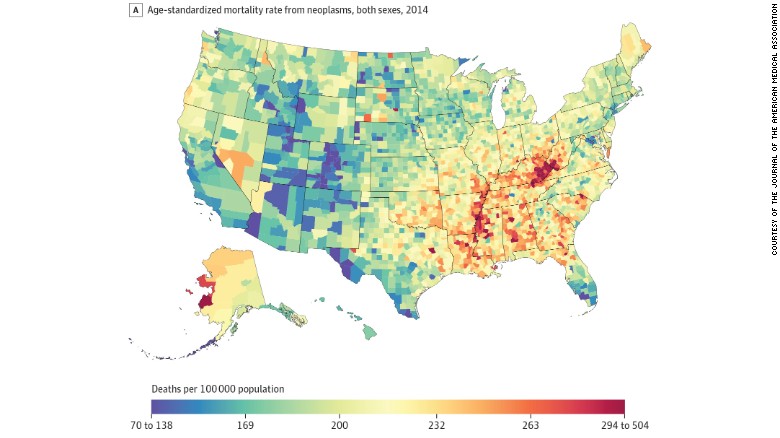
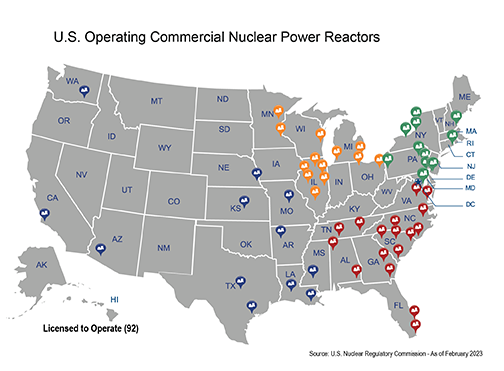
Meanwhile, people in the US are still wondering how and why cancer clusters happen [0]. Look at that map, look the red spots and with a little bit knowledge of the US nuclear industry you will realize what's around that area. What a coincidence? That's what it probably is, just a coincidence because admitting anything else to the public wouldn't really play that well, so coincidence it has to be [1].

[0] http://edition.cnn.com/2017/01/24/health/cancer-cluster-disp...

[1] http://www.bbc.com/news/health-37517770

Yes, why don't we overlay that map of cancer clusters [0] with a map of nuclear reactors. [1]

This is what we get: http://imgur.com/a/VzgMF

Now, I'm no statistician, but to me, it looks like there is... No correlation between the two. Maybe the mundane, unsexy explanation in the article, citing lifestyle choices, smoking, alcoholism, access to healthcare, and poverty as the main factors influencing cancer death.

Cancer valley running through Kentucky has more to do with bourbon, then its non-existent nuclear reactors (It has an enrichment facility in its western part, but that's not where the cancer deaths are).

In short, this is FUD.

[0] http://i2.cdn.cnn.com/cnnnext/dam/assets/170124123712-01-can...

[1] https://www.nrc.gov/images/reading-rm/doc-collections/maps/p...

The new-built nuclear power plants you are mentioning are not finished yet, have huge cost overruns and delays (and that's not finished yet).

The french EPR (Flamanville) for example had many issues (for example, some serious defects on the reactor vessel) and required redesigns while under construction. Quite frankly having seen it from the inside (I worked on a minor sub-system of this plant a few years ago), I even doubt it will ever deliver a significant amount of electricity to the grid. Even if construction is completed, it will be quite unique compared to the other EPRs, so I will not be overly confident about learning and be more efficient at constructing those.

The finish EPR (Olkiluoto) played a huge part in the near bankruptcy of Areva (french company providing various elements of the nuclear life cycle, from uranium mining to nuclear waste "recycling") and lead to its bail-out by EDF (which is mostly state owned, so in the end, the tax payer will pay).

The two Hinkley Points EPRs are a huge gamble, and the decision to go through by EDF (builder and operator of the future plants) on this project lead to much criticism, the EDF workers syndicates are deeply against it and the financial director and a member of the board resigned because of it. Given all the unknowns regarding the EPR, at 20 billion euros, it's a really huge risk taken more for political reasons than economic ones.

Also EDF must face a huge overall of all its nuclear reactors as they are nearly all reaching 40 years old. This "Grand Carénage" will cost ~50 billion euros to gain 10 to 20 years for the 58 existing french reactors.

For the decommissioning part, there are many unknows. The old and small Brennilis plant is being dismantled since 1985 with no definitive solution regarding the handling of the reactor vessel. Also there are tons of criticism regarding the future underground storage facility at Bure.

That the not so bright economic situation of nuclear industry in France (nuclear produces 70% of electricity here).

To finish, I'm personally worried by the implication of nuclear energy. Basically, believing in our capacity to manage highly dangerous wastes for several order of magnitude longer than human civilizations exist (let alone individual states) seems overly confident.

Yes, it has. The UK basically had to agree to pay a substantially above-market price for power for the life of the plant to make it viable: https://www.theguardian.com/uk-news/2017/jun/23/spending-wat... (and it's not clear that it's viable even then). As I recall, some US states have had to subsidise their existing nuclear power plants just to keep them running thanks to falling electricity generation costs. This is only going to get worse as renewables drive down the cost of electricity further.
As I demonstrated in my comment, Hinkley Point C, even with its massive cost overruns (and true, nobody knows if that's the final cost yet, but that's the current figure), is roughly on par with offshore wind in cost per installed GW after accounting for capacity factors. It's just that Hickley Point C will have as much capacity as the entire north sea offshore wind fleet (all countries, not just UK), and so the concentrated single number gets very big. And wind is massively subsidised, too, so the subsidy is not an argument in itself.
Most of your points about off-shore wind aren't quite right..

> These prices are set to go up, as the easy sites for installation are running out.

This isn't even remotely true... You can measure the number of offshore farms in the dozens, there are something like 1,500 cities with populations of at least 500,000 - and most of these are close enough to the water to make broad use of offshore wind power. For instance, there's 1 operating off-shore farm in the US right now.

> New-built offshore wind costs €3-4.7b/GW

Like pointed out elsewhere, this is true if you only look at off-shore costs. On shore wind is more like $1,250/KW. Importantly though, it's only true today. We're rapidly increasing the size of turbines and the height of towers. Most of the existing installations used 4/5/6-MW turbines. Vestas has already shipped a 9.5MW turbine. We'll likely see 20MW turbines within 5-7 years.

If you're building a 500MW off-shore farm with 5MW turbines, you'll need 100 foundations, towers, turbines, you'll need 300 blades and maintenance will have to service each one individually. Increasing those to 10MW cuts all of those costs in half (more likely, by 30% or so to account for scale). Doubling the size again has the same magnitude of impact. With 20MW turbines, a 500MW farm would only need 25 turbines and 75 blades.

The other benefit from these much larger turbines is that they'd sit much higher. If you increase the hub height from 100M to 150M or 200M, all of the sudden you're looking at sustained annual average winds approaching 20m/s. The wind shapes shift significantly as you increase altitude as well, so you can go from c=12, k=2 to c=20, k=3.5. This should easily move the capacity factors from ~50% to ~70+%.

> and, most severely, the expected lifetime of ~25 years[5] compared to 60+ years for nuclear.

Nobody serious expects that wind farms will only last 25 years. They'll last in perpetuity as long as their servicing costs stay below the marginal revenue from production. The initial lifetime expectations of nuclear reactors was 40 years, which has been extended for many plants. The same will happen with wind resources for many of the same reasons (high decommissioning costs, the challenges of siting a new generator, proven financial success at that location, etc.).

Right, but onshore wind is massively cheaper.

Also, renewables can be built out incrementally and start generating very quickly, so your ROI starts almost immediately.

With nuclear you're looking at a ~10 billion upfront investment, that doesn't start generating for at least a decade.

In addition to this, costs for renewables are falling, while costs for nuclear are not.

95% of that cost is due to compliance requirements. 98% of those compliance requirements are 100% bs. If the same requirements were asked of new coal or gas built it would exceed that of a nuclear plant. The average coal plant emits more radiation in a month than the average nuclear plant during its entire operational lifespan. And billions of tons of CO2 for extra planet-killing power.
a) I'm pretty sure you just made those numbers up

b) Yes, Nuclear power is heavily regulated and this affects the cost. But that is the world we live in - and the world we build generating capacity in, so deal with it.

Where have you got those numbers from?