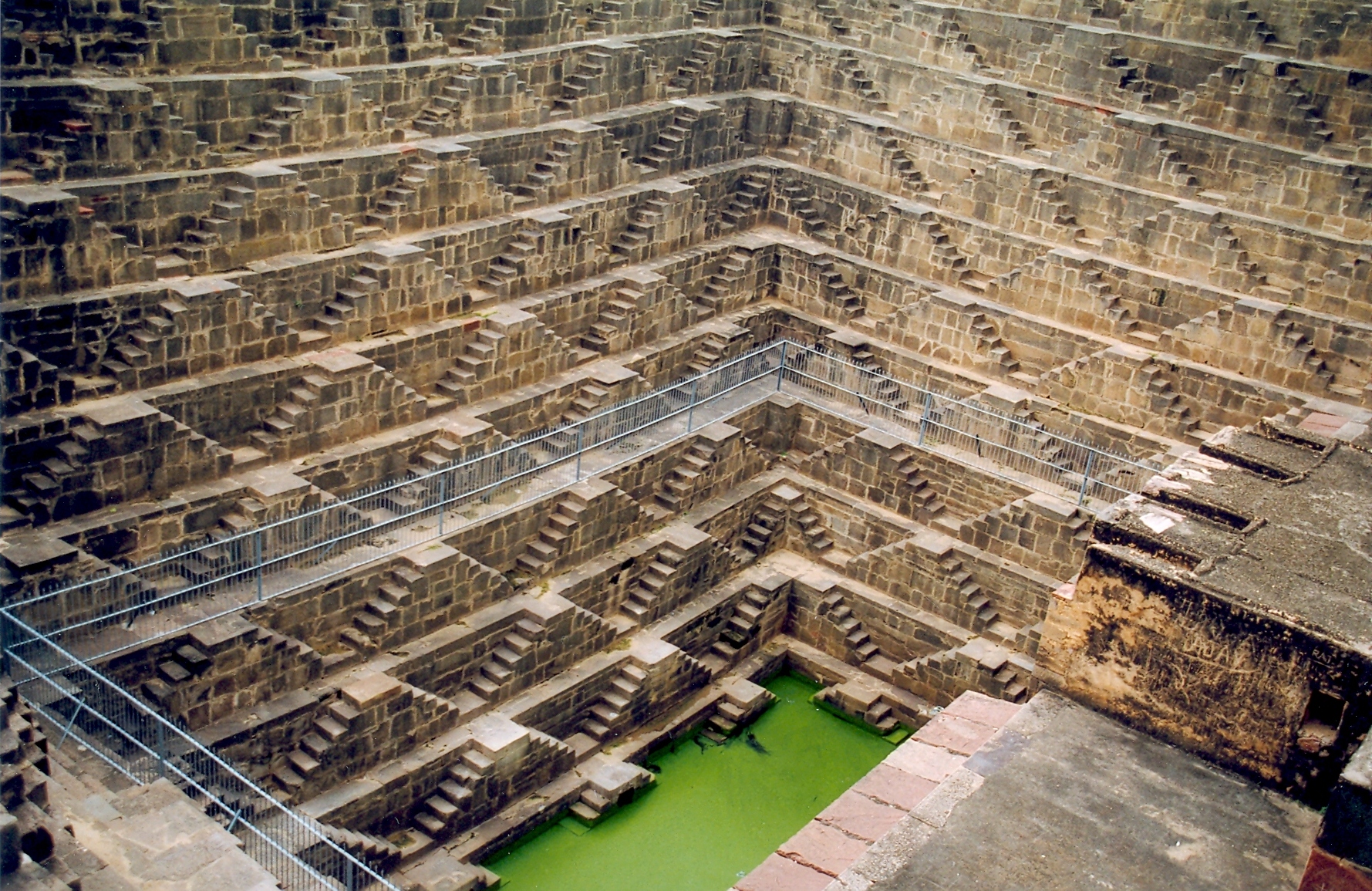
| In India, we employed a variety of methods that, all combined, did a good enough job of keeping things cool. The first was a stepwell, called Baoli in Hindi. This was basically a giant swimming pool dug out and filled with water. Around the stepwell, terrace-like steps were created where the general public could hang out and stay cool. For example[1]. Another method was to have dual walls with some lattice patterns on the first wall. The first wall absorbed all of the heat and would get warm in the evening, but the second wall, recessed from the first wall by a certain distance, would be spared the hot sunshine, and would stay cooler. These second walls made up the walls of your room. Moving to basements was also a popular solution, since beneath the earth stayed cooler. The British especially loved this solution. Older homes in India have high ceilings with ventilation at the top to allow for natural convection. The hot air would escape from the top and be replaced with cool air. In places like New Orleans, the Creole architecture also involves inlet vents in the basement-region, where cooler air would be sucked in. Finally, after the arrival of electricity, we had evaporative coolers, where pads made out of hay would have water dripped onto them. The evaporation of the water would cool things down inside the cooler via latent heat, and this cooler air would be blown into a room with the exhaust fan. This is a fantastic solution for dry heat places because it doesn't get rid of humidity (making the skin feel terrible), and has the power consumption only of a puny exhaust fan (unlike a full blown positive displacement compressor). [1]: https://upload.wikimedia.org/wikipedia/commons/e/ee/ChandBao... |