Hacker News new | ask | show | jobs
by grenoire 3313 days ago
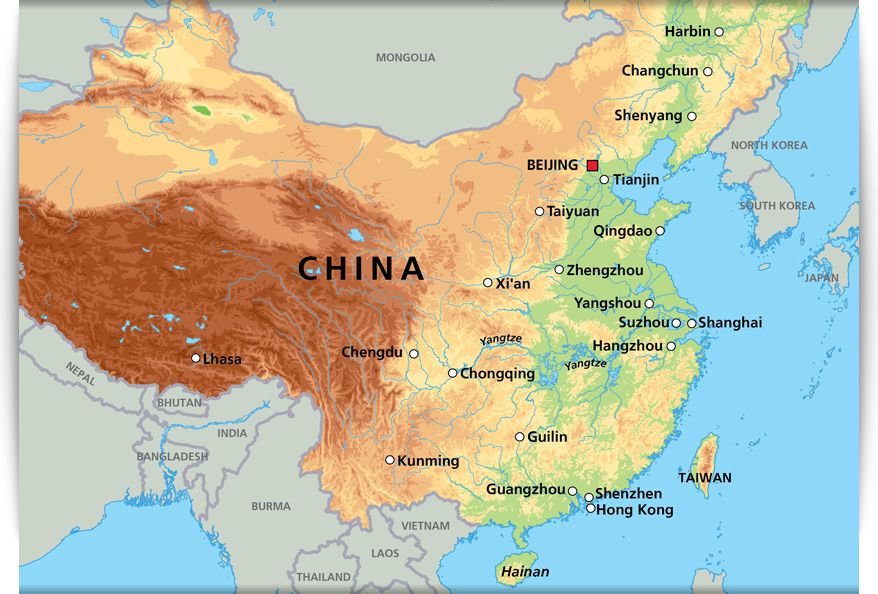
That's partially due to the fact that the less inhabited areas are mostly uninhabitable or simply very inconvenient.

See this height map of China and see how the less populated areas are simply too high: http://chinatoursandholidays.com/sites/default/files/styles/...

I'm guessing that there are a lot of inhabitable places in the US that are just... not.

1 comments

Australia is like mostly one very large desert. All our population centres are on the coasts.
2% of Australia lives in the yellow area:

https://au.pinterest.com/pin/89509111317506788

It's clearly not feasible to provide the mainland the infrastructure necessary for comfortable living, why bother?
To be fair, population centers are concentrated on coasts worldwide, if less dramatically
But what's interesting, most of historic capitals happen to be not coastal, and often a bit more to the north than you would expect of comfort zone.

Beijing, Paris, Moscow, Berlin. For some reason, coastal cities don't have this push to form a state.

I have no idea about Beijing or Moscow, but Paris, Berlin, and London were all located on swamps/marshes.
Moscow region is swampy all right. And I've heard that Washington DC (being an artificial capital) is located on a swamp too.

I think the reason is simple, "Braindead" style. It's just that lizard folk prefer the marshes, so that's where we have to be.

The reason is simple. Swamps are commercially strategic, since they're located on rivers.

For most of history, shipping goods over land didn't make much sense.

Hence the "Drain the swamp" political rhetoric of the last US election cycle.
FWIW, Berlin and Moscow both mean "Swamp Town".
Canberra also.
Beijing has multiple rivers traversing the current municipal area, and they were dammed and directed into channels, or directed underground as the city grew (same for London, by the way - London has multiple historical rivers that are now entirely or almost entirely underground, not just the Thames)
Moscow is located on a big river that used to be a major trade route.
> But what's interesting, most of historic capitals happen to be not coastal, and often a bit more to the north than you would expect of comfort zone.

Cities are created by commerce, capitals are created by war. A state isn't going to last very long with its capital on the front lines.

All set on rivers, which makes transport with small boats viable, and provides access to fresh-water.

Coasts are harsher environments, and requires bigger ships / more crew for safe/efficient transport.

It also had large defensive considerations as large ships became viable but we still did not have large/fast land-based transportation.

London, Rome, Athens, Lisbon, Dublin, Istanbul, Amsterdam, Venice, the list goes on and on (with the last two historic capitals being right in the water, not even coastal; and while I'm aware that Venice is not a capital these days, theirs was a formidable empire)
London, Rome and Athens don't strike me as seaports. They're somewhere not far from the sea, but not on the coast.

Venice reinforces my point, if anything. It was more like a large corporation than an empire, and then it failed to produce a nation state.

Istanbul is not a capital of Turkey. Before that it was a city-state of Constantinople for a long time.

London used to be the seaport of England (before railways outsourced this to Southampton); whence do you consider the name Docklands (the huge area downriver of the Tower)? The rest is just nitpicking ("modern Piraeus is not part of Athens") and moving the goalposts (first it's "historic capitals", now it doesn't matter because Istanbul is not a de-iure capital at present, even though it de-facto is? Plus, there's a major stretch of history between Constantinople and present day)
Maybe because boats didn't used to be particularly good at seafaring?

Dunno!

Good harbors happen to be full of wetlands. The current reality, where there are practically no wetlands near large coastal cities, is very artificial.