Great project! but the title "3D scanning like a pro" is quite a stretch. Real 3D scanning pros use something like this Leica P40 scanner:
https://www.youtube.com/watch?v=GnmerVV5-T4
The definition of pro varies! Here's a short rundown of 3D imaging:
Laser triangulation systems (laser stripe + turntable) will give you extremely highly detailed models at close range. You could build one for under £100 and the accuracy can easily be sub-mm. Downside is it'll only work for a short range.
Long range you're not going to beat a scanning LIDAR system like the sort that Leica offers. A comparable system from Faro (with a public price-tag) is around £30-50k depending on spec. For 'set and forget' scanning, these systems are great. They're also pretty much the only reliable solution for robust, kinda fast capture of large sites. Velodyne's automotive LIDAR (the one on the older Google cars) came on the market for around $75k. The future of 3D imaging is probably low cost MEMS scanning LIDAR, which is being bankrolled by autonomous driving.
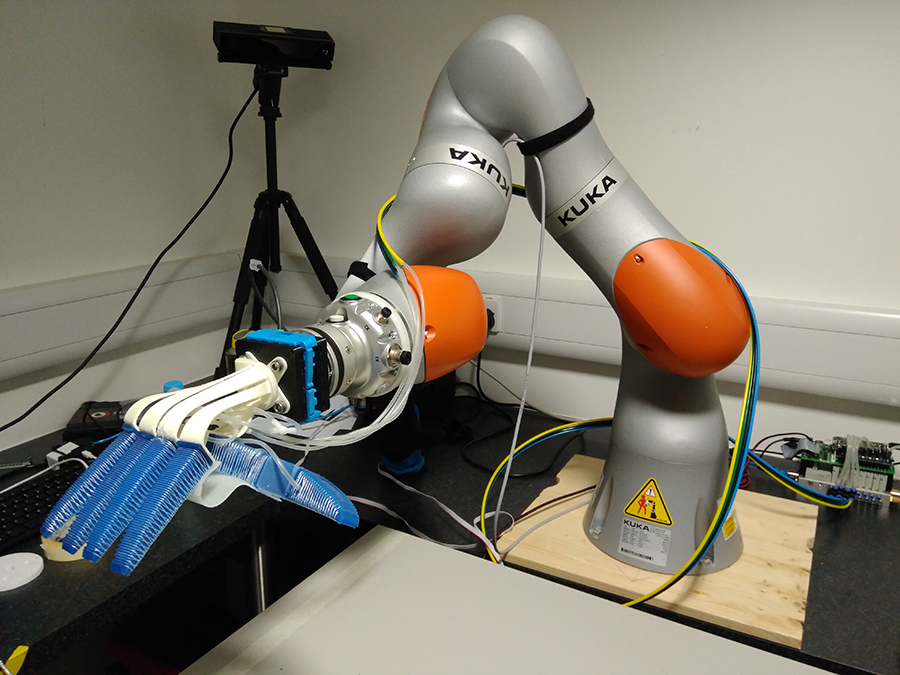
Short range you also have time of flight (Kinect 2) which is used in research and also by several large companies for commercial RnD (e.g. Ocado - http://robohub.org/wp-content/uploads/2017/02/SoMa-Ocado-RBO... - see the thing on the tripod?). My local second hand stores sells the Kinect 2 for about £25, but you need the USB adaptor (£30). Lots of companies make ToF sensors, but Microsoft really forced the price down.
Then you've got Kinect 1-like systems (Primesense), which include Google Tango (and other clones from Asus, etc). I think the Intel Realsense does something similar. These are mono cameras and an IR pattern projector. They don't work in sunlight, but are pretty good indoors. The Kinect 1 was (is) huge in 3D vision research because it was so cheap and relatively robust.
Finally you've got stereo which is the only real competitor to LIDAR outdoors. Much more dense than LIDAR, and you get true intensity information, but poor accuracy at long range. Performance is mostly dependent on the distance between the cameras. It's also the only technology you can reliably use in space. There are very few spaceborne LIDAR systems (e.g. LOLA, MOLA, etc). Stereo is the bread and butter of 3D on rovers and for planetary mapping. Prices vary, but you're looking at around £400-500 for a good pre-built stereo rig.
I think it would be unfair to say NASA and ESA (Exomars should also have stereo cams) aren't pros!
There are also several niche industries like handheld structured light scanners which can also get sub-mm accuracy. These are used for a mix of industrial inspection, capturing props for movies, etc.
You can also take the Kinect 2 apart and modify it for using external power input and regular USB3 (Type B?) cable.
I have done that and it works well, see: http://www.tatsch-it.de/kinect-2-usb-3-modification/
Mikeha, glad to see attention from my favorite 3D scanning company. Results you shared are awesome!
I do admit that my system lacks precision, angular resolution, and lot's of other nice bells and whistles. But hey it was build over weekend including software. Also this is more like rotary stage demonstration rather full featured 3D scanner.
thanks, that does put the OP's work, impressive as it is, into perspective, it's a stunning system you have there and looks like you get to work in some nice venues :)