Hacker News new | ask | show | jobs
by brilliantcode 3331 days ago
Interesting stuff. The Korean language is considered one of the most scientific language on the planet. I'm puzzled why that NASA guy would push Sanskrit to be an actual application language. In my opinion, an HN'er should be able to read and write Korean in about an hour. I don't know if that's true for Sanskrit.

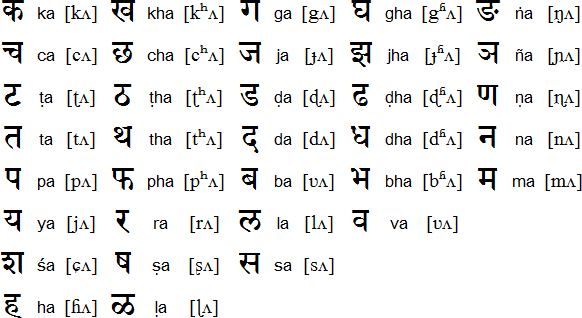
Taking a look at Sanskrit, it looks very cool. I think it's aesthetically better looking than Korean alphabet.

http://www.omniglot.com/images/writing/sanskrit_cons.gif

5 comments

> The Korean language is considered one of the most scientific language on the planet.

It's considered that by lay people, largely due to Korean patriotism, not by real linguists (can you provide a source?)

> an HN'er should be able to read and write Korean in about an hour.

So, you're talking about the alphabet used to write the language, not the language itself. At best you've proven that Korean has a highly regular writing system. But I'd argue that the average HNer could learn to read, for example, Spanish in about two minutes.

> It's considered that by lay people, largely due to Korean patriotism, not by real linguists (can you provide a source?)

I didn't say the MOST, it's among the more scientific languages. I'm not pushing for Korean patriotism, that's just your own assumptions.

> So, you're talking about the alphabet used to write the language, not the language itself. At best you've proven that Korean has a highly regular writing system. But I'd argue that the average HNer could learn to read, for example, Spanish in about two minutes.

Hangul is the writing system that is uniquely different from a latin based system like Spanish. Your argument is moot.

So, can you give me a scientific/academic source that says anything about "how scientific" Korean is?

> Hangul is the writing system that is uniquely different from a latin based system like Spanish.

How? They're just different alphabets. The only unique feature of Hangul is that all the letters making up a syllable are arranged in one square -- is that what you're referring to as making it uniquely different? If not, what?

> So, can you give me a scientific/academic source that says anything about "how scientific" Korean is?

https://scholar.google.ca/scholar?q=korean+language&btnG=&hl...

> The only unique feature of Hangul is that all the letters making up a syllable are arranged in one square

That's one feature that makes it superior to say Chinese. Chinese character is a bitch to learn and it's been bastardized by the communist party to increase literacy.

You really should be more precise. I'm sure you meant "orthography" in every usage of "language". And yes, Hangul is a relatively "shallow" or "transparent" orthography -- though it is becoming less so over time. But so is Spanish's use of the Latin alphabet, Japanese hiragana and katakana, and yes Devanagari.

https://en.wikipedia.org/wiki/Orthographic_depth

Ha, this is exactly the other language that came to mind when I saw this article. I love Hangul, but a lot of its "scientific"-ness comes from it being so recent that the spoken pronunciation hasn't drifted from the written form. There just a few rules for changing sounds, and they're quite regular.

Unfortunately the people in charge of the Revised Romanization decided that these rules should be applied to the Roman alphabet as well, so we have execrable constructions like "Daegu" or "bibimbab" which can't be pronounced from English spelling rules.

I challenge that most could learn to read and write Korean within 15 minutes [0]. At most, stumbling over some of the vowels. It really is a marvelously simple language. Of course - reading it at speed will still take more practice but I feel one could become quite proficient at reading (without any comprehension of what they are reading) within a few weeks of practice.

[0] http://www.ryanestrada.com/learntoreadkoreanin15minutes/

If ^ makes the 's' sound in summit, why is ^| = "she" and not "see"?
TL;DR: Palatalization.

https://en.wikipedia.org/wiki/Palatalization_%28sound_change...

https://en.wikipedia.org/wiki/Korean_phonology#Vowel_assimil...

That "ee" sound is known in IPA [0] as /i/. That sound is also the vowel counterpart to the semi-vowel /j/ [1, 2]. Within languages, /j/ has a tendency to palatize sounds. In the case of Korean, this has resulted in /s/ being conditioned to /ɕ/ before /i/, where /ɕ/ is the alveolo-palatal version of /s/. (This sound is technically different than "she", which is /ʃi/.)

This process of moving where a sound is pronounced is actually known as "assimilation", but this particular case of assimilation is via a palatal sound. That's why there's actually two palatalization terms in linguistics -- the one I linked above and this one: https://en.wikipedia.org/wiki/Palatalization_%28phonetics%29

[0] https://en.wikipedia.org/wiki/International_Phonetic_Alphabe...

[1] English "y" sound, as in "you" /ju/.

[2] https://en.wikipedia.org/wiki/Semivowel

>one could become quite proficient at reading (without any comprehension of what they are reading)

If you can't comprehend what you're reading, you're not reading. Learning the Korean alphabet is not learning Korean.

I disagree entirely. You can read without comprehension - hell I can read my native language without comprehending what I'm actually reading. I'm still reading when I do so. What else would you call it when reading a heavily technical document you don't fully understand? You may not comprehend what the words as a whole mean but you're still reading.

FWIW, only one dictionary definition I can find includes "comprehend" in the definition and it still falls under other definitions such as "speaking aloud written or printed material to other people".

I never claimed it was. My post was very specifically about learning to read and write Hangul.

Korean and Hangul are different. If you know the Latin alphabet that doesn't mean you know how to read English. It means you know how to read the Latin alphabet.
Of course, but can you do the same with Arabic in the same time span? I think not.

With Hangul, you can start writing your own name, lot of English words in Korean which is understood in Korea. Even Konglish (Phonetically typed Korean in English) is understood to a certain degree.

Anything beyond that, you will need to learn the Korean words, but it gets you a lot farther than most languages.

No I don't have scientific evidence to support this but from anecdotal experiences. Somebody wants to write a paper on it let me know, I'll give you 0.1 bitcoin.

You aren't learning Korean. You are learning Hangul. You don't just need to learn 'the Korean words'. You need to learn Korean lexicon, Korean syntax, Korean morphology, Korean idiom, Korean pronunciation, etc. etc. Those are the actually difficult parts of language.

Learning the Latin alphabet doesn't mean you have learnt to read English.

And sure of course you can learn the Arabic alphabet quickly. It's a lot simpler than it looks.

Korean alphabet, not language.