Hacker News new | ask | show | jobs
by cgarrigue 3329 days ago
It's only cheap if you come to Japan for holidays, or if you're an expat detached by your company to Japan. If you're living in the country, receiving the same salary as any Japanese person, Tokyo is an expensive city. And I'm not even talking about language teachers, who cannot really live in Tokyo or all the Japanese people who are part-timers

Everywhere in the world salaries, rents and prices go hand in hand. Unless you're living on one side of a border and working on the other side (which is possible in EU) which allow you to game the system, rents and prices are based on supply and demand. Don't take it personally, but it does not make much sense to compare what you would get with a salary from one country while living in another country.

6 comments

Yeah salaries are pretty low in Tokyo for a lot of jobs, if you're on the lower end of the skill hierarchy you're going to be in pain.

But ... it's not like low-skilled workers in SF are getting paid much either.

The average HN reader might be in a better negotiating position w.r.t. salaries in Tokyo

Some things to consider about Tokyo:

- No need for a car, insurance that comes with

- Your company will (in almost all cases) be paying for your daily transportation by car

- If you're willing to suffer in the morning with travel/take a bus to the train station, you have a range of prices for renting

- There are a lot of people living on low salaries, so there are a lot of services on the low end. 100 yen shops with high quality stuff, all things considered.

For 60,000 yen/month you can get 20m2 studio appartments (25-year-old buildings) within 15 minutes of stations like Nippori or Otsuka. If you follow the "1/3rd of salary" rule, it's reasonable if you're making a bit over minimum wage (not sure what the going rate for English teachers are)

that contrasts with the reality that the average commute time in tokyo is 66 minutes (2011). I suspect the median is probably longer then that.

SF is cherry picked, the most expensive place in the US. I live in Philadelphia and the commute time and cost is substantially lower. NYC would be the most appropriate comparison, and they get to work with nearly 20 minutes less commute.

I bring up commute because many people have long commutes because they simply cant afford to live closer.

> I suspect the median is probably longer then that.

Generally when the median is greater than the mean, it's because there's a long tail to the left dragging the mean down. I expect that the opposite is true: there is a long tail to the right, with a small number of people who have exceptionally long commutes.

So I'd expect the median to be lower, like it is for salaries.

yeah i bet you are right. Its probably bunched up to the left with a long right tail
Tokyo's rent is comparable to Dallas or Madison, WI (give or take some square footage because American housing is less efficient in space usage). Way cheaper than NYC for sure.

There are a lot of people who do 90 minute+ commutes for sure. Even for relatively small commutes you end up with a fixed cost of about 20 minutes for just going to the station from your home or leaving to go to the office, so 30 minutes is good.

It's possible to live close to your office if you're willing to live far from trains a lot of the time though. Living 20 minutes from any station instead of 5 easily cuts 30% off the rent

How accepting are the authorities and people of electric bikes/scooters?
People ride scooters all over the place in Japanese cities. They're pretty commonly used for delivery services as well. Biking culture is actually more aggressive than in many places in the US. For example, it's for some reason acceptable to ride your bike on crowded sidewalks, belying everything I understand about notions of Japanese civility.
One reason this works is that folks use their bells and people yield. Even in more unexpected areas:

https://www.youtube.com/watch?v=k7oGk-ozhKI

Electric bikes are making headway but many employers have rules specifically forbidding employees from riding them (or any other form of personal transportation) to work. There is a major national insurance company with which employers have a contract and that company won't pay out for accidents that happen on the way to or from work while the employee is on a bicycle or in their own car, so employers ban commuting by bicycle or car.
Ah no worries. Give SF 30 years of declining revenue for all it's industries (like Japan), with several financial disasters during that time, and SF will not be expensive anymore either. Living within 66 minutes commute to SF will be positively easy.
This is why I'm not buying a house in the Bay Area. I look at these properties on the market for $1.5m for a run-down house in the bad part of town just because it's "only" 15 miles from SF and I think that there's no way this is going up in value forever.
Great! I can't wait for SF to become cheap enough so I can move there.

...

When it gets cheap enough, you won't want to move there. That's why it'll be cheap.
Good weather, nice charm, isn't that why everyone wants to live there anyways? It's like how California is just is crowded so no one goes there anymore.
Tinto is also the most expensive place in Japan. It's quite expe dive compared to Osaka, the second biggest city.
I assert that you can find an apartment considered appropriate for a middle-class person in Tokyo for approximately $800~$1,200 in virtually any district of the city in under one day of looking. This is not true of Manhattan or San Francisco.

If you strongly believe this is unlikely, name a neighborhood and I'll show you three apartment listings.

If you want a 1K ~ 2DK [1] for 1 ~ 3 people I think you are right.

For larger families? I dunno. We're a family of 5 (1 in jr high, 2 in elementary) and really struggling to find a place to move up into from our current 2LDK. :(

I admit, we have a bunch of constraints, but I don't think they are too unusual. (want to be reasonably near to work, school, and in-laws)

[1] For those that don't know, apartments here are typically listed by number of rooms, plus if the space includes an "L" living room, "D" dining area, "K" kitchen. So "1K" would be a single room with a place to cook. 2DK would be 2 rooms, with an eating area and a kitchen.

>If you strongly believe this is unlikely, name a neighborhood and I'll show you three apartment listings.

I don't believe it is unlikely but I'd like to take you up on your services. ;)

Got anything for the Harajuku or Akihabara districts? You seem to be more knowledgeable on how/where to search for this info and I'm a bit lost. (Still have over a year to properly research this stuff on my own, but I really want to move to near one of those two districts next year.)

Even in Shibuya? That's interesting, because depending on the size of the apartment you consider middle-class, this would make it cheaper than Paris. Definitely not what I remember from living in Japan 10 years ago.

Has prices softened that much since then?

Here are 45 properties within a 10 minute walk of Shibuya Station, ranging from ~$600 to ~$1,200 and 1K through 2DK.

http://suumo.jp/jj/chintai/ichiran/FR301FC001/?ar=030&bs=040...

For folks who don't have the local color here: if you're willing to live in apartments sized for middle class Japanese folks, and that is a big if for many foreigners, Tokyo can be impressively inexpensive to live in. Shibuya is a very desirable and relatively centrally located neighborhood; think "SOMA" or, hmm, I don't know Manhattan that well but somewhere in Midtown maybe?

(If you optimize for commute down to the minute, prestige of building, or living space, you can end up paying a lot of money. Though even in an apartment that scores well on all three my rent is less than the median in SF.)

Anybody who lives in Manhattan would be thrilled to get a Tokyo-sized apartment at Tokyo-sized rent.
What is the delta between a wall-street programmer salary and Toyko programmer salary? I think it is 5x or 10x last time I checked...
In Tokyo, the salaries for developers range from $50K to $100K. In order to get the 10K, you need to be a senior developers and bilingual.

All salaries include public Social Security.

Ya generally speaking a new grad programmer is doing great if he/she makes $50k/yr.

Engineers that'd get $300k comp offers from big5 tech here would make $80k--$150k, provided you go to a web/mobile company. If you go to an older industry you will make less.

Who gets $300k comp offers? Principal engineers?
You can hit $300K (All-in) as a senior engineer at Google.

Various finance firms on the east coast can also send recruiting e-mails, touting their >400K comp. I think the key to that one is having work experience in an investment bank, as well as at AMAPGOFA.

> AMAPGOFA

?

Well, not all Manhattan residents are "wall street programmers".
Really? My TV tells me they are all waitresses, songwriters and lawyers living in a magical world of coffee shops and art galleries.
I was always impressed with the huge spacious apartments people working low paying jobs could get.

I guess Friends wouldn't have been that uplifting if it was shot in Rosses' cramped, leaky studio apartment.

For all it was, Friends did spell out some Manhattan realities. The main set, the girl's apartment, was an illegal sublet of an older relative and therefore subject to rent control. Even characters in decent jobs shared apartments. Several had wealthy parents who lived outside the city. A couple of the female characters made no bones about how they wanted to date/marry rich men, often significantly older men. And I got a kick out of the story arch where the Chandler character, despite a reasonable job history and a degree, had to work as an unpaid intern. The visual dimensions were certainly a total fiction, but I got the impression that some of the writing staff wrote what they knew.

That bit with the hanukkah armadillo and superman is still one of the funniest things I've seen on TV.

But would they still be so thrilled on a Tokyo salary? People here (I live and work in Tokyo) have a much narrower pay band than you would see in NYC or any American city. You might make $25~30k to start, and $40~50k at age 40.

I'd love to move back to my native NYC, but I've been priced out forever, as the cliche goes. There are entry level people earning more than I earn as an 18-year veteran in Tokyo.

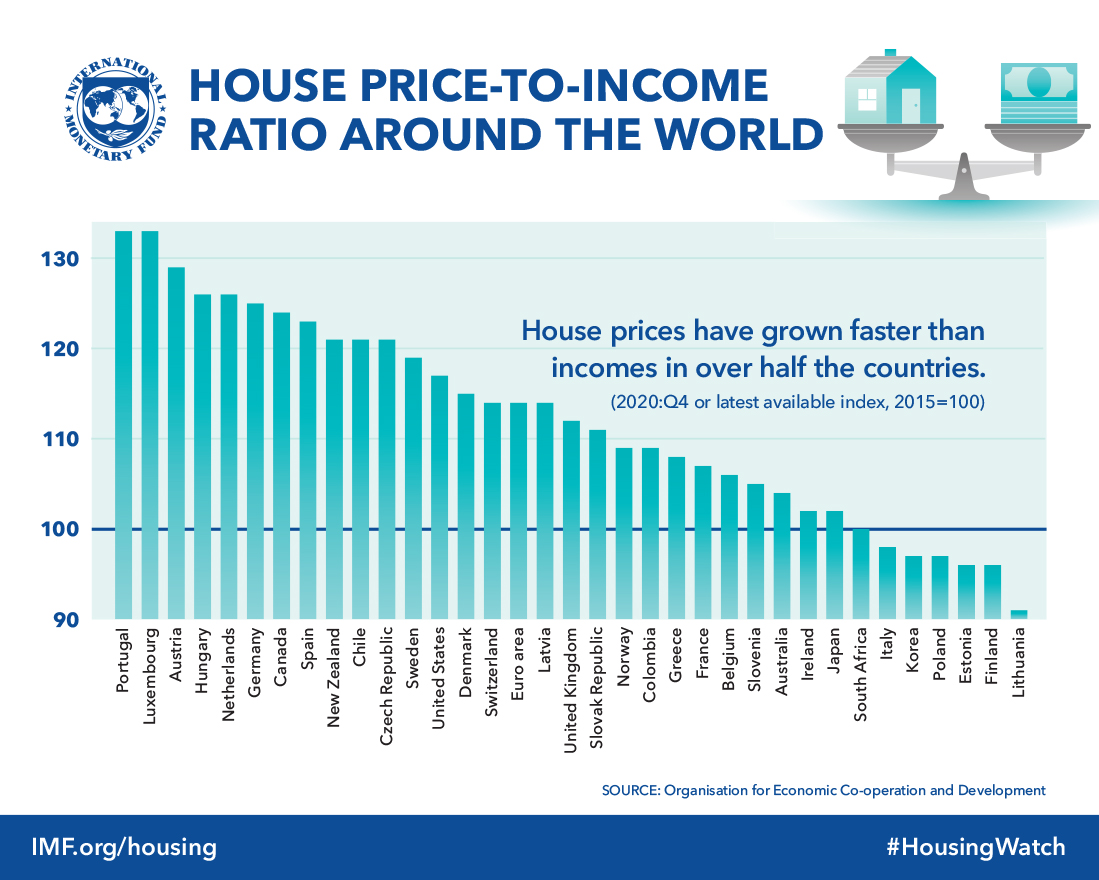
Everywhere in the world salaries, rents and prices go hand in hand.

Not true. There's huge variations in OECD countries. Here's a graph showing house price to income ratio. I know this intimately because I live on the far left :'(

https://www.imf.org/external/research/housing/images/priceto...

That's a rather weird graph - it doesn't show house price to income ratio at all, even though that's its title. It shows change in that ratio since 2010. Tells you essentially nothing about the actual house price to income ratio.
> Everywhere in the world salaries, rents and prices go hand in hand

Check r/London and look for topics like "how much of your salary are you paying on your rent?". I've seen a lot of people spending 50% up to 70% of their salary on rent.

I pay 50%, used to be 35% before I went full time and shifted part of my salary to an end-of-year bonus.

It will move up to close to 70% if my roommate moves out in August. It's a little shocking to consider that I would actually consider paying that much to stay here. I seem to really like Midtown Atlanta that much.

Once you get used to it, it's not that bad. Out of all the things you could spend your money on, having an utterly sweet pad in the dead middle of town isn't the worst thing.

The old rule of thumb used to be not to spend more than 30%, but I imagine that's changed greatly in recent times.
I recently started a full time job after getting recruited to a company in Tokyo, the wages are pretty damned good, and the cost of living is very low. By comparison I've worked in Sydney where the wages were comparable, potentially a little higher (less than 10%), and the cost of living was about three to four times higher. And done the digital nomad thing where cost of living was slightly cheaper still than Tokyo, but not by a lot, and average income was (variable, admittedly, but generally speaking) enormously smaller.

It does appear to be an optimal combination for both good wages and low cost of living in my experience having traveled and lived extensively all over the world.

The single caveat I'd make on saying this is that the way that I prefer to live might be uniquely suited to Tokyo, and uniquely unsuited to Sydney. That being; I hate commuting, I want somewhere small and comfortable but otherwise as cheap as possible to live, but as close to work as possible so I can just walk to and from every day. In Sydney working in the CBD this means you'll be stuck with some status signalling lifestyle apartment coupled with the already significant premium on rentals in general which is applicable to all Sydney real estate, and it's stupidly expensive (average 2250 - 2500. You could probably get away with a rundown roach palace for a little cheaper, but the floor on Sydney rentals in my experience is just absurdly high.

By comparison I got a no frills apartment that is perfectly useful, comfortable and serviceable within 300 meters walk to my office in Shibuya no problem at all, 1100 USD per month, and everything else on top of that with the bountiful microwave dinners, amazon, and roadside eating joints by the dozen, extremely fast and cheap internet (gigabit for < 40 USD pm) doesn't increase the price by much at all.

I'm curious to find out more about looking for and getting a tech job in Japan, as well as the overall working environment. Did you look at specific jobsites? Do you speak Japanese? Are tech companies in Japan similar in culture to your usual stereotypical long hours salaryman jobs in mainstream corporate Japan?
Regarding jobsites, no, I was contacted on LinkedIn for a specialised project that I happened to be uniquely suited for. I was not in the country at the time, and my employer handled immigration and the relocation and everything associated on my behalf.

I did not speak any Japanese at all at the time I started, and I am slowly learning it now but don't have a lot of time to dedicate to the project. I intend to gain fluency in it eventually. Unlike many of the places in the world I've lived, I would say if you intend to comfortably exist here long term, you will need to learn the language both spoken and written. It's not like a lot of places these days where English is almost an official second language or there's extensive proficiency amongst the local population.

This is my first and only time working in Japan so I have no basis for comparison to other companies here. My impression of the culture is there can be an overemphasis on hours worked rather than output produced and the quality thereof, but they're conscious that is an issue at least where I work and they're mindful of it and try to address it. They also have things that seem strange to me as a foreigner but I am more prone to just accepting and trying to do things their way (when in rome).

All in all, I'm finding it pretty good, it definitely helps that this particular field has pretty much devoured all my energy, life and thinking since I really immersed myself in it a few years ago, so working in a global hub central location where it's really having an explosive impact on a core related piece of infrastructure is pretty much a dream job for me.