"Safety" - he's technically correct, but I believe it is guaranteed death if he'd try it:
"The suit can currently fly uninterrupted for around 10 minutes."
That leads me to the assumption that if he climbs up to a few thousand feet or goes full throttle to reach that speed, he'll be out of fuel faster than he can break & land.
> "it is easily capable of an altitude of a few thousand feet. But, for safety reasons, he keeps the altitude and speed low."
Sure.
I have watched some of the video, and at no point does he sustain a height high enough to stop benefiting from ground effect.
Hovering for maybe 10 seconds at 5 meters up would do it.
Until he does demonstrate this, I shall choose not to believe him, and won't consider this actual "flight". For much the same reason that an Ekranoplan is not actually an aircraft.
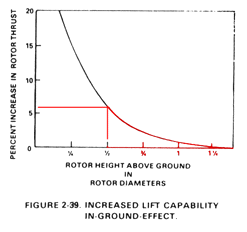
Ground effect in this case would be virtually non-existent because of the extremely small disk loading in the case of those miniature jet engines. The ratio of the jet diameter to each jet's height off the ground shows that the ground effect is pretty small in this case. Probably less than 1 percent thrust increase in the case where the jets are attached to his arms and back according to this graph: http://www.copters.com/aero/pictures/Fig_2-39.gif
(This graph proves that he's getting essentially zero ground effect.)
The actual exhaust velocity of those jets is extremely high, and for a lot of the video he is holding the jets at a significant angle with respect to vertical, giving cosine losses. With a thrust to weight ratio of over 1, I have no doubt he could achieve extremely high speeds (yeah, 200mph or over) given even a slight amount of lift from his body in horizontal(ish) flight.
> Ground effect in this case would be virtually non-existent
Then it should be easy for him to demonstrate a sustained hover at 5 or more meters up. Or if it's not a lack of power, does he not have the necessary fine control do do that?
How would you like to fall from 5 meters height while carrying 6 lit jet engines and a bunch of flammable liquid on your back?
The answer is pretty obviously safety. That, and I doubt flying is terribly reliable either given he is doing it with muscles and his muscle memory (super impressive, by the way), so if he did it over water just to prove a point, there's a good chance he'd ruin tens of thousands of dollars worth of equipment.
He could fly to five metres attached to a safety line on a ten-metre tower, or a crane. A simple auto-descender would do fine.
My impression watching this guy's videos when they have hit the news over the past few months has been that, for whatever reason, it skims the ground and can't ascend. If he wants to disprove that, it should be possible to rig up a safe test.
As far as I can tell, they're working on a garage budget. A ten meter tower and crane is non-trivial to rent and setup.
No reason to disprove something that is disprovable with a basic understanding of basic physics and aerodynamics.
I expect the big challenge with a device like this is NOT ascending too high where you'd be at risk of breaking a leg or thousands of dollars worth of red-hot jet turbine. This isn't a drone, it's a flying person.
I think this takes some time. It takes 2 years of constant practice to learn how to walk well, and we evolved that capability. Learning to hover and fly might similarly take years. He most certainly could do it, but at significant risk of breaking bones and wrecking his equipment and/or starting on fire.
To get ground effect with something like that you would have to interrupt any recirculation (see helicopter ground effect). Just looking at the dimensions of everything you would think that the possible ground effect (recirculation) zone would be less than half a metre and the engines are higher off the ground than than that.
Does ground effect apply, when your lift is from a narrow jet rather than a wing? I believe ground proximity presents a problem for VTOL jets, at least in part due to recirculation.