Hacker News new | ask | show | jobs
by Jabanga 3348 days ago
Centralising spending in the hands of a monopoly inevitably leads to rent-seeking behavior, like the rise of teachers unions and legislation like collective bargaining acts.

I think the net level of support people can expect their children to receive from redistributive programs plays a role in their decision to have children when they have low income. It's also important to note that it won't just be schooling if the goal is to provide equality of opportunity. It will have to be food as well, and other resources needed to have an equal opportunity.

As for education and fertility rates, this is not guaranteed to last. Formal education is not something humans were evolved for. But evolution has a way of quickly adapting to maximize its programmed objective: reproduction.

1 comments

> As for education and fertility rates, this is not guaranteed to last

That is not a valid retort. You can't just take a bunch of data points and discard all of them because "evolution has a way". I'm not extrapolating based on this data: these studies show that improving access to education in a wide variety of regions and cultures decreases fertility. These are completely valid statistics and research demonstrating that education is correlated with reduced fertility, you can't discard them with idle speculation. If you have evidence demonstrating your position, we can talk.

Evolution is a well understood phenomenon. It's reasonable to extrapolate its long term effect, especially when very high levels of government spending on education is such a recent phenomenon.
You have a hypothesis, but do you have evidence supporting your conclusion? A study suggesting that increased access to education, or welfare in general, increases the birth rate among the poor? Maybe an example of a species which, upon a decrease in difficulty raising offspring (I'd accept a decrease in infant mortality as an example), started to produce more offspring than normal?
I certainly have evidence that suggests welfare leads to people having children when they're in poorer financial circumstances:

https://books.google.ca/books?hl=en&lr=&id=Gl5Xvza-bmsC&oi=f...

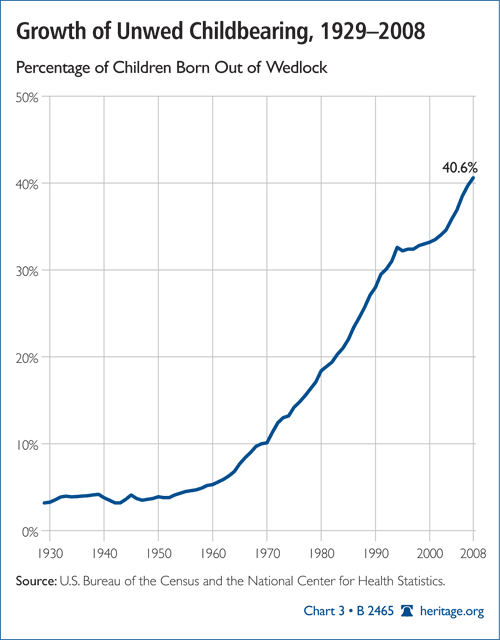
The rise of the welfare state over the last 50 years has been associated with a massive rise in out-of-wedlock childbirth:

http://www.heritage.org/sites/default/files/~/media/images/r...

>Maybe an example of a species which, upon a decrease in difficulty raising offspring

It's a well known maxim that feeding animals leads to a population explosion.

1. Welfare doesn't mean access to education. At no point have I mentioned welfare, only access to public education, specifically public primary and secondary education.

2. Just because people are having more out-of-wedlock children doesn't necessarily mean they are having more children over all. It could simply mean people aren't getting married anymore.

3. Your first link has the following quote in the introduction section: "a reasonable reading of the evidence to date is that the welfare system may increase non marital childbearing, but the magnitude of its effect may not be large relative to the effect of other factors in contributing to recent increases in nonmarital child bearing in the US. In fact, the simplest evidence indicates that the welfare system has not been largely responsible for the recent increases in nonmarital child bearing."

4. Feeding animals increases population, but that's not the same as increased fertility. If an animal normally gives birth to a litter of 5, and only 3 normally live to adulthood, but now all five live to adulthood, then population will increase even though each couple is producing offspring at the same rate. And I'd also like something showing that human beings would exhibit the same phenomenon, because human behavior is a complicated thing governed by more than evolution.

1. You wrote in your previous comment: " A study suggesting that increased access to education, or welfare in general, increases the birth rate among the poor?"

2. The fact that an increasing number of people are having children out of wedlock should be very concerning. Many social problems are strongly correlated with high single parenthood rates. The evidence suggests to me that more welfare encourages single parenthood by changing its costs/rewards.

3. Even that finding is shocking in how anti-welfare it is, given the well-documented leftist bias in the social sciences. Even accepting it at face value, it points to a definite negative effect. Over time, it could get worse due to natural selection.

4. I can do some research and see what I find. As for human populations, I think the most likely outcome is that they inevitably reach a state of evolutionary optimal behavior.