Hacker News new | ask | show | jobs
by coldpie 3369 days ago
The messaging coming from Republican politicians is either that climate change is not happening, or that it is a natural cycle and nothing to do with humans. Both of these hypothesis are objectively false.

Setting that aside, emissions per GDP is an interesting and useful statistic, but it doesn't paint a complete picture. If you were to entirely eliminate the top three highest emissions per GDP countries from your list, you will have done nothing to combat climate change. If you sort that list by total emissions, the US ranks #2 a short distance behind China. China is actually fifth from the very bottom of that list.

It's a complex situation and will have an impact on the global economy no matter what. We can decide to do something now and take short-term losses to prevent massive devastation in the long term from doing nothing.

> I am really not impressed by any sides efforts to combat global warming.

Hmm. What would impress you? I honestly think climate change is the most important issue in the world right now, and I would love to know what we can do to get you on our side.

4 comments

> The messaging coming from Republican politicians is either that climate change is not happening, or that it is a natural cycle and nothing to do with humans. Both of these hypothesis are objectively false.

Climate change is a shibboleth and people largely appear to recognize it as such. For example, in Ware County, GA (to pick somewhere at random), 70% of folks voted for Trump but 2/3 answered "yes" to "global warming is happening."

> I honestly think climate change is the most important issue in the world right now, and I would love to know what we can do to get you on our side.

Supporting diplomatic efforts to combat climate change are virtue signaling. I'm an environmentalist and I agree that climate change is probably an impending disaster. But diplomats aren't going to fix it. The Kyoto protocol, for example, accomplished almost nothing: http://www.circularecology.com/news/the-kyoto-protocol-clima.... The only thing that can save us (if we can be saved) is technological breakthrough, and the prospects of that happening won't change based on U.S. participation in international climate change protocols.

The phrase "virtue signaling" is so useless. As if any action that does not have clear and immediate results is just posturing and pandering.

I think change absolutely has to come from governments and thus diplomats. Are corporations going to cooperate at a global scale to fix this with no regard for short term profits? Corporations like Exxon knew about climate change 40 years ago. Personally I think we should be litigating against a corporation that would hide something of global importance like that.

Where is the money to research these technical solutions going to come from? The article you linked showed that there were improvements among the signatories even though without the fall of the USSR it would have been 2.7% vs. 4.7%. Still it was something vs. just saying "this problem is too big to solve, let's hope some smart scientist finds a fix before we all die". Had China and the US been adhering to the Kyoto protocol undoubtedly the impact would have been much greater.

> The article you linked showed that there were improvements among the signatories even though without the fall of the USSR it would have been 2.7% vs. 4.7%.

That's rearranging deck chairs on the titanic. And acting as if that's an important thing to spend political capital on is precisely "posturing and pandering."

Still not seeing your point. The goal is x. We achieve x/2. We still achieved something. We proved we can actually make an international agreement with long term goals and short term sacrifice and make improvements. I don't really blame politicians for taking further credit and trying to spin their success as even more impressive. Do you think the Paris agreement (https://en.wikipedia.org/wiki/Paris_Agreement) would ever have happened if not for that initial (however small) success? Reading the aims it seems on the surface to provide reasonable goals that balance growth and fairness with trying to prevent climate change.

What should they spend political capital on? Seems like this section is also going to help develop technological solutions: https://en.wikipedia.org/wiki/Paris_Agreement#Ensuring_finan...

The problem I have with pointing to international frameworks as failures because of their less than optimal results is the alternative.

How could we fix the climate more effectively? Elect a world dictator / threaten other countries with nuclear annihilation unless they cut their emmissions.

Would we rather live in that world?

I agree with you about "virtue signaling". I don't agree with Rayiner about this stuff, but in a good, sort of bracing way --- until I get to the line where he says that everyone trying to do something politically about climate change is doing so in bad faith.
At some point there's a threshold beyond which alternative enegry sources become more profitable than fossil fuels, and at that point zillions of dollars will be spent on R&D. We're getting there, albeit perhaps a little more slowly than environmentalists would prefer.

One way to ensure that doesn't happen is to put a tax on carbon emissions. Governments then become dependent on fossil fuel usage for revenue and will enact policies that ensure that revenue stream never gets cut off.

I really feel that climate change is totally irrelevant. There is so much other pollution out there and it's all a symptom of massive over consumption, planned obsolescence, negligent/unplanned obsolescence and consumerism.

The quest for things, the newest things, the newest non-upgradable things, is leading us into disaster. We can't keep throwing away phones after two years or purchasing new laptops instead of fixing what we have. We don't have the raw materials to replace the millions of gas cars on the roads with electric/hybrids.

Things like rail, consuming less, paying more for longer lasting devices, smaller factories that produce fewer yet higher quality goods, etc. etc. will fix the underlying problems. Things like CO2 emissions, the massive plastic patches in the oceans, heavy metal in our water supplies, toxic waste--these are all symptoms and not the root problem itself.

It requires a massive change in thinking, advertising and economies. For example, Intel should be happy when it has a massive growth reduction because it means they created something that lasts a long time, is still valuable and is non-disposable. Companies need to be rewarded for things that simply last longer or can be upgraded, recycled or refurbished. The fundamental role of money and its representation of resources has to change. Our values about what is valuable needs to change.

Climate change is just a runny nose out there that people try to plug up with pseudoephedrine when the real problem is the virus that's killing your body.

I'd love to hear your thoughts on how those issue can be solved that doesn't involve totalitarianism or in other ways infringing on people's rights. Because the problem you're trying to solve has been attempted by many murderous dictators in the past. "But this time is different," they all say, and it never is.
What about taxing things on the consumer side? I know a number of municipalities that charge people per bag of garbage.

What if that were extended based on toxicity? Enough so that throwing out year old electronics started to get expensive enough that consumers started valuing longevity again?

I don't think you'll get US buy-in for any sort of manufacturer-targeted externalities tax. See carbon tax debate. But, if you tax the consumer (either on the front or back end), demonstrate that the tax revenue is 100% funding something they believe in (e.g. toxic electronic waste fee -> parks, libraries, and after-school programs) then you might have a shot.

Part of the problem is that the 60s-00s were in Moore's Law, so there was a finite performance incentive to upgrade devices frequently. I'm hopeful as that changes, build quality becomes a key distinguisher.

In general I agree with you that a technological breakthrough is the only thing that will really help us and that government cooperation will be hard to come by but I do think that lobbying for carbon taxes could help move the needle on how much effort is put into research.
Indeed it is a complex situation. The difficulty is that, among proposed solutions, there are ideas that are being taken seriously that have the potential to drastically slow down the economy, decrease the standard of living for millions or billions of people (which could realistically involve people in developing nations starving to death), and massively increase government control over our lives.

Now I get that all of these things may be required to save the planet. But the alarmists have been warning of impending doom and destruction for decades now, and everything is still fine. So maybe let's practice some level-headedness and stop disingenuously pretending that the skeptics are just stupid extremists?

With all due respect, I don't think so. Program lifetime cost of the F-35 Lightning is projected at a whopping 1.5 trillion US$. For the same amount of money, you could bring the renewable energy level to 50% of US electricity consumption (~1 US$/W). Scale effects not even included. Nobody wouldn't even miss the fighter (well, nobody missed it for all the years it was late).

It would be a concentrated effort of just 5 years going all the way at the scale of the Manhattan or Apollo projects, just a question of somebody really wanting to do it. It's just that it's way less sexy.

Uh, citation needed.

Isn't the 1.5 trillion number the total cost projected out to 2070 or so? (with maintenance included)

You can't take the cost of the whole program to 2070 and then state that nobody would miss the program. Not saying that defense budgets aren't up for debate, but your line of reasoning is not convincing.

Would spending $1.5 trillion from now until 2070 (the time horizon for the F-35 expenditures) avert climate change? Or will climate change happen anyway, and the only consequence will have been a reduction in our abilities to fight other countries for dwindling fresh water resources?
Everything is not fine, however. We are currently experiencing the effects of global warming. In the first world we are largely insulated from this but we've seen more frequent severe weather (of the 15 busiest hurricane seasons on record -- with records dating back to the 19th century or so -- 10 have been since 2000). Severe drought and heat have also become more common. We've seen migration patterns of wildlife change and that has lead to impacts on communities that rely on those for their livlihood (native communities for example). We've seen the sea level rise 88mm since 1993. There have been real impacts. Just because we don't feel it in the first world, doesn't mean people haven't been impacted.
So what is the solution?

What do you do about the expansion of populations (http://www.nzdl.org/gsdl/collect/fnl2.2/archives/HASH8cd2.di...) in developing countries that are still waiting for rapid growth? Intuitively, as they transition to developed economies that will come with greater CO2 emissions. Do you force them to adapt less economically viable sources of energy consumption? Natural gas may be the best bet there. I am not holding my breath for solar power and wind turbines to be adopted by countries that still face widespread malnutrition.

I don't think democracy and liberal capitalism will have any consequential solution to global warming, people are too inherently motivated by short-term and local gain. Unfortunately, any massive change will probably have to be dictatorial/authoritarian/militant, what are the byproducts of that?

The cost of solar is dropping fast, and for the time being the largest emitters per capita are developed economies. So we should start in developed economies, were we can spare the effort and then work on developing economies.

On the poorest economies, quite a few of them are close to the equator were solar looks very good, plus a rather nice thing about solar is, that it scales very well. In countries were malnutrition is still a wide spread problem, a solar powered lamp enables people to work outside of daylight hours, and a solar oven prevents them from sitting in kerosene fumes while cooking. This are small appliances with a rather minimal footprint, but improves their lives in ways it is hard to imagine for us, who are just used to always having electricity.

Plus, there is not reason to assume that they have to take the same development path as the developed economies. They have the second mover advantage, that is developing economies can avoid the problems western industrialization did create, simply because they can see these problems in the west.

> Do you force them to adapt less economically viable sources of energy consumption?

How about: Voting for policies of boosting the development of renewable energies in the US, putting to work all the unemployed of the coal mines, so it's American companies (instead of, say, Chinese) that make them more economically viable than non-renewable sources. So when these countries transition to developed economies, they become consumers of American manufacturing.

How about: that the contribution by humans is unclear, that we may be able to resolve issues that do arise and/or that adaptation is a viable solution?
The contribution by humans is unequivocal. If you would like to understand how we know that, take a couple hours and read the IPCC report Summary for Policymakers. It is a fascinating and relatively easy read. It also includes projections based on several different models and estimates the impact on society from those projections.

http://www.ipcc.ch/pdf/assessment-report/ar5/wg1/WG1AR5_SPM_...

Also note that the different curves of the projections don't mean that the most probable is in the middle. The highest and the worst one is under the assumptions "if we don't do anything about it" which is exactly what was done up to now!

The lowest one is "if we soon stop using the fossil fuels completely" which is not going to happen.

And to those who don't believe:

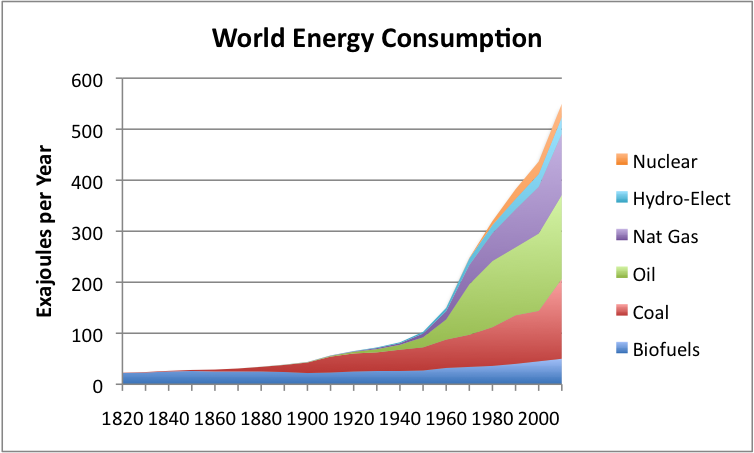
It is caused by humans: see the energy used in the last 200 years:

https://gailtheactuary.files.wordpress.com/2012/03/world-ene...

And see what it means that the "climate changed before":

https://xkcd.com/1732/

The principle the warming works is the same why you wear a coat in the winter: the coat keeps the surface temperature of your body warmer, even if the coat itself doesn't produce a new heat. A thick coat keeps you warmer than a thin one. More CO2 does the same to the Earth surface. Without the greenhouse gases the average Earth temperature would be 0°F (or -18°C) and it is 59°F (15°C). And "a few degrees more" is really a lot and awfully fast, see the xkcd drawing again.

The xkcd thing is compelling except not sure the data source and I've seen conflicting data. Rest of post not compelling.
> I've seen conflicting data

That's called the "wishful thinking" fallacy, to which you cling to confirm your previous "investment." If we'd look at your sources of the apparent "conflicting" data, we'd be able to see that they are intentionally biased, fabricated, cherry picked or whatever. But I would be surprised that you accept that fact, on average it doesn't function that way psychologically. Which is how humans work, but not a scientific argument.

Anyway, the natural processes, unless cataclysmic, don't make such rapid changes that we experience now. The speed of the change is orders of magnitude faster now than the non-cataclysmic natural ones. It is really going to be worse than most can even imagine. Our children or grandchildren are going to hate us for not doing enough. The politicians and lobbyists who only see their own benefit will be dead and won't care.

To compare with the "good old times": the study of human DNA shows that 70000 years ago, only 2000 humans survived one extinction event:

http://news.bbc.co.uk/2/hi/science/nature/2975862.stm

And then there was no civilization infrastructure to fail, just the hunter-gatherers, ready to move.

Whether or not it's caused by humans isn't relevant. If it's a problem, regardless of the cause, we ought to be thinking about what we can do to avoid it or to adapt.

So I don't understand why so much of the left chooses to frame the issue in such a way that makes it contingent on that cause.

Understanding the cause is key to learning how to avoid it.
Is it really? Would it not be easier to find consensus (hence more productive) if we were to focus on whether the climate is changing (and not why)? Determine what the impact of the climate change will be and how we should address this problem?
I have to admit I'm baffled by this line of thinking. Since coal-fired power plants are a primary driver of climate change, it makes sense to stop using them in order to help avoid further contribution to climate change. If they didn't contribute to climate change, then that incentive to stop using them would not be there. Understanding the causes of climate change directly impacts what policies we implement to mitigate it.
The impacts i clude the possibility of humans being literally unable to survive on some parts of the globe if wet bulb temperatures become high enough. And a constantly shifting coastline requiring recomstruction of the coastline every decade.

That's if we keep burning all the carbon. Yes, causes are important.

> consensus

So you're saying that we need consensus to do things now? My sides are splitting.

Can you name a thing that you think we have "consensus" about?

edit: and wait... "easier to find consensus"! I admit you lost me there. We just don't live in the same world. Do we have consensus for the policies we have now? So what is the justification for favoring them?

The warming part is much clearer than the anthropomorphic part.
Even if it's maybe not clear to you or to those you like to believe, it's still clear to the relevant scientists of the whole world.

"Total radiative forcing is positive, and has led to an uptake of energy by the climate system. The largest contribution to total radiative forcing is caused by the increase in the atmospheric concentration of CO2 since 1750 (see Figure SPM.5). {3.2, Box 3.1, 8.3, 8.5"

"Human influence on the climate system is clear. This is evident from the increasing greenhouse gas concentrations in the atmosphere, positive radiative forcing, observed warming, and understanding of the climate system. {2–14}"

http://www.ipcc.ch/pdf/assessment-report/ar5/wg1/WG1AR5_SPM_...

The politicians, lobbyists and the media aren't the same as the scientists.