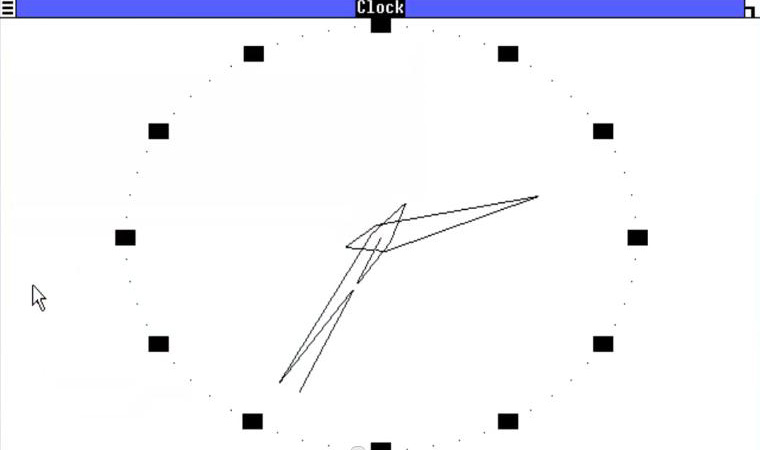
On the other hand, iPhone's "Clock" app has an icon that shows the correct time with a super smooth seconds indicator. Which doesn't drain the battery.
It probably does drain the battery if you leave it on the screen for a while. They can get away with it because people usually aren't looking at their app icons for extended periods of time.
The Windows 95 optimization related to the blinking clock making it difficult to page code out... which was very important on systems at the minimum 4MB RAM required by Windows 95.
I suspect that iPhone's "Clock" app would have difficulties both with smoothness and battery life if constrained to 4MB of RAM and paging...
Pretty sure any sane software implementation of a simple seconds pointer would easily update faster than 1 Hz while using little to negligible CPU time in a Desktop processor from the 90's and onwards.
Keep in mind though, that the performance optimization the Windows article talks about is how to reduce the working set in memory more than the CPU consumption.