Hacker News new | ask | show | jobs
by mbroshi 3382 days ago
A big plus of automating tickets is that it's no longer biased. You're not more likely to get a ticket in a poorer, more high crime neighborhood, just because there happen to be more police there. This way, rich white people in the Loop are just as likely to get tickets as poor black people in Woodlawn. To me this democratization seems like a big plus.
6 comments

Except the companies are for profit. The red light cameras increase rear ending accidents:

https://arstechnica.com/tech-policy/2014/12/major-chicago-st...

..because most people don't want to intentionally run red lights.

Furthermore, most cities run these as civil violations, but if you take them to court, the courts run them under criminal procedures. IANAL, but there was an excellent post someone shared on HN a few weeks back where a law professor fought one of these tickets (I can't seem to find it right now). He wasn't driving, but felt the burden of proof shouldn't reside with him, but the state.

He lost his case, had to appeal, won that case and was never given any of the bond he issued to appeal.

These tickets don't add points to your license in most states, their safety improvements are questionable, and they're pretty much a money making racket for cites and the companies that make/run the cameras.

> A big plus of automating tickets is that it's no longer biased.

Yes, it is.

> You're not more likely to get a ticket in a poorer, more high crime neighborhood, just because there happen to be more police there.

IME, you (the same person) are more likely to get a traffic ticket in a rich, low-crime neighborhood, because the police that are there are more likely to be concerned with writing traffic tickets.

People who live in poorer, high-crime areas are more likely to get tickets (in either poor or rich neighborhoods), but that's a different problem. (And, unlike the one you identify, one that automation might actually help.)

But, in any case, there's as much opportunity for bias (and by the same people) in placing devices that automatically issue tickets as their is in placing officers, plus automated devices don't mean that human officers can no longer issue tickets, so no matter which direction it operates in, the source of bias you identify (that is, inequity based on choices of deployment of officers) is not addressed by automation.

I don't feel like this is true - the rich people can hire the lawyers to get them right back out of the ticket. Secondly, the cost of the ticket creates different amounts of deterrence, as when you're rich enough with no social shame (cop car with lights), you're probably going to run red lights.

See: cars parked brazenly illegally are rarely beaters.

These types of "democratizations" usually leave the poor even worse off, where they have no extra-legal wiggle room (chat with the cop) and no intra-legal resources.

See: Modern credit cards, mobile phone billing, etc.

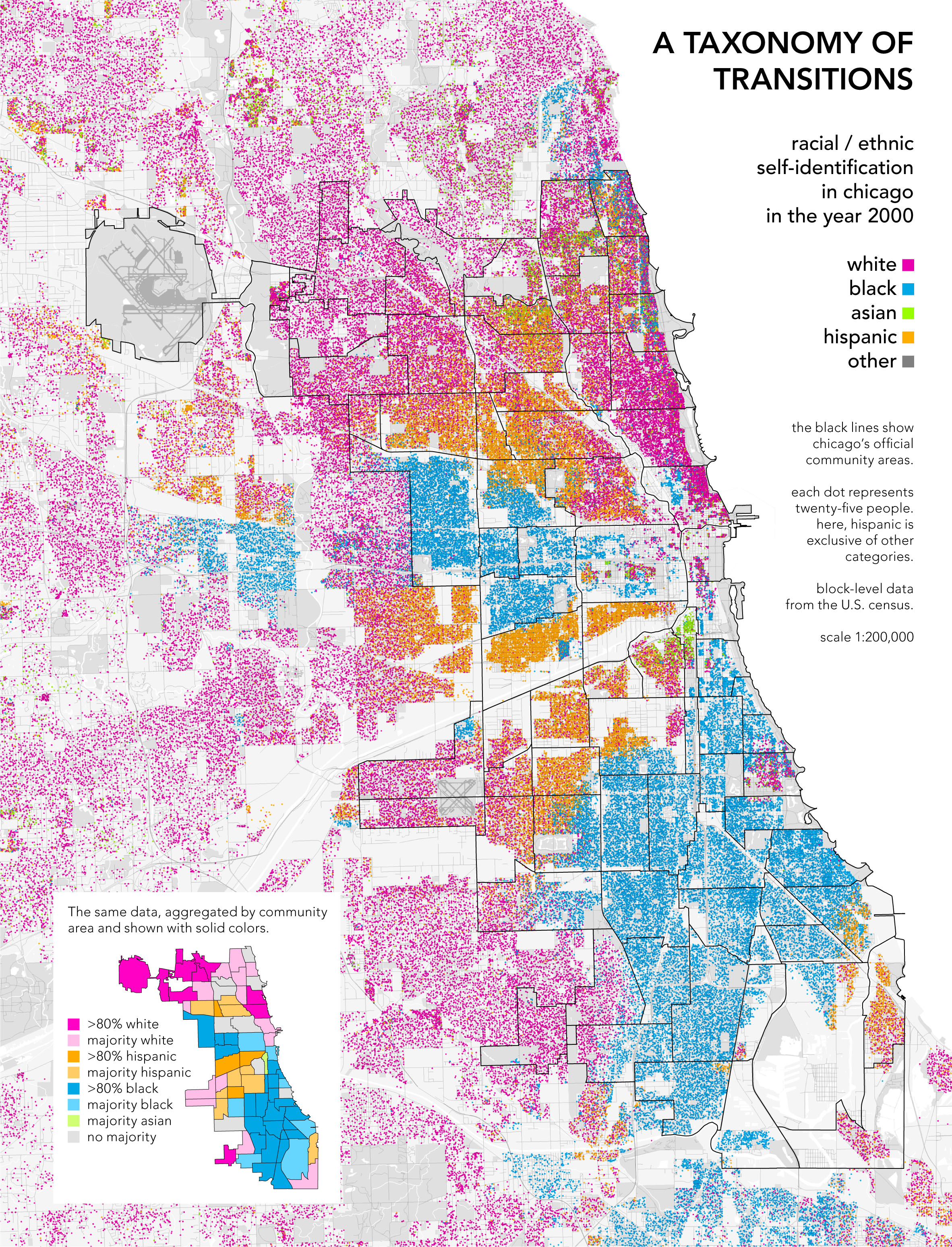
The red light cameras are not distributed equally. You'll find more of them in minority neighborhoods.

Look at what redlining hath wrought:

http://www.radicalcartography.net/chicagodots_race_big.jpg

http://www.photoenforced.com/chicago.html#.WNKlsxLyufc

I know it's an anecdote but in Denver they are only in the very wealthy neighborhoods. Usually here those parts have the city have much lower speed limits than a comparable street in a poorer neighborhood would have so they can generate more revenue from them.
No, they are not at all in the wealthy neighborhoods, they are out in Aurora in the poorer areas and around Buckley AFB to nab the servicemen. I drove past many of them going to work/home and they erroneously flash when a bird flies past or the wind gusts too hard. There seems to have been no correlation at all with the many people I would see running red lights, just random.
I was talking Denver not Aurora or the outlying suburbs. I guess I could of been more clear. Around here they camp outside of Cherry Creek Golf Course and in uptown around 17th. I was also speaking of the speed limit cameras.

The red light cameras here are mainly on large intersections, 6th and Speer etc. Not really poor nor rich more based upon volume of traffic.

Bingo.
Unless a red light camera is put on every single intersection with a light, there's still a bias in play, a bias based on who uses the intersections where the cameras are placed.

The busiest roads (and thus those most likely to get cameras) are fed by those who are commuting into town to a day job; not by those who live in-town. This immediately creates a bias based on income; the larger the city and the higher the costs of living in the city, the bigger the bias.

Mmm, where they're placed (and more to the point, where they're not placed) is still a political decision.
It's much harder to hide racial bias in fixed camera installations, which can be nicely illustrated on a map, than in the day-to-day decisions of individual police units.

These decisions are also made by different groups of people, and a city's elected leadership tends to better reflect the population's diversity than the police department.