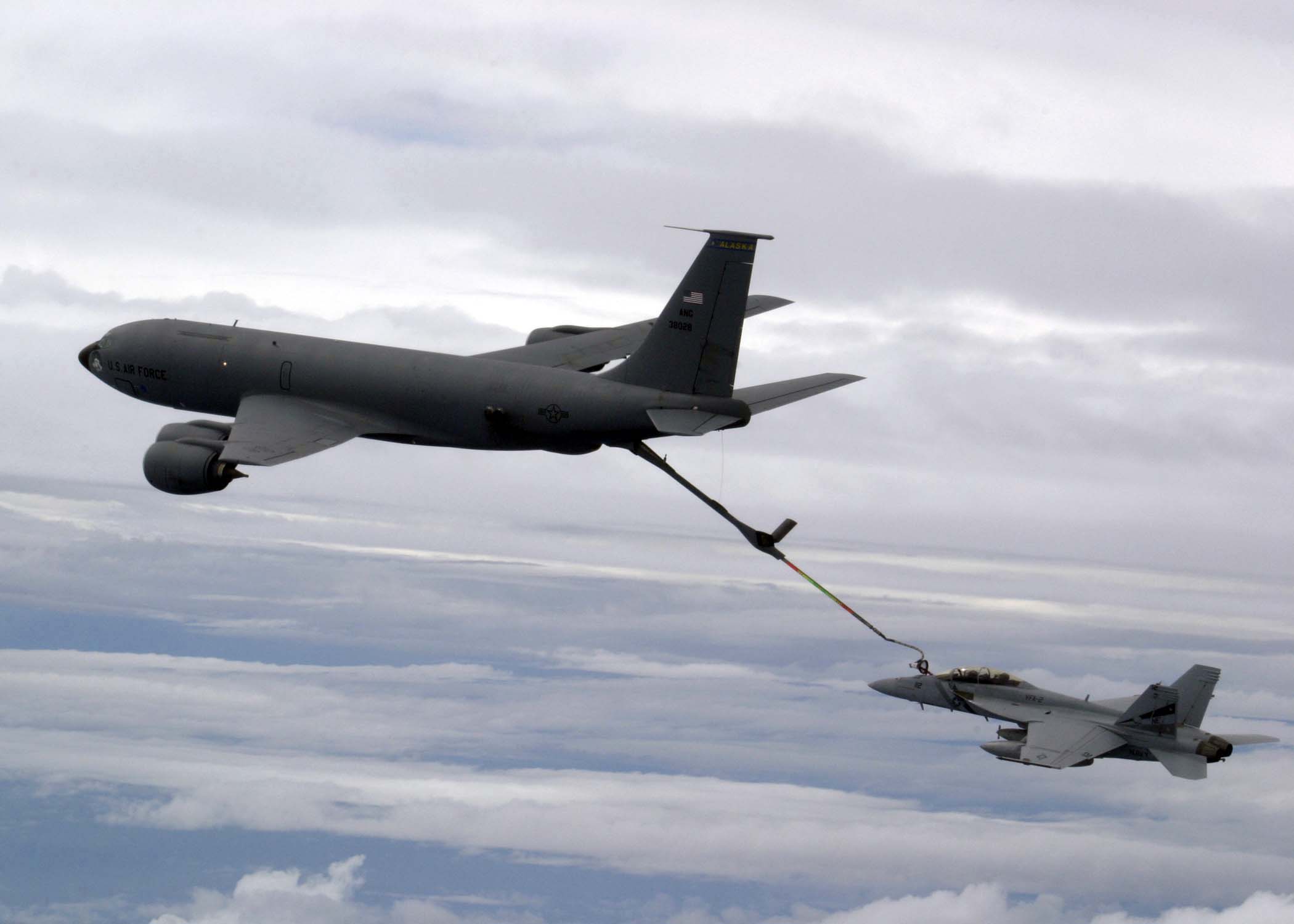
Do you happen to know how arial refueling works then ? E.g. in this image [1] the jet is flying where I would expect a lot of deflected air to be moving to ? Or is it just deflected much more steeply ?
The other two replies covered your questions well, so I'll just add that wakes don't descend particularly fast. According to the FAA's Pilot's Handbook of Aeronautical Knowledge[1] (page 14-28), "Tests have also shown that the vortices sink at a rate of several hundred feet per minute, slowing their descent and diminishing in strength with time and distance behind the generating aircraft."
Considering the Challenger's encounter with the A380's wake, it took 1-2 minutes for the Challenger to hit the wake, so the wake probably had 1-3 minutes to make the 1000-foot descent. That very roughly fits the expected "several hundred feet per minute" descent rate.
Considering the case of refueling, the wake's motion downward is much slower than the aircrafts' horizontal motion, so it wouldn't have descended much by the time it's left behind entirely.
being close is relatively safe from wortexes - there still is some other turbulence to consider, but the standard turbulent flow caused by drag is chaotic so it'll shake you but will 'even out'
Considering the Challenger's encounter with the A380's wake, it took 1-2 minutes for the Challenger to hit the wake, so the wake probably had 1-3 minutes to make the 1000-foot descent. That very roughly fits the expected "several hundred feet per minute" descent rate.
Considering the case of refueling, the wake's motion downward is much slower than the aircrafts' horizontal motion, so it wouldn't have descended much by the time it's left behind entirely.
[1] Available for free at https://www.faa.gov/regulations_policies/handbooks_manuals/a...