Hacker News new | ask | show | jobs
by problems 3524 days ago
The best legitimate criticisms I've seen are here: https://m.youtube.com/watch?v=RNFesa01llk

Basically expansion and contraction as well as just plain vulnerability of running a vacuum make it extremely difficult to do practically. The phrase he uses, "all the problems of space travel except in a gun barrel" is a pretty accurate description of the issue. Any loss of vacuum will almost guarantee loss of life. No realistic demo has been done even on a small scale as of yet.

3 comments

Ahh yes, the infamous Thunderf00t "debunking" video. Never have so many Hyperloop myths been created by a single piece of content! I've debunked-the-debunking a half dozen times myself, and it shows no signs of slowing down.

The big problem with his air cannon theory is, pipes are not lossless! Friction and viscous interactions between the entering air and the tube wall will slow down that "shock front" to a highway speed wind in only a couple km. So unless it's so close that the pod can't stop in time (and actually derails at the breach), there should be no loss of life.

As far as thermal expansion, that can be solved with sliding interfaces every few hundred meters. The Hyperloop has switched to mag-lev designs for levitation, so the ultra smooth interior is no longer necessary. There will be some air leakage at the joint of course, but this can easily made up by the pumping stations installed at intervals along the track.

The pressure in the Hyperloop was specifically chosen so that simple mechanical vacuum pumps can be used -- no turbomolecular or cryopumps needed. The Hyperloop runs at 1/1000th of an atmosphere. True "vacuum trains" use vacuums at about 1/1,000,000th of an atmosphere, meaning the pumping is about 1000 times harder (not because the pressure difference is meaningfully different, but because you only get 1/1000th as much air per "stroke" or "cycle").

The Large Hadron Collider uses a harder vacuum still (about 1/1,000,000,000,000 of an atmosphere, and yes that's a trillionth of an atmosphere), which is why LordHumungous's experience mentioned earlier isn't terribly applicable. The LHC is doing something a lot harder than the Hyperloop.

You assume that Hyperloop's tube will run a vacuum, which is a misconception. The Hyperloop One design uses low pressure tubes which is completely different from being completely evacuated.
Vacuum doesn't exist for all practical purposes, every form of vacuum is just low pressure. So if you don't say anything about what level of vacuum or how low the pressure is your statement is meaningless.
Watch his second video, he provides extra explanations including that one.

https://www.youtube.com/watch?v=DDwe2M-LDZQ

Without a vacuum it's just a train with no need to be enclosed.
its effectively a vacuum
Why would loss of vacuum necessarily result in loss of life? I would expect loss of vacuum to result in sudden deceleration, but not with a deadly level of force.
Air being drawn in results in pressure on the capsule, propelling it. Check the video out for a demo.
There are three mitigating points for that issue:

First, you would get choked flow at the inlet, and if you do the math it actually takes a massive opening to really make a dangerous shockwave.

Eg, if a joint in the tube disconnects and the two halves pull apart, the inlet area is the tube circumference * gap between halves. The two halves would need to separate by the full diameter of the tube (~15 ft) to get full atmospheric pressure going in both sides. A realistic gap of a couple inches to a couple feet is far less scary.

Second, these incidents will be exceptionally rare. Gaps that big are equivalent to a freeway overpass collapsing. It's a total failure scenario, so you see a single digit number of them a year in the US.

Lastly, the speed of sound isn't all that quick on the scale of this thing. It's about 13 miles/min, a fifth of a mile a second.

If you place emergency fill valves (one time use things, dirt cheap, just explosive bolts in the simplest case) you can flood a whole section of the tube with atmosphere in a controlled manner over say 15 seconds, and your shockwave will be largely stopped after 3 miles.

An emergency fill like that would also stop all pods in the region as they hit very high drag, so you don't even need to carry heavy emergency brakes on every vehicle.

Seems like you could also solve this with blast gates. If the tube breaks open behind the train, slam a gate closed to stop additional air from entering. There'd likely be air in the tube already, but with no additional supply, the propellant force would diminish rapidly.
Okay, I was assuming a failure in front of the train. If the failure is behind the train, it's still an extremely solvable problem. Blast gates to stop the inflow of new air. Or inject air in front as nickparker suggested. I don't see that this is a legitimate blocker to this technology.
That demo is unrealistic. The entire end of the tube isn't going to open all at once. Instead, any realistic leak would be pretty small in comparison.
Forces of nature or other things never suddenly disrupt infrastructure.

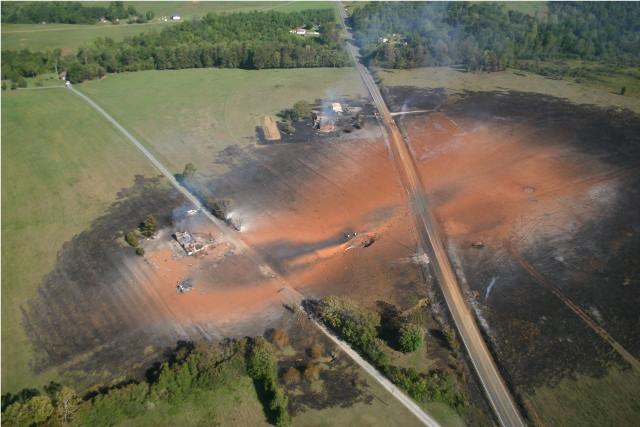
See: http://whns.images.worldnow.com/images/22787728_SA.jpg

It's an elevated track so it really could be designed to deal with that kind of break. Water, Oil, and Gas pipelines for example have long dealt with those issues without breaking when designed correctly.
How do oil pipes do this? Automatic cutoffs every mile?
Big water infrastructure breaks too.

My wife was PM on an emergency project to replace a 72" main feeding a city that failed.

I don't understand why a tube section couldn't come away? What if a bomb went off, a truck hit a support beam, or an earthquake caused a section to topple over...

I don't think it is unrealistic at all.

1) Because the pods are not designed to go that fast through the air.

2) Because in the case of an explosive recompression there might not be a tube anymore.

This is a hollow answer. "Not designed for" is an absurd claim for a thing still in prototyping. Same for the "explosive recompression" claim. You're making this claim about a system that doesn't exist.

I'm not bullish on hyperloop but I see no reason to believe that the engineers can't design a pod capable of not disintegrating in air, or capable of designing a track with a failure mode better than completely falling apart.