Hacker News new | ask | show | jobs
by garagemc2 3519 days ago
As a follow on, one could ask the question: what where the circumstances that led to China being unified and Europe not.

Something to do with culture? Something to do with population levels? Something to do with the crops being grown?

13 comments

One "explanation" you hear a lot is geography. China's central plain is... a plain. It's easy to conquer and hold a plain. Europe has got mountains in the middle, plus various odd bodies of water getting in the way. That makes it much more difficult (given ancient/medieval modes of transport and warfare) to unify politically. Hence the conditions of perpetual competition that the article mentions.

China has mountains around the edges, and had a hell of a time conquering the little kingdoms that were in them. In most cases, the best they managed was tribute, and never really established real administrative control.

The mountains are hit quickly. Take a train from Beijing to Guangzhou, and you are in mountains from Hubei on down (and even Hebei is mountainous in the north). In fact, this is China's major problem: it has too many mountains and not enough arable land (of course, they can and do terrace the mountains to grow things on).

Geography alone doesn't really explain China's early unification, since they had more barriers than Europe to deal with. My hunch is that it is more of a fluke in history that could have happened in Europe also (and did with the Romans).

Sure, I don't think it's a silver-bullet explanation, just one that you hear frequently. I still think it holds water, to a certain extent -- the central plains have continually been the cradle and heart of Chinese civilization. And one of China's most culturally fruitful periods, Warring States, occurred when even the central plain was fragmented, which would seem to uphold the theory of the article.

I think spread out over enough time, these pervasive environmental factors do have a real influence. You could see the unity of the Roman Empire as being Europe's fluke, and the disunity of the Warring States as being China's.

But again, it's really all speculative.

If you look on the wikipedia page, a "true" unification of China as people identified as Chinese didn't occur until about the revolution in China, where it was necessary for a strong centralized government to control all of China. Beforehand it was more considered like warring states, each culture very distinct. Some of it still remains today.
If that's the case, then China still isn't unified. The emperor was a strong central government, but, which is true even today, often "tian gao, haungdi yuan."

Warring state periods did occur during history, but stable and strong political unions were the norm in most of the dynasties.

But the Romans did manage to unify much of Europe for hundreds of years. Why wasn't that feat ever replicated again?
The Roman Empire was only stable on the parts bordering the Mediterranean, where you could quickly and (fairly safely) sail. Gaul, the Balkans, Brittania, etc were constantly rebelling or getting invaded.

Lots of modern europe was never touched by the Roman Empire because it was too far from the water.

I am not a historian, but the Romans seem to have grown at the expense of weaker and more disorganized foes, who either didn't have any form of centralized leadership prior to contact with the Romans (like the Gauls and Iberians) or who were pitched against eachother in civil war (like the Egyptians). When fighting against similarly sized centralized states, like Parthia (or Carthage, in the early republic), they had a much harder time winning anything out of them. I think they mainly exploited a preexisting assymetry.
That's an interesting question I've thought a lot about in the past (the rise of the great empires in general, to be honest).

My best guess is that they were able to do this thanks to the advancement required to face off the threads before their eventual rise. There wasn't anybody who could really compete with what they had after those wars were won. The Pax Romana held relative peace in Europe because of that strength.

I'd love someone with more knowledge on the subject to come and answer this - really fascinating subject.

A lot of Roman strength was organizational. In conquering, they spread that knowledge. It would probably have been hard to do it again with the same technique.
Xinjiang interestingly wasn't conquered until the 17th century, I think?
China's borders fluctuated a lot over the last 2000 years. Parts of Northern Xinjiang were part of the Han (2nd) dynasty.
Which seems to be the justification for claiming large parts of territory for the PRC.
The Tibetan Empire used to control large parts of Xinjiang and western China, but you don't see the Dalai Lama making any claims :).

There are very valid reasons for China wanting that territory in their country (security, resources, etc...) and its not like the west + Russia were playing a "Great Game" there just a century ago. China gets the territory because they took it and were able to hold it, plain and simple, it doesn't need a flaky moralistic reason.

> The Tibetan Empire used to control large parts of Xinjiang and western China, but you don't see the Dalai Lama making any claims :)

Many Tibetan exiles are rather fond of "minority in our own homeland" claims which are true only if you define the homeland as covering areas not ruled over by Tibetans for centuries though :)

"There are very valid reasons for China wanting that territory in their country" Or so the Chinese say. One person's security buffer is another person's colonization.
The Roman Empire was a unification of sorts. 27 BC to 476 AD in the west and 1453 AD in the east.
That overlooks the fact that the actual Western Empire was pretty small towards the end, and that Byzantine power really declined significantly after both the Arab conquests and esp after the later highpoint of Basil II.The territory they "unified" was more than often small rather than large.
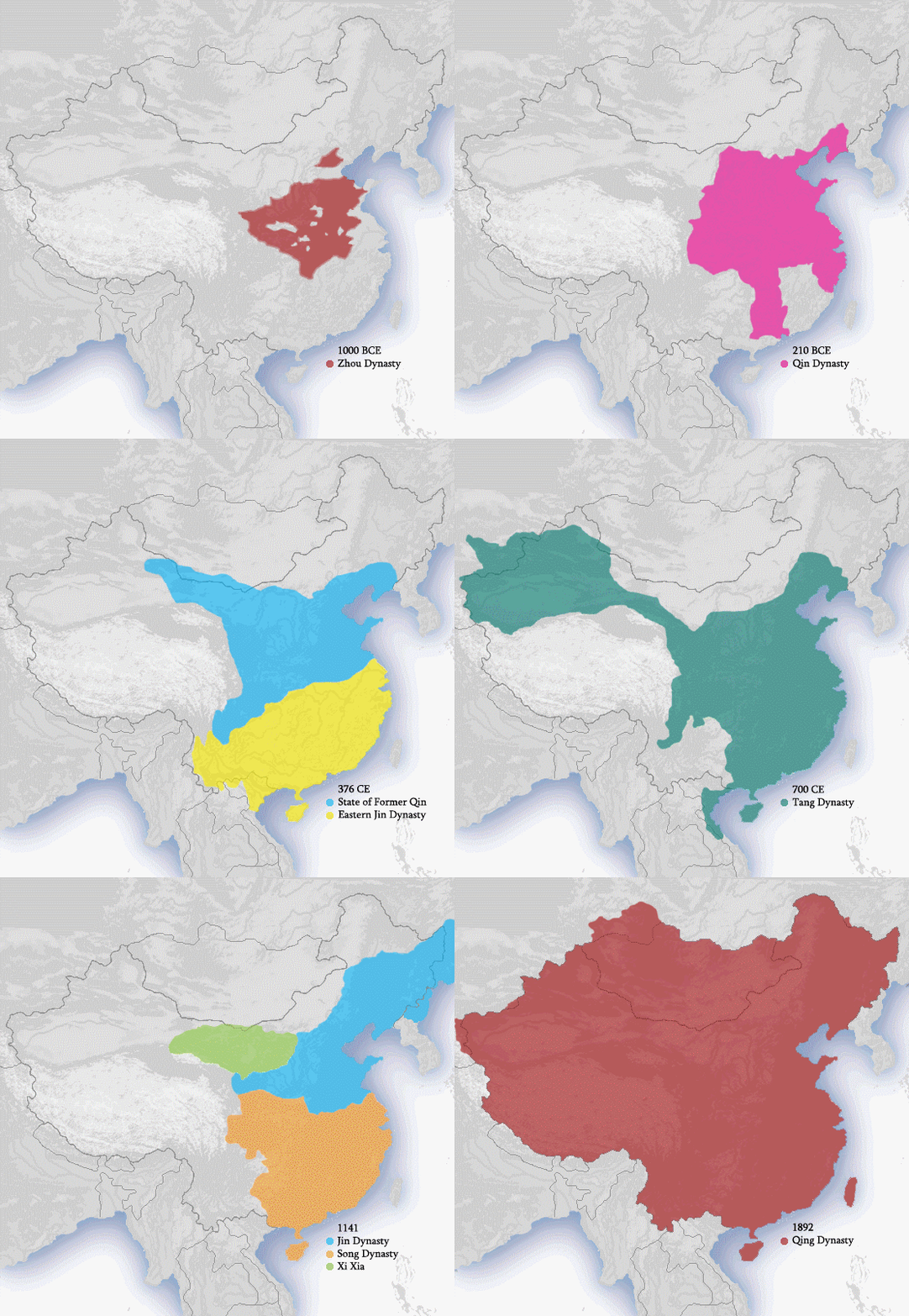
China's unification is a relatively "recent" phenomenon. Even the area we might notionally think of as "China" historically (maybe the Qin?) was quite small. There have been literally dozens of states within the boundaries of what we today call "China", and which follow some kind of historic thread of connection.

You'll notice on maps like this one [1] that only some of the parts of "China" are colored in throughout history. Well, what about the uncolored parts? People lived there too, and organized themselves into groups with governments and so on. We don't bother with them though because some modern government just washes all of them away into the dustbin of history.

In a similar fashion, most people don't consider the Eastern Roman empire "Rome" after the fall of the Western Empire. But it was no more or less "Rome" than say, the Eastern Jin was.

Even today, China isn't unified, Taiwan operates as an independent entity.

1 - https://upload.wikimedia.org/wikipedia/commons/5/54/Territor...

I have read that one important factor that kept Europe fragmented was England. Thanks to the English channel, it is very difficult to invade. However, it could be if some country took over the whole of Europe.

The English realized this, so whenever some country like Spain or France threatened to conquer the rest of Europe, England would put its military strength on the other side to prevent this from happening.

"Among Celtic and Germanic peoples, the predominant custom during ancient times seems to have been to divide the land in equal parts for each of the sons." (1)

Which also applied to countries and why Western Europe kept going from a unified empire to a bunch of countries. The last time this happen was in 843 "When Louis the Pious died in 840, his eldest son, Lothair I, claimed overlordship over the whole of his father's kingdom .../... Lothair's brother Louis the German and his half-brother Charles the Bald refused to acknowledge Lothair's suzerainty and went to war against him. .../... after which Lothair became willing to negotiate a settlement." (2).

1: https://en.wikipedia.org/wiki/Historical_inheritance_systems...

2: https://en.wikipedia.org/wiki/Treaty_of_Verdun

IIRC from Jared Diamond, China is a huge flat field with a couple of rivers to help navigate.

Europe, especially preindustrial, was forests and Alps and Pyrenees. A lot of trees in Germany. Italy is hilly.

Also, China is unified by language. At least the written kind that lets you run a bureaucracy. The med had a bunch, Latin, Greek and Arabic, and was multiple "countries" for a good long time.

About the crops being grown, there's ideas about the difference between rice and the middle eastern crops. Something to do with the fact that rice requires constant attention whereas med crops are intensive only during harvest. Not too familiar with that line of thought.

I you look at world geography you can see that large tracts of plains seem to support large empires. E.g. consider the Russian Empire, the Mongolia and various Arab empires. They also support strong central governments.

In contrast Europe has a lot of rivers, mountains and forrest dividing the lands naturally.

E.g. you can see this replay itself at every level, e.g. within Scandinavia, flat Denmark had a stronger central government than Sweden early on. While e.g. my home country Norway full of fjords, rivers and forests always had very weak central power. Nobody could easily hold such a country.

I think the good part of that though is that such a situation foster democracy. These large plain countries always seem to end up strong but autocratic. I don't think there is any accident that Russia lagged behind the rest of Europe in freedom and development of democracy.

Switzerland is another example of a mountain country with strong democracy traditions and also historically very hard to keep control over by central powers.

Now China does of course have lots of maintains as well, but it matters how they are distributed. They still got quite large plains. I think there was a simulation ran, which simulated the creation of empires just based on geography and China was far more likely to produce empire's with its geography than Europe.

Geographic reasons aside, there is the cultural factor of the Mandate of Heaven, which spread throughout China in its early days. The Mandate held that Heaven wants things to be a certain way, culturally, aesthetically, etc., and this is how everyone should be. This created a sort of religious unity over a large geographical area where maintaining certain cultural practices was considered to be a necessity. As a result, when kingdoms fragmented or were conquered by other peoples, their cultures didn't change much and they continued to be similar to one another, making future reunification much easier.
The West had divine right and the Catholic Church. The pope literally crowned kings in the Holy Roman Empire for hundreds of years.
However, the principle of splitting the inheritance (including huge tracts of land) among sons is a big cultural difference that makes countries more fragmented.
I don't know much about Chinese history but it seems to me that some sort of China as a unified entity existed for 1000s of years. In Europe on the other hand, borders were much more combated due to expansions of this or that empire (Rome, Turkey, France, Germany etc.) E.g. modern Germany wasn't unified as a nation until after the Napoleon wars in the 19th century. In that sense, the EU is a rather courageous project of countries that were enemies not so long ago.
The idea that China has always more or less been a unified entity over the ages is at least imprecise, if not completely wrong and propagated due to various reasons by the present day Communist party, but also any people that have a vested interest in China appearing unified and its people considered as one, united.

If you check out the Wikipedia article about Chinese history as a starting point, you will see that there have been many periods in which 'China' does not exist. Instead, there were several kingdoms, many different states, or there was only a single state but one could definitely put forth an argument that 'China' is not a direct descendant of that ancient entity.

Granted, the extent of fractionalisation regarding both time and geography might be less than in Europe, but it is far from some imagined 'continuued' existence of a Han Chinese state.

If you include places like Tibet, Guangdong, Taiwan, Manchuria and Xinjiang in this debate, this rings even truer.

One explanation could be the big rivers and reliance on dams, dikes and irrigation.
I think it really just takes one emperor winning and no rebellions that won.
bloodyshovel.wordpress.com is pretty excellent on this and related issues.
To describe China as "unified" ignores their dozens of civil wars and conquests by external groups. They kind of have an at best metastable "tough shell / gooey center" dynamic, and I would not be surprised if their proportional deaths by strife were greater than the European number over most timeframes.
Europe was settled and civilised relatively lately (at least by h. sapiens), and saw constant assault from various quarters. The critical region was the Mediterranian, which saw the Levant, Mesopotamia, Egypt, Cretian and Minoan civilisations, the maritime culture of the Phoenecians (and perhaps an earlier one, I'm a tad rusty), Greece, Macedonia, Persia, the Romans, Gauls, Huns, Carthage, Moors, Norsemen / Normans, Anglos and Saxons, etc., etc. There was no cultural or linguistic unity among most of those.

European territory made external travel (around the coastline) quite easy (good for invaders, hard for defenders to move to where the attackers are).

China's geography had a much smaller coastline (relative to landmass), and a far superior interior river network, augmented early (~1,000 BCE IIRC) with manmade canals, making internal movement of forces far easier. China also wasn't surrounded by capable enemies -- India was the nearest significant civilisation. The Mongols managed to invade, yes, but they were a fluke and also managed to occupy nearly all the Eurasian landmass, from the Pacific to central Europe and India. (The Mughal Empire was the result of Mongol invaders of India.)

China did see internal strife, but those splits resolved with a resumption of the previous Chinese bureaucracy rather than a replacement of it, as seemed more typical of Europe.