"A woman's desirability peaks at 21, which, ironically enough is the age that men just begin their "prime," i.e. become more desirable than average. Following that dotted line out, you can see that a woman of 31 is already "past her prime," while a man doesn't become so until 36. As we mentioned above, after age 26, a man has more potential matches than his female counterparts, which is a drastic reversal of the proportion in young adulthood, when women are much more sought-after. Because men's dating preferences skew so young, and women's are age-equitable, men peak later, and have a longer plateau of desirability, than women."
EDIT: Don't shoot the messenger, I didn't make the personal choices underlying the dataset.
EDIT 2: I'm very curious how this data correlates with data about vast swaths of underemployed or completely unemployed men who simply aren't interested or able to compete in the economic system to signal status to attract a partner:
along with the data that women are more particular about dating men below their own education level, causing there to be an imbalance between women and men in the dating pool:
http://www.vice.com/read/youre-single-because-there-arent-en... (TL;DR There are enough men, just not enough that meet the standards of single women in the dating pool; law of unintended consequences of societal employment changes, men's attitudes shifting from past generations about what happiness and responsibility looks like, and much larger cohorts of college-educated women in the dating pool)
"So, where are all the men?
I mean they exist, they're just not going to college. This isn't China or India where they have a man-made gender imbalance because of all sorts of horrendous things. [Men are] out there, they're just not going to college. Last year about 35 percent more women than men graduated from college."
"But there have been multiple studies on this and it turns out Americans have become less likely, over the past 50 years, to marry and date across educational lines. So educational intermarriage—I don't know if that's a real term, maybe I just made it up—is at its lowest rate in 50 years."
Interesting, reminds me of some old provocative article by Timothy Reichert "Bitter Pill" someone told me about sometime back. In that instance it was something along the lines of women being in a prisoners dilemma with regards to contraception and some economic market analysis stuff about women's SMV although I forget if he used that term or some other form of market value applicable to the ladies.
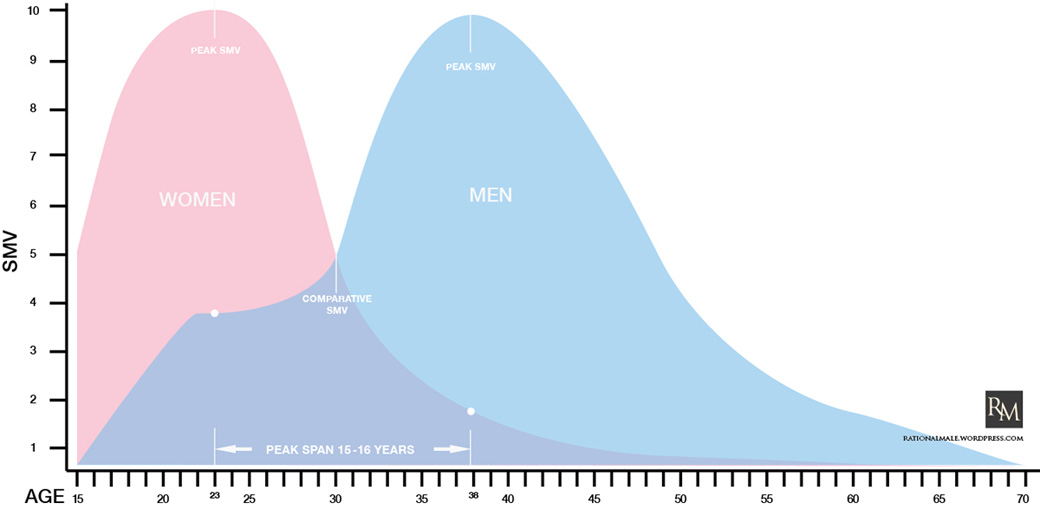
Seems to jibe with Okcupid's data: https://blog.okcupid.com/index.php/the-case-for-an-older-wom...
"A woman's desirability peaks at 21, which, ironically enough is the age that men just begin their "prime," i.e. become more desirable than average. Following that dotted line out, you can see that a woman of 31 is already "past her prime," while a man doesn't become so until 36. As we mentioned above, after age 26, a man has more potential matches than his female counterparts, which is a drastic reversal of the proportion in young adulthood, when women are much more sought-after. Because men's dating preferences skew so young, and women's are age-equitable, men peak later, and have a longer plateau of desirability, than women."
EDIT: Don't shoot the messenger, I didn't make the personal choices underlying the dataset.
EDIT 2: I'm very curious how this data correlates with data about vast swaths of underemployed or completely unemployed men who simply aren't interested or able to compete in the economic system to signal status to attract a partner:
https://www.washingtonpost.com/opinions/americas-quiet-catas...
along with the data that women are more particular about dating men below their own education level, causing there to be an imbalance between women and men in the dating pool:
http://www.vice.com/read/youre-single-because-there-arent-en... (TL;DR There are enough men, just not enough that meet the standards of single women in the dating pool; law of unintended consequences of societal employment changes, men's attitudes shifting from past generations about what happiness and responsibility looks like, and much larger cohorts of college-educated women in the dating pool)
"So, where are all the men?
I mean they exist, they're just not going to college. This isn't China or India where they have a man-made gender imbalance because of all sorts of horrendous things. [Men are] out there, they're just not going to college. Last year about 35 percent more women than men graduated from college."
"But there have been multiple studies on this and it turns out Americans have become less likely, over the past 50 years, to marry and date across educational lines. So educational intermarriage—I don't know if that's a real term, maybe I just made it up—is at its lowest rate in 50 years."