Hacker News new | ask | show | jobs
by sanderjd 3642 days ago
> They want sites that work quickly, are easy to understand, and work on mobile just as well as on a desktop.

Not quite: users want to achieve specific tasks as quickly and easily as possible. Certainly "work quickly" and "work on mobile" are two huge pillars of that for many (probably the majority of) tasks, but for many applications you have to make significant trade-offs in functionality under the constraints of a static site.

Anything built on the web is competing with something that already is or can be built natively. Native applications don't have to concern themselves with this sort of limitation on interactivity as a trade-off for latency, which is an advantage. On the other hand, the web has the (huge) advantages of open discoverability and no-install distribution. It makes sense for both platforms to be working to fill in their gaps while trying to minimize the trade-offs.

It's clear that slow startup due to big chunks of js (and media) on load has become a big problem, and people are working on that, perhaps without much to show for it yet, but it isn't obvious to me that ceding the territory of interactive applications back to native implementations would be the better way forward.

1 comments

And it's not clear to me that fixing a broken system is worth the time, when we have a working system standing by idly. I don't know of anyone who is asking for more interactiveness for most of the web, but I do know that non-js works, and works well. It may not be as "interactive", but I view that as a good thing.

Of course, this is all in context of a typical webpage. There are exceptions to this.

> I don't know of anyone who is asking for more interactiveness for most of the web

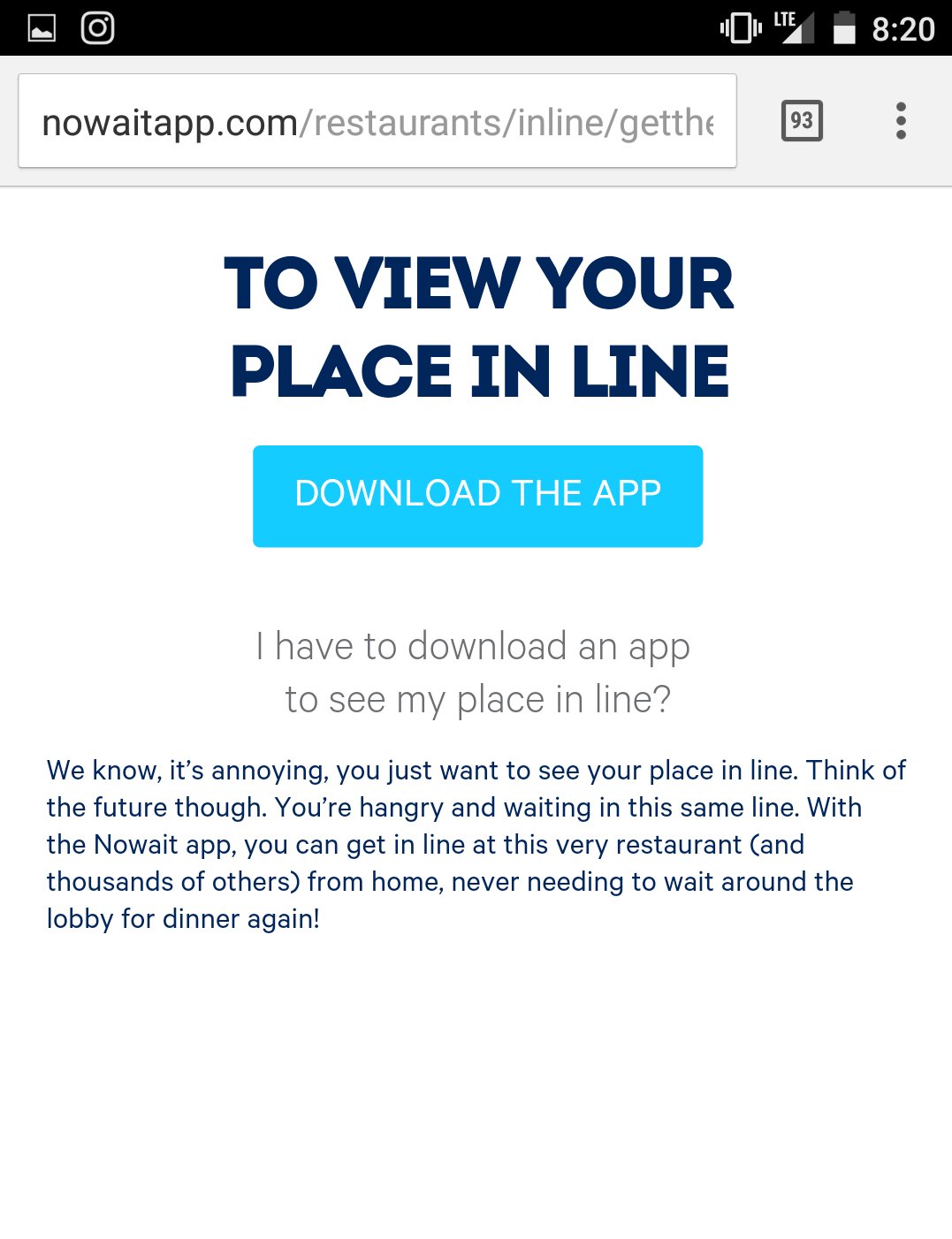
Hi, that's me. The reason is, quite simply, because this is not a good user experience:

https://pbs.twimg.com/media/CmaP3JvUcAA8-5a.jpg:large

The open web is my platform of choice, and the technology is finally there. Progressive Web Apps[1] offer the features of native but are instantly-available, without downloading or installing. So yes, I very much want that as a developer.

https://developers.google.com/web/progressive-web-apps/

I don't see how that image proves your point. Shitty designs are shitty if they are in a web-app, or mobile-app.

OK, fine. I'll concede devs want more interactiveness. I have yet to see evidence that users want more interactiveness. I think that points to the arrogance of devs "who totally know better than the user".

Users want positive experiences, and devs want to build those positive experiences. Look at some of the most popular websites out there: Youtube, Spotify, Amazon, Reddit - they're built on interaction. You're not just reading a post on reddit, you're upvoting it and influencing the front page.

This had traditionally happened through POST/GET requests and having all the logic server-side. Yes it's possible to build interaction without Javascript, but it's not a great effect. Imagine if you had to wait for a page load every time you voted on a post on reddit.

Now extend that to modern webapps. Take Google's Voice Memos demo[1]. It loads instantly. It supports any device. You can even add it to your homescreen and you won't be able to tell it from a native app. Everything about it just works. Why would a user not want such an experience?

Javascript interaction is the natural evolution of the web. If it wasn't JS it would have been something else. This growth has been driven by users, devs, and browser vendors alike. There's nothing "arrogant" about it.

[1] https://voice-memos.appspot.com/

That's funny, I just replied to you arguing the opposite. People in tech are the only ones I ever hear complaining about rich web apps. YMMV I suppose!
> I don't know of anyone who is asking for more interactiveness for most of the web

I don't know of anyone, besides programmers, who doesn't like the current interactive-web-app web more than the decade-ago full-page-load web. They don't like ads and popups and things being slow either, but they love Gmail and AirBnB and Facebook and on and on. We should solve the problems without throwing away all the good stuff.