|
|
|
|
|
|
by k0ngo
3641 days ago
|
|
|
> On a different note, why is that (as far as non-expert me knows) that nice mics often have eq settings? Is this not a blatant layer violation? The low-frequency/subsonic content that this switch will remove often consists of wind noise, pops from talking too close, vibrations from the floor/mic stand, etc.
Even if these low frequency noises may be more or less inaudible, they'll contribute to a large signal swing that will decrease the headroom in the following amplifiers. In other words, you won't be able to turn up the gain in the microphone amplifier/mixer as much as you'd want, because the low-frequency but high-amplitude content will make the amplifier clip and distort the sound.
Filtering the signal after the mic preamp won't solve the problem, because the preamp (which can provide in the order of 60 dB gain) will be the component that clips.
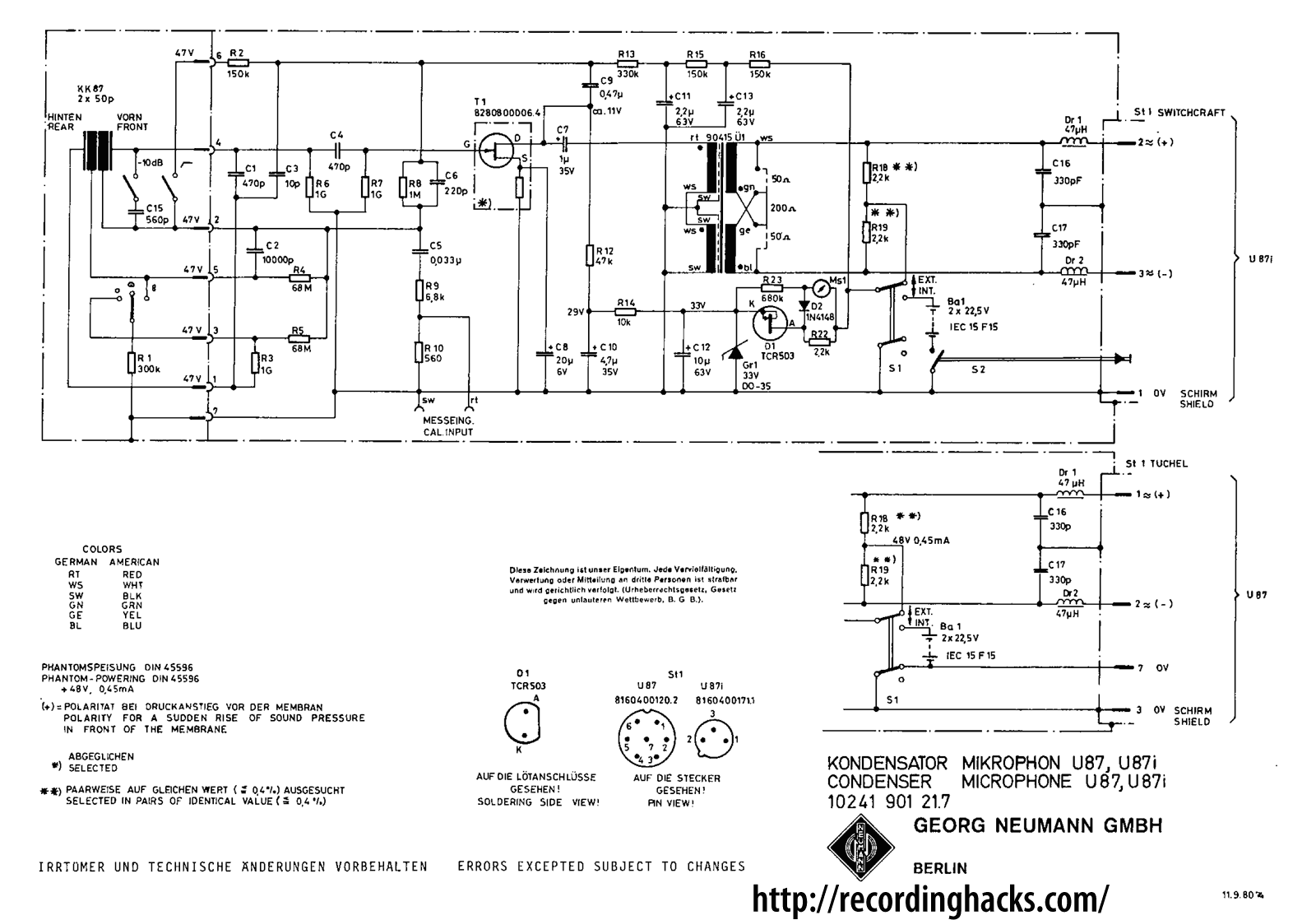
By including a low-cut filter in the head amplifier circuit inside the microphone (the amplifier serves only as a buffer, and usually with unity gain), the disturbing low-frequency noises can be removed before entering the high-gain microphone preamp. You can find the low-cut switch next to the capsule in the U87 schematic [0]. It seems to me that they increase the capsule bias voltage, thus changing the low frequency response by electrostatically tensioning the membrane. [0] http://recordinghacks.com/images/mic_extras/neumann/U87-sche... edit: tweaked some things. meta: i'm not very good at commit messages. |
|
|