I've got put options on SPY as well as a portfolio hedge. They lose value every day (theta or the premium you pay for time) and if the S&P goes up puts lose value so fast it would make your head spin.
In the end for a big liquid etf like SPY, they aren't that much different than going short. Now for small companies that could skyrocket overnight and destroy a short seller, puts offer some protection since your loss is capped at 100% instead of theoretically infinite losses.
edit: I should add that puts give you leverage. To short 100 shares of SPY you would need $20000 worth of margin, while to buy 1 sept 2016 in the money put (100 shares worth) you probably only need to cough up $800. If the delta value of the put is equal to 1, your gains or losses will move inline with that 100 share short position.
"I've got put options on SPY as well as a portfolio hedge. They lose value every day (theta or the premium you pay for time) and if the S&P goes up puts lose value so fast it would make your head spin"
I wonder if you would compare/contrast with short selling UPRO ?
That is, short selling the triple-long S&P 500 ETF.
The thinking here is that a long ETF (especially a triple long one) loses value every single day[1] due to the natural decay of long ETFs ...
So in a flat market, your short position is positive, and in down markets it is very positive. Further, it's not an option - you're simply short an ETF - so you can hold it through a market rally if you wanted to.
I have never employed this hedge, but it interests me.
I've never tried it. I'm skeptical that a broker would let you short a leveraged ETF since it's a bad deal for them. There are options out there for these but something tells me the decay is priced in or else it's getting into arbitrage territory. I have seen this question asked a few times before but never saw a definite answer.
If you were able to short TVIX or SPXU or any leveraged etf for a long period of time it seems like a near 100% chance of massive gains which makes me think there is a catch.
Shorting ETFs is expensive. You need to borrow the shares from someone in order to re-sell them, and you pay them for the privilege.
Futures work on margin with relatively low fees so if you wanted leveraged short exposure to the US market that's what you'd naturally trade.
One of the posters below who describes buying a put and selling a call at the same strike is describing a roundabout futures trade. The put/call method would have far higher transaction costs, though.
There are also leveraged inverse ETFs like SDS, which I have used at times. You don't want to hold them for more than a few weeks at a time because they decay, but for short-term trading they work fine.
"There are also leveraged inverse ETFs like SDS, which I have used at times. You don't want to hold them for more than a few weeks at a time because they decay, but for short-term trading they work fine."
Yes, that's the point - the idea is, instead of buying the short ETF, you short the long ETF.
They both decay, as you would expect an ETF to do, but by shorting the long, the decay works in your favor...
Shorting is (roughly given efficient market assumptions) equivalent to buying a put and selling a call at the same strike. If the stock has no chance of going up a lot, the call will be relatively cheap, and so selling the call won't change much.
Edit: on the other hand if it has low volatility in both directions, then both are cheap, and it's a bit more complicated. Buying the put will be cheaper, but shorting will also require less margin because the margin provider will have less risk. (See e.g. http://openmarkets.cmegroup.com/3785/understanding-margin-ch...).
This should cancel out in theory, but might not for various reasons like transaction costs.
Just look at the payoff graphs. This is how options are explained and tested in finance classes and they are usually more accessible than textual descriptions.
If you are long puts on spy, imho it's much better to fund them with short calls at the same strike, and hedge yourself with long otm calls at 1.2*strike.
ie. Forward + Call, as opposed to long put.
Gotta make another trade to neutralize that theta component like a calendar spread. For situations where you're making a bet on a really really big move, ratio spreads are the best.
qqq would probably be ok. I like the open interest and spreads on spy options. I'm not looking to make a killing on options (or I should say I would love to but don't think I could), just looking to hedge out some systemic risk on a buy and hold portfolio.
I've made some huge mistakes, but I'm up 20% overall YTD. Just randomly picking tech stocks with out of the money puts has been profitable enough to stay up 20% even if the majority of them wash out. Biggest hit was 8x.
I own a diversified basket of stocks that I believe reflect the best of the S&P. Then I have a much smaller position in spy puts. The basket has a positive beta and increases in value much faster than the puts lose value. The puts are sept 205 strike and would be deep in the money if August 2015 or January 2016 happen again. Isn't that positive carry?
I would love to find two assets that are inversely correlated but somehow both have a positive return at the same time, but I haven't found that yet :)
I don't understand. EG, say I'm long a portfolio of US equities that I expect to outperform the market. I want to hedge my risk in case the market drops, but I don't want to limit my upside. What positive carry hedge should I do?
he can, which presents downside risk on those options equal to their purchase price.
however, the article seemed to describe a portfolio position of _actual_ borrowed stock, meaning he is trying to execute a classical short position trade on it, and not just hedge it with options.
his downside risk in that case is basically unbounded, though realistically only as much as the stocks might rise in price which is not unlimited.
but his ratio of short positions to long positions is 1.5:1 which means he could easily get blown out if he holds on for too long through even a relatively short lived rally. its a pretty substantial gamble no matter how you look at it.
Or he can sell SPX calls. Or sell calls on another index or individual stocks. Or a combination of the two. Or he can sell futures. Or buy options on futures.
There are a zillion ways of shorting the market while not selling or directly shorting your existing long positions.
Careful with selling naked options though. You can have limited profit and unlimited risk in some cases. Selling naked puts on a stock you want to own or selling covered calls are pretty safe. Otherwise maybe spreads to hedge things out.
I didn't say they had to be naked. I almost always trade spreads. Naked options tend to be for casino individuals.
Also, selling naked puts against the VIX is a good long hedge. It's not going to 0 and when it gets really, really low there's already a little resistance in there as skepticism kicks in. You won't make a ton of money on the downside, but you can sell enough to buffer any long losses.
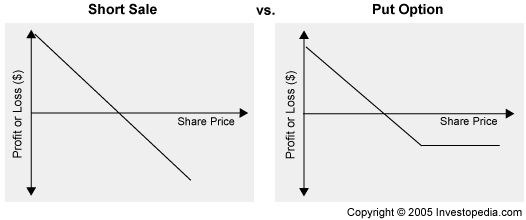
In the end for a big liquid etf like SPY, they aren't that much different than going short. Now for small companies that could skyrocket overnight and destroy a short seller, puts offer some protection since your loss is capped at 100% instead of theoretically infinite losses.
edit: I should add that puts give you leverage. To short 100 shares of SPY you would need $20000 worth of margin, while to buy 1 sept 2016 in the money put (100 shares worth) you probably only need to cough up $800. If the delta value of the put is equal to 1, your gains or losses will move inline with that 100 share short position.