If they are needed, they might as well be paid a decent wage.
If they are not, they might as well close down -- living close to subsistence levels with 2-3 part time BS jobs is not any long term solution.
It might be worse for those people short term, if they are fired from those jobs, but at least it would reflect the true issue in the economy/employment, instead of hiding it under the carpet (in that below $xx jobs are not a solution). And then there could be actual corrective measures and policies, instead of feeling complacent while people make pittance.
The most effective way I've seen work ethic develop in a young person is by real world trial and error. You work hard in an entry level unskilled job, you are rewarded for that work, you develop something akin to self respect, pride, or whatever you want to call it, and that becomes the foundation for the rest of your professional life. Or you make a mistake and screw up, get fired, learn a valuable lesson, and reboot. Higher minimum wage eliminates these entry level jobs and encourages automation. In a world where the vast majority of entry level tasks have been automated away, what happens? Some kids will continue to leap frog from high school to college to medical school/law school to the operating room/the courthouse and populate the white collar professional ranks. But what about all the others? Automation and basic income aren't silver bullets for a better life.
>The most effective way I've seen work ethic develop in a young person is by real world trial and error. You work hard in an entry level unskilled job, you are rewarded for that work, you develop something akin to self respect, pride, or whatever you want to call it, and that becomes the foundation for the rest of your professional life.
Unskilled jobs and below minimum wage jobs have little to do with either young persons or "work ethic development".
There are tons of 30 and 40 and 50 and even 70 year olds working in such jobs. And lots of young people with excellent work ethic to begin with, often juggling 2 of those to make ends meet.
This is far closer to what's going on out there that Horatio Alger:
Someone wrote: "wrong - those jobs are currently needed at a specific pay rate. They may not be needed if hourly wage is raised enough that automation is cheaper."
Well, that makes the argument more solid, not "wrong", as I covered that case already.
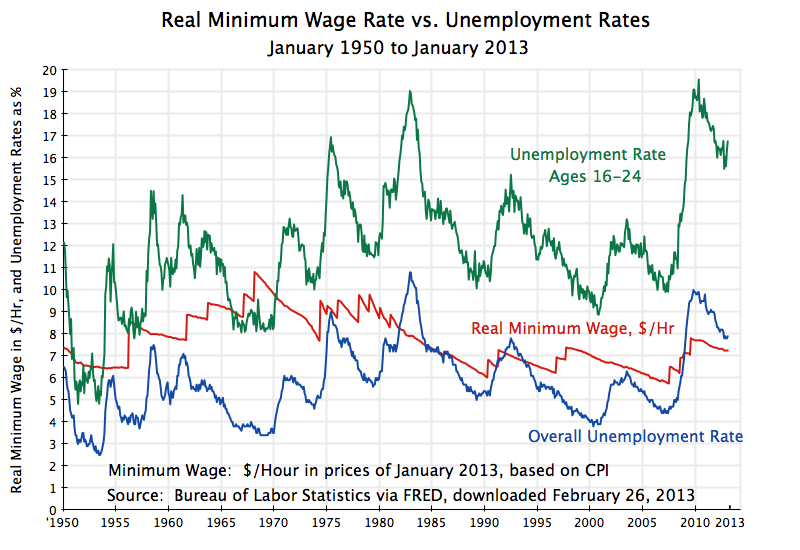
Also, I don't mean to imply that these events correlate. I was simply saying we have data that shows how these two things correlate. (There is no strong correlation between the two)

If they are needed, they might as well be paid a decent wage.
If they are not, they might as well close down -- living close to subsistence levels with 2-3 part time BS jobs is not any long term solution.
It might be worse for those people short term, if they are fired from those jobs, but at least it would reflect the true issue in the economy/employment, instead of hiding it under the carpet (in that below $xx jobs are not a solution). And then there could be actual corrective measures and policies, instead of feeling complacent while people make pittance.