Hacker News new | ask | show | jobs
by TheOtherHobbes 3743 days ago
>No matter what degree of variability is chosen, alien planets are very unlikely to be much larger than the Earth. To be specific, we can say with 95% confidence that another planet with intelligent life, such as our nearest neighbour, will have a circumference no more than 20% greater than that of the Earth.

Huh? I see no justification for this.

I'm firmly in the "We know nothing about aliens and won't until we get some hard data" camp.

Alien life will, by definition, be alien. We have no basis for assuming it's even going to be recognisable as life.

Life essentially seems to be a persistent self-reproducing dissipative structure that responds to evolutionary pressure. There is nothing in the manual that requires liquid water, gravity, a planetary surface, carbon, or any of the other ingredients that define life on Earth.

8 comments

You're missing the point, then.

Have you heard of the German Tank Problem? https://en.wikipedia.org/wiki/German_tank_problem

You can make estimates from a sample size of one. That's literally the point of the entire article. If you want their justification, it's here:

============

A similar connection between area and population is seen among countries on Earth. Those with a larger population also tend to have a larger area. This effect is not quite as strong as you might think, due to the way countries are formed. A tiny region of land is less likely to declare its independence if only a handful of people were living in that region to begin with. The smallest countries therefore tend to have slightly higher population densities. Overall though the trend is clear, larger countries do hold significantly larger populations. Most countries are smaller than sixty thousand square kilometres, yet most individuals live in a country of over one million square kilometres.

If we are to estimate the size of an ordinary alien planet - one that hosts intelligent organisms - we first need to make two decisions. The first is the connection between population size and planet size. The simplest approach is to suppose that, on average, the population density will not change with planet size. For small changes in planetary radius this ought to be a good approximation. For planets much larger than Earth one could imagine that a larger proportion of the planet’s surface - for example near the poles and the equator - tend to become uninhabitable. A more detailed study of planetary atmospheres, and the prevalence of water, is needed to give a better answer here. For now we shall stick with the simple model where the average population of a civilisation increases with the planet’s surface area.

This is a fun thought-experiment, but they need to do a lot more footwork in applying our unique population characteristics to theoretically ancient civilizations in highly different contexts. For instance, who knows what the behavior of a self-regulating population is on hitting the carrying capacity of a region—we already have and use birth control, and we regulate our worldwide economy (albeit poorly, look at our use of oil).

> For now we shall stick with the simple model where the average population of a civilisation increases with the planet’s surface area.

This is exactly what keeps it as an amusing thought experiment a la the doomsday argument—it's an unintuitive result from treating our population growth as simple as possible and extrapolating it to a general law.

As far as I'm concerned, this is exactly the doomsday argument but applied to size and habitat rather than time.

I accept the doomsday argument, but I had heard that it is controversial, so I expected more debate here.

FYI, the controversy with the doomsday argument is the distinction between Self-Indication Assumption versus the Self-Sampling Assumption. The question comes down to whether you are a priori more likely to live in a world in which more people exist (over all time) or not. Does the existence of more consciousness make it more likely that you, a 'randomly' chosen consciousness, exists in the first place? If so, then that factor exactly cancels out the doomsday argument. [3]

[1] https://en.wikipedia.org/wiki/Self-indication_assumption [2] https://en.wikipedia.org/wiki/Self-sampling_assumption [3] https://en.wikipedia.org/wiki/Self-Indication_Assumption_Doo...

Thanks for the information. Wouldn't the same argument apply to the big alien discussion here?
The doomsday argument is sound. It's controversial with the assumptions about population growth, which plain don't make sense—I don't claim to understand what happens, but I think that an argument would need to be made for the entire population basically vanishing when it hits the cap. There are certainly scenarios that would lead to that (e.g. nuclear war over resources could plausibly destroy statistically significant human populations enough to allow for extinction), but again, it requires argument.

Or another way, you at least need to argue AGAINST rational rationing of existing resources to make calculating potential populations over all time quite difficult and run up against heat death calculations.

That said, I love both these thought experiments because they highlight how hard it is to figure out population growth with (theoretically) rational populations.

You're misunderstanding the Doomsday argument. There is no cap, nor does humanity have to disappear overnight. In fact it makes no claims about how humans will go extinct.
What is the correct interpretation of the "doomsday" but the point at which our population growth becomes statistically likely to stop. If we have any other model for population growth, the ability to finger a likely date for maximum population tends towards zero. What am I misunderstanding?
This assumes alien populations are stuck on there initial planet. We could just as easily find most life living on Dyson spheres, small moons etc.

Of note, if fusion get's cheap enough planets far from stars may be more useful as they get to radiate more energy into space.

It doesn't assume it, but it does imply a low likelihood of it being the case seeing as we are not living on a Dyson sphere or small moon.
> There is nothing in the manual that requires liquid water, gravity, a planetary surface, carbon, or any of the other ingredients that define life on Earth.

On carbon, this is from [a recent Astrobiology textbook](http://books.google.com/books?id=x83omgI5pGQC&q=%22there%20m...) which probably does count as a manual : )

"There are, after all, only a finite number of elements in the periodic table, and many of these are very poorly suited to support life for any of a fair list of reasons. Consequently, many of the 90-odd naturally occurring elements can be ruled out. So many, in fact, that in the end there may very well be only a single element--carbon, the basis of all life on earth--that is able to support the complex chemistry presumably required to create any self-replicating chemical system. The easiest way to appreciate the special, perhaps even unique, qualities of carbon is to compare it with silicon, its closest cousin.

Many of the properties that suit carbon so well to its central role in Terrestrial life are shared or even exceeded by silicon. For example, silicon, like carbon, is tetravalent--that is each atom forms four bonds, allowing for the formation of a rich array of complex molecular structures. And, while silicon-silicon bond is weaker than a carbon bond, the discrepancy is only about 25%. Consistent with this, both silicon and carbon can form long molecular chains, For example, compounds of silicon and hydrogen, called silanes, with up to 28 consecutive silicon-silicon bonds have been reported in the scientific literature. Likewise, while carbon is the fourth most common element in the Solar System as a while, silicon is many orders of magnitude more common on the surface of Earth. Indeed, silicon is second only to Oxygen in terms of its abundance in the Earth's crust. Nevertheless, silicon simply cannot support the same rich chemistry as its "upstairs" neighbor in the periodic table. The problem lies in both the thermodynamics (equilibrium stabilities) of silicon's interactions with other atoms and the kinetics (rates) of these reactions...

So carbon wins over silicon. But what of the 90 or so other naturally occurring elements? They fare even worse than silicon."

> in the end there may very well be only a single element--carbon, the basis of all life on earth--that is able to support the complex chemistry presumably required to create any self-replicating chemical system

This assumes the fine structure constant has the same value throughout the entire Universe for all time. Tentative results from recent observations suggest it could increase in one direction and decrease in the other along one of the spatial dimensions of the Universe.

The fine structure constant may not have the same value throughout the universe, but I'm still curious if its a measurement error. Changing it by much would prevent the synthesis of carbon in stars. But are you suggesting a different value would allow some other atom to take on properties as useful as carbon? If so I would like to read more about it.

Regardless, if there is a gradient, any meaningful change in the fine structure constant beyond the range at which we could observe anything in the universe, so it still makes sense to only assume carbon-based life.

There are many assumptions and a story built on assumptions in the quote you mentioned.

Like, only elements we know about exist, and no matter what conditions might be carbon is an absolute must for life.

That's not an assumption, it's a fact. There are a finite number of arrangements of protons and neutrons which can yield atoms. Each sequentially increasing count of protons is a new element. Adding neutrons to a given count of protons makes an isotope. We know which of these can exist in nature, and which can't due to their short half-lives / instability.
The quote doesn't assume you need carbon, the quote says that carbon is much better at the sort of chemical processes we associate with life than anything else. Nobody thinks all life absolutely must be made out of carbon.

But if you're looking for life, it seems very likely that most life is made out of carbon; possibly nearly all of it. You might as well start looking there. We have limited resources, after all.

> only elements we know about exist

The interesting thing with elements is that they describe almost all conventional matter in a very predictable pattern and we can pretty much enumerate them. Some scientists are even trying to make the next elements (Ununennium for instance), even though there are incredibly unlikely to occur in nature.

Granted, elements only describe a fraction of all matter, but we do not really expect anything complex to last long as plasma (stars), and we do not know much of dark matter anyway.

> no matter what conditions might be carbon is an absolute must for life

GP was answering this exact point. In short, it's just that the other elements do not look as promising as carbon for building complex molecules (whether we know them or not).

>So carbon wins over silicon.

Hortas disagree with you.

> "There are, after all, only a finite number of elements in the periodic table..."

That's because we've only discovered or figured out how to make a finite number of them. Is there a reason that other (alien) elements can't exist that we've never been exposed to?

Yes, there is a reason. We've thoroughly explored the periodic table through our studies of nuclear processes (lots of government funding for anything nuclear weapons related). It turns out you can create a ton of elements we don't see in nature, but almost none of them are stable: you smash atoms together to make a new one, but the new one flys apart after a <second (and that's actually a long lifetime for these atoms, many have lifetimes of nanoseconds). There is a potential "island of stability" around element 120-130, but even there lifetimes are predicted to be less than a minute.

In addition to the stability argument, there are also energy requirements. It turns out fusion (stars) only gives energy up to iron, then it requires energy to make bigger atoms. In other words, you get energy back out when you split big atoms (I.e. nuclear reactors). In nature, all elements past iron are created only in the spectacular energies of supernovas, which occur in less than a second.

Basically, we have a really good grasp on the elements that can exist. We're only missing the details on a few things that occur on nanosecond and less timescales.

>> In addition to the stability argument, there are also energy requirements. It turns out fusion (stars) only gives energy up to iron, then it requires energy to make bigger atoms.

That's actually a common misunderstanding. If you fuse hydrogen (or even lithium) with iron, you can get a higher numbered element and some excess energy. See the chart on this page:

https://en.wikipedia.org/wiki/Nuclear_binding_energy

While iron is at the top of the curve, that just means you won't see iron-iron fusion. There really is no reason the lighter (common) elements can't fuse with the heavier elements.

This is also the idea the LENR (low energy nuclear reaction, formerly known as cold-fusion) guys are considering. If you fuse Hydrogen with Nickel62 to produce Coppper63 you could get some energy out. Notice that Nickel is already heavier than Iron. Some claim to have seen this copper production in hydrogen-nickel cells. The claims are not really relevant - the math supports it as a possibility. Weather it can happen on earth or in a star is open for debate. One key question is how the excess energy would get out as heat, and there are ideas about that.

I for one find it amusing that people don't think something like this is where all the naturally existing heavy elements came from.

Wrong, it really does mean that it takes energy input to fuse iron and hydrogen. Naturally existing heavy elements are the result of supernovas, where a percentage of the energy of the dying star is converted to fusing elements beyond iron.
The structure of elements/atoms is well understood based on their subatomic constituents. Naively, you might think that can you just keep combining increasingly larger numbers of electrons, protons, and neutrons to create new elements. However, the stability of an atom becomes problematic when the size of the nucleus approaches the interaction length of the strong force (i.e. the nucleus is too large for the strong force to hold it together). These elements are unstable and therefor not relevant as far as organic chemistry is concerned.

Furthermore, the formation of elements in the Universe is also a fairly well understood process. For elements lighter than Fe it generally occurs through nuclear fusion in the center of stars. For elements larger than Fe it generally occurs through the r-process and s-process. With these we can model nucleosynthesis extremely well and it gives us a very good idea of the elemental composition of the Universe. That being said, there could be some crazy unknown element out there but it would contradict almost everything know about atomic physics.

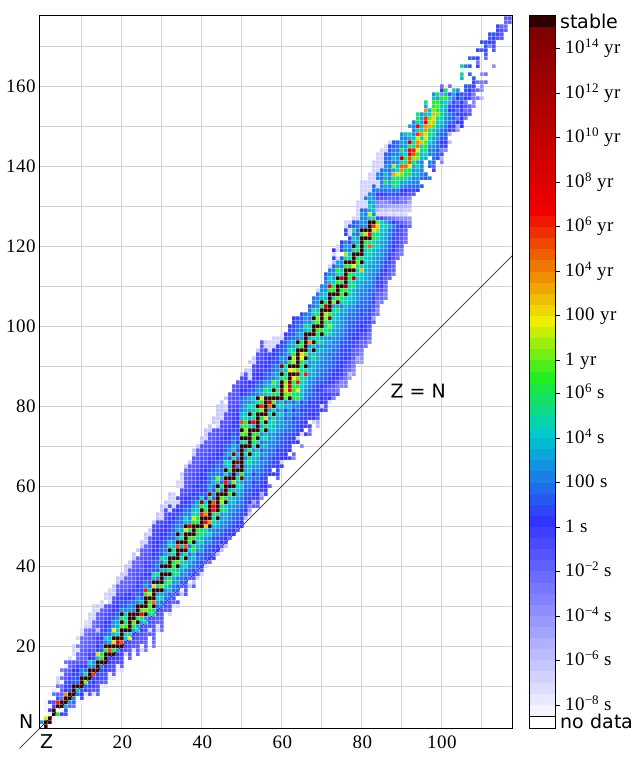
To add some visualization, you can have a look at the isotope chart [1] from Wikipedia showing the half-live times of the known isotopes to get the big picture. The distinct area towards the top is called island of stability [2] and contains long-lived but nonetheless unstable elements. A second island of stability is suspected even further up in yet uncharted territory but nobody expects additional stable elements beyond lead.

[1] https://upload.wikimedia.org/wikipedia/commons/8/80/Isotopes...

[2] https://en.wikipedia.org/wiki/Island_of_stability

Good answer, but I think you mean Fe, not Pb.
Good catch! It has been corrected in my comment.
> Is there a reason that other (alien) elements can't exist that we've never been exposed to?

Yes, because you form new chemical elements by adding protons (and stabilizing neutrons) to the nucleus, and humans have found or synthesized the first 118 of these. The ones that don't occur in naturally on earth are short-lived an unstable.

If there was a lot of exotic elements out there, we'd have seen it with our telescopes. It would point to new physics, for a start, since we don't think very heavy elements are likely to form naturally at all, let alone be stable long enough to be observed in any quantity.

Even if such elements are out there in the universe in tiny quantities, we'd run into a billion carbon-based biospheres before we found any.

To elaborate on the first point, we can identify elements by the spectrum of light they produce. We discovered helium in the sun before we discovered it on Earth.

(This only works if the element is common enough and hot enough to emit light that is seen from Earth.)

Physics is the reason that other elements likely don't exist. One can only arrange protons, neutrons, and electrons in a fixed number of "stable" ways.

Of course, this is today's understanding. We may be wrong. :-)

Agreed that size thing doesn't really have justification anywhere, but w/r/t the second part of your comment:

What about the fact that Hydrogen, Oxygen and Carbon are the basic building blocks for all types of life that we have observed so far on Earth, and they are also 3 of the 4 most prevalent elements (H, He, O, C) in the observable universe in general?

Sure, people have theorized that there could be Silicon- or Germanium-based biochemistries out there that work similar to Carbon-based life, but it's probably more likely we're going to find something closer to a Carbon-based biochemistry than not, just given the distribution of elements out there, right?

I think we can still talk about statistical probabilities without having actual observable data on a non-Earth life form, can't we?

I think the author messed up a classic "Doomsday argument" [1] style estimate which wouldn't depend upon the distribution. I see no way to recover the attempt, though. (I assume that's what the author was going for, given the precision of the estimate along with the use of 95% and 20% which are almost the standard doomsday argument values: that we're 95% certain that the total number of humans ever is at most 20 times (not 20%) the number that have existed before us.)

[1] https://en.wikipedia.org/wiki/Doomsday_argument

If we are talking about alien life in general, I completely agree. But this calculation relates specifically to intelligent life. And from that collection we can deduce something, as explained in the website. The calculation assumes nothing about the presence of water or carbon.
I see no justification for anything in this article. His assumption that beings like us (ability to reason about our place in the universe and even leave our own planet's gravity well) are common is dubious. There is no evidence of that at all.
I think the argument is this: given N beings in the universe that want to search for other such beings, if each being assumes they are the median it maximizes the chance that one being finds another. So maybe we are actually the 99th percentile in size, then it's okay that we are looking for larger beings, because the vast majority of beings that really are around the 50th percentile will be looking for larger beings.
> His assumption that beings like us (ability to reason about our place in the universe and even leave our own planet's gravity well) are common is dubious. There is no evidence of that at all.

Yes I want to believe this but, I'm afraid there is no science behind it. Based on # of galaxies and stars it does seem logical however, what unknown variables also equate into determining this? Needless to say I stopped reading after this assumption in the first paragraph.

Here's the one piece of hard data that we have on alien life: We haven't observed any.
Yes, but that doesn't prove anything. You're not going to see alien life on other planets when your technology is so primitive that you've never even send manned missions beyond your nearest moon, and you've only recently even begun to detect other planets (outside your own star system), and even there you don't have the capability of detecting planets as small as your own.

If you don't bother to actually observe planets similar to your own, then of course you're not going to observe any alien life similar to your own.

We do have the ability to detect signals: none found. We have also not detected any von Neumann - Bracewell probes. These are significant negative results, since any civilization slightly more advanced than ours could quickly (a few M years) seed the galaxy with vN-B probes -- and would eventually do so with probability approaching unity.
The other responder is correct.

The signal detection thing is just dumb. Signals quickly fall in strength to background noise levels, so you need to broadcast a huge amount of power in a tight beam to overcome that over any significant distance. So basically, you're arguing that just because no ETs have bothered to pour a lot of resources into 1) finding us and learning of our existence, and 2) building a gigantic, power-consuming radio transmitter and directing it at us, that they must not exist.

The probes thing assumes that the ETs actually want to talk to us. That's a pretty huge assumption. We've had civilizations here on Earth which had no desire for outside contact (namely the Chinese during some of their dynasties). What makes you think the ETs are so intent on pouring resources into making artificially-intelligent probes to establish communications?

By that logic, WE don't exist, because we haven't bothered to do these things either.

All it takes to have a galaxy forever full of self-replicating vN-B probes is the launch of one probe from one civilization sometime in galactic history. The odds that we would observe no probe here are (1 - P(a civ will launch a probe)) ^ N(tech civilizations). I assert that no probe has been observed, and I contend that N(tech civs) must be low, since P(launch) must be pretty high -- it just takes one E.T. script kiddie with a Stephenson matter compiler to make it happen sometime during the lifetime of a tech civilization.
You're making a lot of assumptions. You're assuming that it's that easy to make a self-replicating probe that's that intelligent, for one. Any civilization that advanced may have put a lot of thought into what such probes should do, and how they should interact with other civilizations. They may very well have come up with the Prime Directive and only observed, without becoming detected by primitive cultures such as ours.

You're assuming that there aren't other spacefaring civilizations out there who are opposed to these probes, and that don't actively seek them out and destroy them.

You're assuming that the galaxy and nearby vicinity is old enough for one of these civilizations to become this advanced and to build these probes and for one of them to reach us. Who knows, maybe there just aren't that many really old civilizations around yet. Just look at how long it took us to evolve to this point.

Assuming they actually want to talk to us.
Assuming at least one of them might want to talk to us, yes.
Did you read the article?