Hacker News new | ask | show | jobs
by todd8 3751 days ago
Hand-held calculators might have been carried on many NASA missions, but not the early ones. The first missions started in 1961 and hand-held HP calculators weren't invented until more than ten years later. By that time we had already been to the moon 6 or 7 times.

The first actual hand-held calculator I every saw was a Bowman Brain (simple 4 function calculator) it was for sale in 1971 at the MIT COOP (the bookstore). I only knew one person that bought one; the rest of us continued carrying around our slide rules (they came in handy leather holsters with belt loops.) The HP that came out about a year later was a real scientific calculator.

Years before that, sometime between 1965 and 1968, on an episode of Lost in Space (a TV program with a family of early space explorers lost in outer space) the son, Will Robinson, was carrying around a large device about 3 inches thick and a foot tall that looked like a calculator. I thought the idea quite marvelous and went to bed thinking about it and how much better it would be than my slide rule for playing around with calculations. (I was a weird kid.)

2 comments

We must be about the same age. I went through college with a leather holster for my slide rule. I saw the first TI calculator after graduating from college in '71. I lusted after it and later I went to work at HP and got an HP. I was a super-fan of reverse-polish at that time. HP stayed with RPN for some time.
Did the astronauts use slide rules? I know the E6B is pretty common for pilots still.
I spoke at some length with Fred Haise Jr, Lunar Module pilot of Apollo 13, and when I showed him my slide rule, he enthusiastically took it and started to play with it. Yes, astronauts used to use slide rules.

He asked me what I used to lubricate it, and showed some simple calculations to our host. He said he'd mostly forgotten how to use it, but it was clear that it was very, very familiar to him.

He signed it. Later I got Jim Lovell to sign it as well. One of my most treasured possessions. I only wish I'd had the presence of mind to get TK Mattingly to have signed it when I met him a year earlier. There is yet time.

> I know the E6B is pretty common for pilots still.

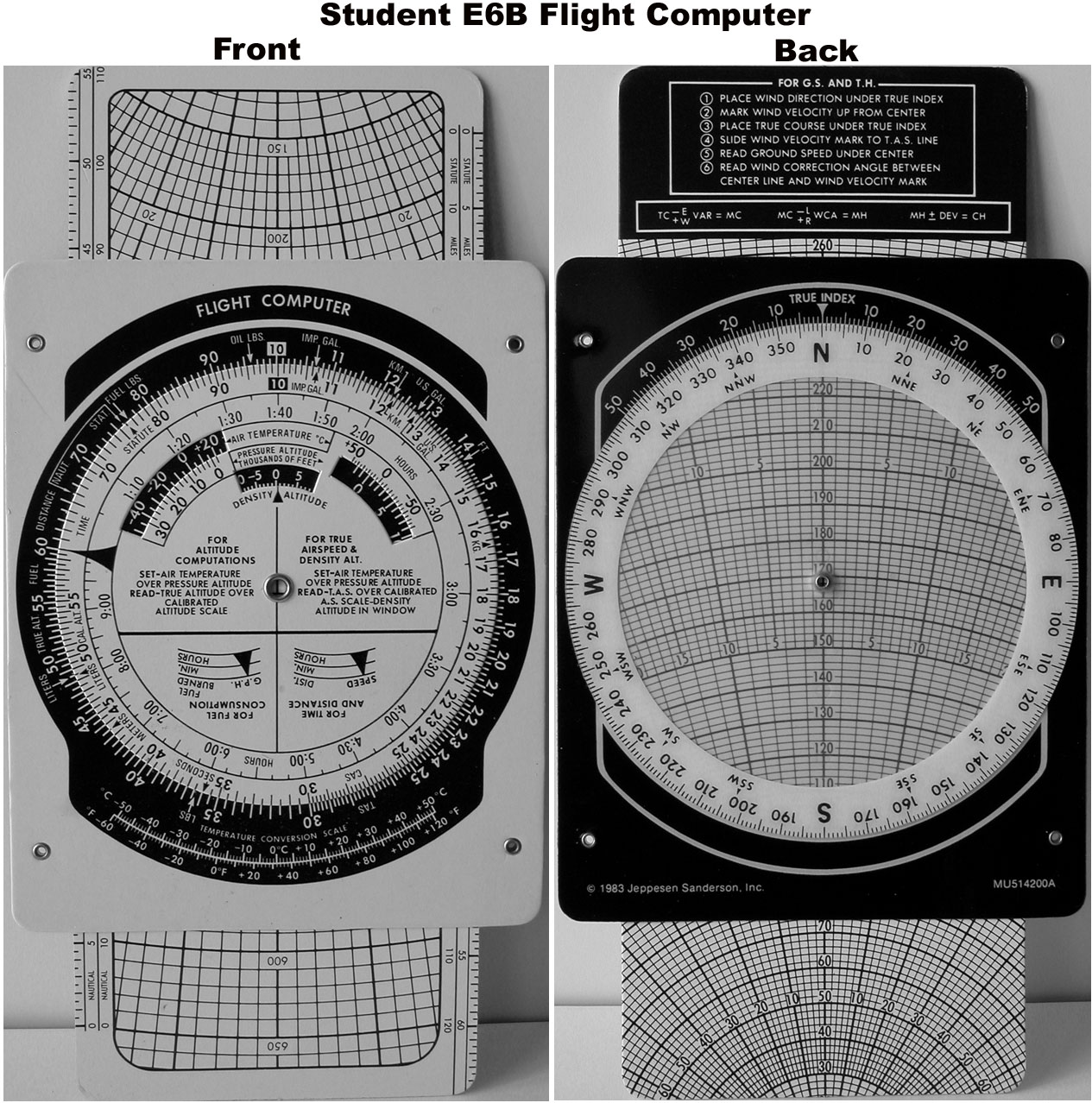
I've used that before. It is not a standard logarithm stick but a vector addition tool. Does one thing very quickly.

The other side from the vector adder ("front" side at https://upload.wikimedia.org/wikipedia/commons/c/c4/StudentE... ) includes a circular slide rule with perfectly normal log scales for fuel, time, distance calculations, an extra scale to help with hours/minutes conversions, and some marks for various conversion factors, including lb/gal fuel and lb/gal oil for use in weight/balance.

The main difference between a straight and circular rule is that it has only one appearance of the index, so you don't have to move the slide around as much, and it's round so the equivalent of a 10" rule has around 3" diameter.

It also has other scales for converting altimeter/airspeed (really pressure gauge) readings into other numbers more useful for certain purposes like true altitude (good for missing obstructions) and "density altitude" (for estimating takeoff performance, also helpful for missing obstructions).

This is amazing. The idea of converting units of multiple types in a hurry when it matters with a slide or circular rule in imperial units is terrifying. Somehow doing that in metric seems less so, but the fact that the system got people to the moon relatively recently is still amazing.