Hacker News new | ask | show | jobs
by reimertz 3765 days ago
How-to become a douchbag in 10 steps:

1. Be the supervisor for a thesis that will become a open-sourced project

2. Use this open sourced project in one of the classes you teach at University

3. work together with and ask for help from the creator of the open-sourced project

4. see the value of the open-sourced project

5. fork it

6. claim it as yours

7. get rich by selling it

8. write super douchy email to a previous maintainer of the project you forked.

"Sorry JC but you had nothing to do.with this…. You can’t possibly try to get credit for.something you hadn’t been involved with"

9. Lie to media

".. In two days, Mellis banged out the code; three days more and the board was complete. .."

10. Tada - you are the biggest scumbag of all times.

Man, these guys deserve some shit. Why don't you send him a tweet? https://twitter.com/mbanzi/

6 comments

This is part of the reason I just buy the cheapest Arduino-compatible clones possible and laugh at the idea that we should all buy genuine Arduino to support the people who put in the hard work - it's been fairly obvious for a long time that it was a Wiring rip-off through and through. Probably also why the official Arduino ports to non-AVR architectures are so incompetent compared to third-party ones; the AVR port was taken from Wiring and just modified slightly, so no-one there had the skills to write one from scratch.
My favorite Peeve about the arduino boards, was the half pin center shift on one of the headers that makes it impossible to just plug in some perfboard with headers on it and make your own shields. Thus opening up the path to selling expensive shield hardware.
> makes it impossible to just plug in some perfboard with headers on it and make your own shields

Not so. You just have to drill ten holes, using another piece of tenth-inch perfboard as a drilling guide. I've done it; it works.

Agree. I bought a better than Arduino clone for $5. The Chinese even sell cheaper ones but you must have some luck with the soldering.
I also remember needing a non-standard USB driver, for a CH340 -- a bit scary to install: http://0xcf.com/2015/03/13/chinese-arduinos-with-ch340-ch341...
On Windows that is. On Linux they work out of the box.
I would do that but I'm afraid of the ftdi clones that can get bricked
I think Altair and IBM PC both was at least original designs, but neither were they particularly good designs either. Unfortunately I think ANSI/ISO and other standard committees was probably poorly suited to setting standards in this area. The right way back then would probably be to design a reference system and release schematics and other design information.
Banzi might come out as a douche, like Steve Jobs was. At a very very very different level they achieved the same. Would you prefer a world where wiring would still be a pretty niche project badly marketed only available for those in the field or a world where someone much more marketing oriented made Arduino explode and ignite a small but meaningful revolution in the approach to electronics?
This is a false dichotomy. I would prefer a world in which Banzi worked together with Barragán, which Barragán would have clearly loved and which might have given Arduino an innovator at its helm and the ability to actually keep up with the times, rather than being steamrolled by the Raspberry Pi on one end and by better microcontroller designs like Particle (Spark), Tessel and the MicroPython boards on the other.
Of course, you're right, but we don't really know whether that could work. From the way Barragan puts it I don't think he would have liked the path Arduino followed, although he's of course happy about the success, just frustrated by attribution issues. Therefore I think your outcome would have been improbable at least.
If you put two Steve Jobs in a room and ask them to work together, the result isn't always going to be mecha-Jobs, it will just as often be a fight over clashing visions. Open source is great because it lets people pursue those visions. Sometimes it isn't going to work out.
Still, super scummy not to be open about ehat arduino really was. And then to make oodles of profit and not even give a gift or some type of consolation? Highly against internet standards for openness.
After watching the entire documentary I have reconsidered. It appears there is inconsistebt behavior or an exaggeration on the part of OP. Banzi is quite transparent and the origins seem pretty innocuous.

https://vimeo.com/18539129

I would say, as open source developers, we have no right against commercial forks of our code lest we choose a more restrictive license. I believe OP is tormented by the lack of valor in the quite prickly situation but as hackers and devs we need to defend fair use of what code is licensed by. Fair licensing, fair commercial endeavor. It sucks when someone forks without even making contact but part of me feels like open source should be a little bit wild west. The rules are sharp square and leave little for interpretation, thats how we want our freedom

I wish it were possible to bottle up your last paragraph and force new developers to drink it before they could learn to program. I mean, insofar as anybody should be able to force anybody to do anything.
it doesn't really matter what one prefers. Rights are rights. One cannot just appropriate others work because some website community feels it's in their interest to do so...
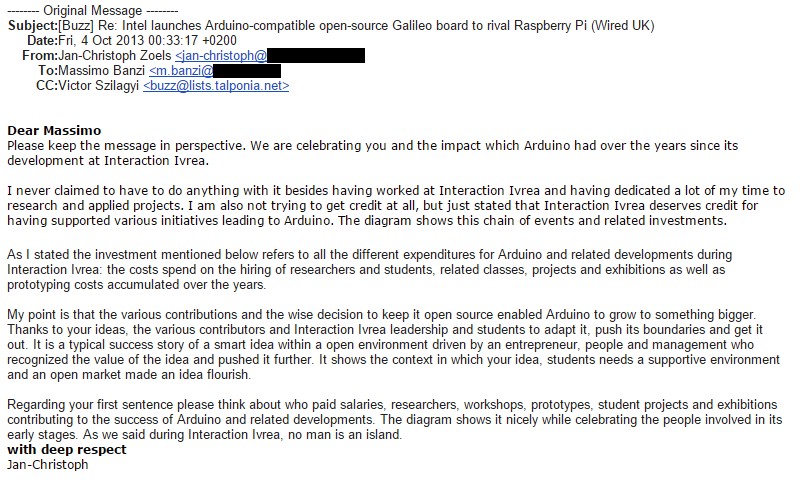
Step 8 is inaccurate. JC is not the author of Wiring, he's a faculty member of IDII [0]. Banzi was saying that IDII should not try and get credit for Arduino as they did not help them with the funding (beyond ordering 50 boards). [0]: https://interactionivrea.org/
Here's Jan-Christoph Zoels' reply to that message: http://arduinohistory.github.io/images/full/JCEmailThread2.j...
Are these the same guys from this arduino documentary?

https://vimeo.com/18539129

EDIT: Yep - the first speaker in that doc is Banzi

I dub this...The Banzi Scheme.
Why open source a project and let other people fork it if you are going to get completely bent out of shape when someone does fork it and build on it? What is the point of open source if that isn't exactly what happens?
Since you created this account 17 minutes ago (before this post) you are clearly trying to troll, but in this case I will make an exception and reply to a troll.

The Wiring developer is not upset about someone forking the project, but the lack of acknowledgement and deliberate misinformation, even lying by the Arduino developers.

What I am arguing against is that people shouldn't be using the word "steal" in reference to forking an open source project and building a business on top of it. People do that every day. They aren't expected to walk around giving credit to the originators for everything they do afterwards.

Steal is when I take something private, locked down, under patent and use it to profit. Show me what was stolen that wasn't given for free.

Arduino did give them credit, they said it originated from Wiring. The other factual details where relatively minor, something that could easily be confused by most people.

I love how the voting system in Hacker News is used as a weapon to suppress all dissent. What did I say that was trolling? Creating a new account because I work too near this field.

> "The other factual details where relatively minor"

The team behind Arduino hasn't made its lineage clear enough, that's why this article is newsworthy. I also think it's worth knowing about as it adds a new perspective to the recent legal issues surrounding the rights to Arduino.

Also: Don't DOWNVOTE people because you disagree with them. DISCUSS with them. Downvote me if I am being an asshole. To downvote because you disagree is not the right use of downvote.

I actually did read the entire article. Most people seem to be reacting to the title, Arduino clearly attributed Wiring, they didn't just steal it and not say anything:

34. Banzi is the creator of the Programma2003 Development Platform, a precursor of the many ARDUINO-branded products. See: http://sourceforge.net/projects/programma2003/. Banzi was also the Master’s Thesis advisor of Hernando Barragan whose work would result in the Wiring Development Platform which inspired Arduino.

This was probably written by a lawyer and not Massimo himself. Its a legal filing. It says clearly Arduino is inspired directly by Wiring. What else do you wan't from an attribution of credit? Should Massimo get a tattoo that says "Wiring" on it and put it on his forehead?

I read the article - your points are covered by it, maybe that's why people are downvoting instead of discussing.

That quote attributes more credit to programma2003 than wiring (precursor vs. inspired by). Is that an accurate portrayal of the history?

And there's a middle ground between stating inspiration and getting a tattoo. Inspiration implies idea not substance. Since it was a fork, 'based on' may be more appropriate.