Hacker News new | ask | show | jobs
by mbrock 3775 days ago
There's an important kind of compromise that isn't discussed as often: using an external library but behind an interface of your own design, an "anti corruption layer". If the external dependency is limited to one small bridge in your application, then it's so much easier to see what parts of the dependency you actually depend on, to upgrade the dependency when its API inevitably changes, to replace it entirely if it becomes a burden.
2 comments

I'll link to the facade pattern, since last time I mentioned it people went a week or so before realizing it wasn't a term of my own invention:

https://en.wikipedia.org/wiki/Facade_pattern

The downside is that you bring in another layer of indirection and, as a result, greater cognitive load for yourself.

Mycode -> facade -> library

Navigating code becomes more cumbersome and stack traces longer. I do like this approach too but it isn't free.

That reminds me of another thing I'd like to tell library writers: please think of your stack traces as somewhat public, because I always end up 40 layers deep trying to debug something and it's just painful.

Hopefully a facade will introduce a small constant number of stack frames...

Anyway, with something like Lodash for JavaScript, I'd even want to "facade" that into a project-specific utilities thing. Right now we're on an old major version of it and upgrading would require changing hundreds of locations. When very many files in a project mention the same external dependency, that seems like a recipe for future sadness.

A facade should only add one layer of indirection.

As for project-level management of external dependencies the tooling can be used to provide a facade for imports. I'm not sure about Webpack but JSPM already does this using a config.js file that maps all of the dependencies to readable import names, sans version numbers so the site doesn't break on future updates.

Ideally, once ES6 modules are used more widely it would be great to see libs start to adopt the facade pattern to provide finer granularity of control without deep linking into a project's source.

>That reminds me of another thing I'd like to tell library writers: please think of your stack traces as somewhat public, because I always end up 40 layers deep trying to debug something and it's just painful.

Unless you're using Spring, of course, then all bets are off. That's the biggest downside of IOC containers, they tend to ruin the usefulness of stack traces and the "step in/step out" functions of the debugger.

There was a code base where people wrapped glibc-functions. Most of the time it was straight calls to the corresponding functions in glibc, but they were called x... instead, so malloc became xmalloc, free became xfree, &c.

At one time there was a lot of zombie processes lingering for a long-ish time until the parent terminated and the zombies were reaped by init. I didn't bother to look at the implementation for xpopen, as I assumed it was just a call to popen. Turned out it wasnt; it was fork/exec with a socketpair turned into a FILE* with fdopen. The child was not waited for in xpclose.

I think there can be times when the facade pattern makes sense. I think there can be times when importing the world makes sense. I think there can be times when the opposite is true too. I think talking about these things in an abstract way can miss the point of the very insanity in some concrete solutions out there.

Heh. Well, yeah, abstract opinions are always suspicious. In your case, making a facade around standard POSIX functions does seem weird, especially if the facade is itself buggy! For something that needs to be portable across many platforms, such a facade could be very useful though.
Hah I stopped worrying about stack trace length when I started writing Scala ;)

Usually only 1 or 2 lines of the trace matter, you learn to skip the rest pretty fast.

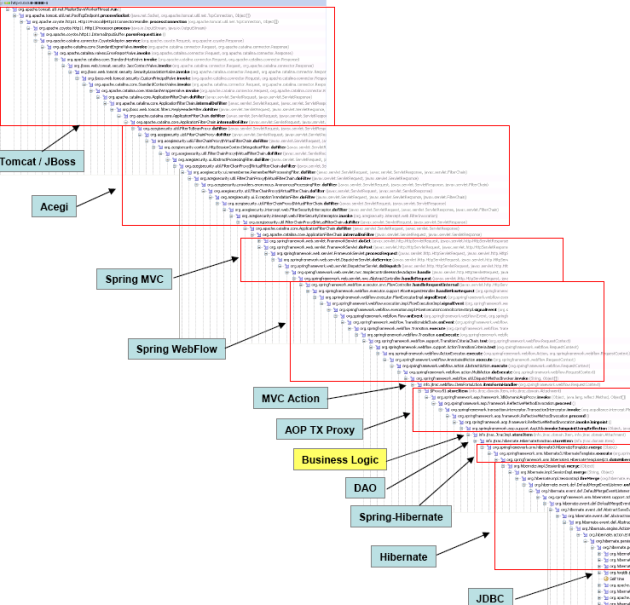
Here's an interesting story from the Java world - "Filtering the Stack Trace From Hell":

https://dzone.com/articles/spring-vs-java-ee-the-real-story-...

An even more breathtaking stack trace image can be found here:

https://ptrthomas.files.wordpress.com/2006/06/jtrac-callstac...

And the PDF version:

https://ptrthomas.files.wordpress.com/2006/06/jtrac-callstac...