Hacker News new | ask | show | jobs
by marvin 3809 days ago
SpaceX actually got very close to sticking this landing. Sea conditions were reasonably rough, with 3-meter waves. It's also the first time SpaceX launches in fog, IIRC. Everything about the landing except the stuck leg seemed to be perfect.

So IMHO, the fact that the rocket exploded is not the most pertinent fact about this experiment. The main piece of news is that SpaceX is exceedingly likely to be able to recover rocket boosters intact from sea, even in non-perfect weather conditions.

5 comments

As a former gymnast, I like the sticking the landing analogy but a human (even on an unstable mat) has far more control over their balance point (we do much of our balancing by bending at the waist - if only the rocket had one).

In any case, I agree that this was very close. I've also spent a reasonable amount of time on "big water" and was specifically watching the attitude of the landing deck with respect to the horizon. I didn't see much movement of the barge (but that doesn't mean there wasn't some instantaneous movement that together with the force of landing exceeded the leg's load rating).

The other thing that's struck me is that the SSTO advocates could end up becoming irrelevant. Who's going to argue we need SSTO at all if we can recover and reuse all the stages anyway? Multiple stages will remain dramatically more efficient (Yes - I know we don't get space planes with two hour flight times from New York to Tokyo quite as easily).

Finally ... I just have to say "I LOVE THIS". I remember as a child watching the Apollo missions and, as an engineer, I haven't been this excited about a project for a long time. Isn't this exactly the type of thing we can rally humanity around? Who's going to argue that it's not a great accomplishment?

The Falcon 9 isn't totally reusable not does it plan to be. It still has a non-recoverable second stage so it's not quite to the point of a SSTO.
Are you sure that there's not a plan to recover the second stage once they've consistently been recovering the first stage? (I'm assuming that would be part of the road-map).
From Wikipedia:

    The project's long-term objectives include
    returning a launch vehicle first stage to
    the launch site in minutes and to return a
    second stage to the launch pad following
    orbital realignment with the launch site
    and atmospheric reentry in up to 24 hours.
https://en.wikipedia.org/wiki/SpaceX_reusable_launch_system_...

However, from other sources:

    SpaceX would love to recover the second
    stage, which they had planned.  But it
    sounds like they have given up on that.
http://space.stackexchange.com/questions/7814/what-happens-t...

What they are referring to there is a transcript I have been unable to access. It's here:

http://shitelonsays.com/transcript/elon-musk-at-mits-aeroast...

More discussion about it all here:

https://www.quora.com/Could-SpaceX-feasibly-recover-the-seco...

https://www.reddit.com/r/spacex/comments/1zg7zm/how_soon_can...

https://www.google.co.uk/search?q=space-X+recovering+second+...

Seems way harder for way lower returns to recover the second stage. Only 1 engine instead of 9, and you're recovering from orbital velocity which opens up several new cans of worms. Would they need heat shielding? The extra weight there might blow away any cost savings from recovering the engine.
Heat shielding is needed, as well as extra landing engines that work outside of vacuum, since the second stage engine would destroy itself under atmospheric pressure. It's easy to see how quickly you start to get dimishing returns, but it would be cool if they could pull it off.
It certainly was at the start. https://youtube.com/watch?v=sSF81yjVbJE

Apparently they are no longer pursuing stage 2 reuse on the Falcon 9. The next gen superheavy lift rocket, the BFR, is intended to be fully reusable though.

A reusable SSTO would be a very difficult project, given that noone's even built an expendable SSTO yet.
If you're going to build an expendable rocket designing it as a SSTO doesn't really make sense. With a single stage you can't shed the extra weight of the engines and rocket that got you out of the atmosphere and have to have engines that work both in atmosphere and in vacuum.
I agree. I'm just saying it's easier to make an expendable than a reusable one, because you don't have to allocate mass to return systems.
What I was trying to say is that there are other reasons to not build a single stage to orbit expendable rocket, mostly cost and payload capacity. I agree it'd be easier than a reusable version but if you're not returning the stage it makes way more sense to use the 2+ stage designs that are common today. Being able to shed the weight of the atmospheric stage and switch to a vacuum optimized engine is a big benefit.
Interesting that modern alt-space community often employs the concept "test a little, fly a little", and consider making reuseable systems easier.
I read somewhere, that the new first stage can do SSTO unloaded.
>It's also the first time SpaceX launches in fog

Musk said the "root cause may have been ice buildup due to condensation from heavy fog at liftoff."

Ice buildup on cryogenic components has been a problem with earlier private launch attempts from VAFB. See [1]for a frozen main LOX valve that didn't fully open due to ice frozen out of humid air.

[1] https://en.wikipedia.org/wiki/American_Rocket_Company

3-meter waves?! For context, once those hit the surf zone they stand up a bit more. Here's what that looks like when it's breaking

http://www.surfline.com/forecasters/blog/12_foot1.gif

(source: http://www.surfline.com/surf-science/wave-heights---forecast...)

There's a pragmatic difference between recovering the booster over some period of time, vs literally parking the booster right where it took off & ready to re-launch within hours/minutes.
I can't see re-launching withing hours any time in the foreseeable future. Even once they're proven reusable each booster will need significant inspection and likely maintenance before being ready to re-launch.
> I can't see re-launching withing hours any time in the foreseeable future. Even once they're proven reusable each booster will need significant inspection and likely maintenance before being ready to re-launch.

Initially, yes of course. But if they manage to launch a stage 100 times and it always passes inspection and etc, etc etc it's not impossible that eventually you'll get to the point where you only inspect every 2 launches, every 3 launches, every 5 or 10 launches.

Once the ride to orbit costs: $100million/X + $Ymillion + $Zthousand

where X is the number of reuses

Y is the second stage cost

Z is the fuel, launch fees, refurb, etc

There's an experience curve (https://en.wikipedia.org/wiki/Experience_curve_effects) that shows you how much you'll save as you build more and more units and it's entirely possible that the (expendable) second stage could eventually get very cheap to the point where you don't want to spend $1 million (or whatever) going over the rocket for every launch.

If you're launching priceless (or very, very expensive) fancy space telescopes that cost tens of billions then the cost of a failed launch is very, very high. But if you're launching a bunch of food and you can lob another shot next week if it fails, and everything else is cheap enough, it might someday make sense.

Before you ask me if I'm crazy, please understand that airplanes do exactly this; you have to get your engines overhauled every few thousand hours and I'm sure there are inspections, but they don't tear the plane down and rebuild it after every flight. Once systems get reliable enough, that's a thing.

This is all correct, to expand a bit on it here's a spreadsheet someone posted in /r/spacex analyzing the cost benefits of reusability:

https://docs.google.com/spreadsheets/d/144Y_OVmFFYTh_zTiV-FH...

"Reusing the first stage three times halves the overall cost of launch. Reusing 9 times cuts the cost to 1/3. However, there is little benefit to first stage reuse beyond that… Reusing both stages just once halves the total cost of launch. In addition, reusing both stages four times reduces the cost to 1/4, and reusing eight times reduces to 1/8."

As you touched upon a lot of things in space are expensive because launch vehicles aren't reusable, once they are it makes sense to create cheaper and expandable payloads rather than multi-billion dollar payloads strapped to rockets that can't be allowed to fail.

The same stage probably won't be ready to relaunch but imagine an assembly line of reusable stages that land at the same facility where they take off and then head right into a service center. With enough stages in rotation you can have a near continuous stream of launches.
> Everything about the landing except the stuck leg seemed to be perfect.

And there's the issue: it only takes a tiny bit of imperfect to ruin a landing.

I do think that SpaceX is going to get to the point where they are recovering enough of their rockets to make it pay off. But there will probably always be a significant chance that some little thing will go wrong. Don't be fooled later by "we've landed 5 in a row" about that.

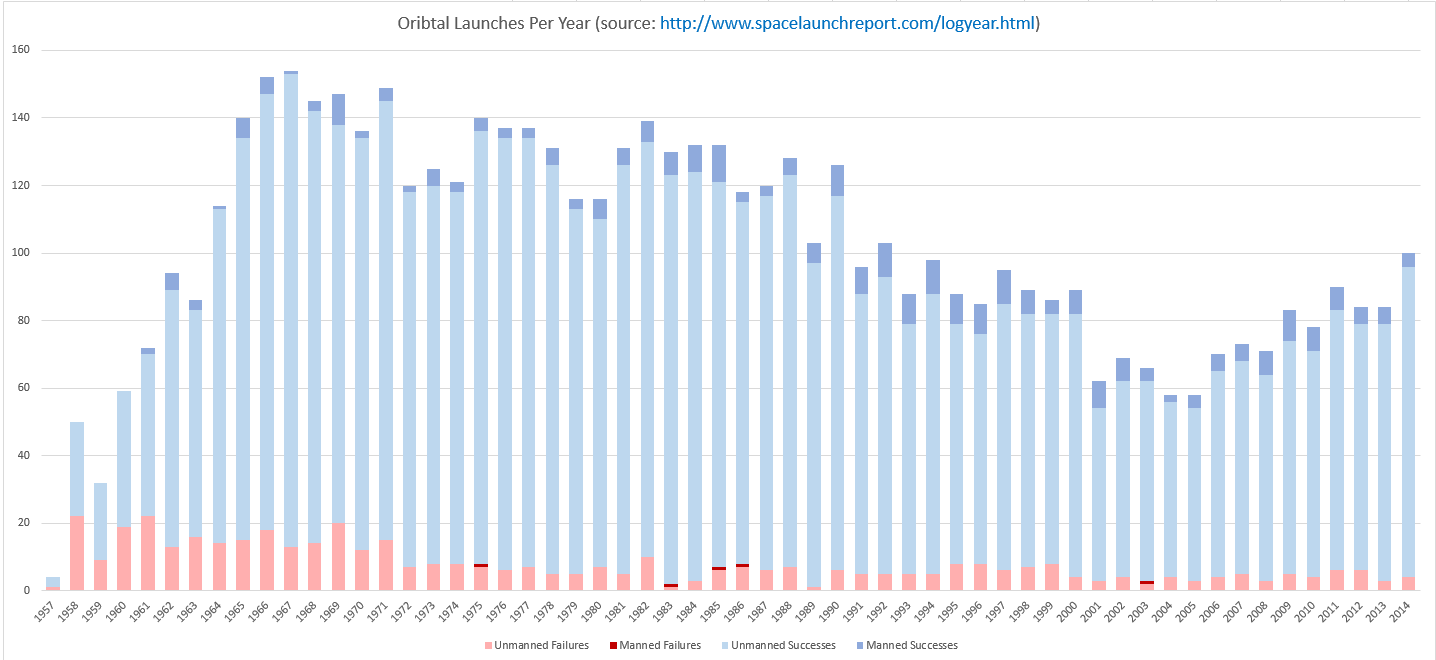
I guess it depends on what you mean by significant. It's true that, inherently, space flight is risky business.[0] This is new technology, so of course they are going to continue to uncover weaknesses even much further down the line once they start hitting a higher success rate.

But for the tiny bit of imperfect: the same could have been said for the space shuttle, and that had people in it. And its fragility was a fundamental to its design (it rode exposed on the fuel tank with its critically important heat-absorbing tiles). And the shuttle still had a decent success rate!

I would argue that these failures are less fundamental to the design of the rocket. And the difference is that if, in the future, you have that 1/100 failure on landing, it's only a loss from a cost perspective, not a human one.

[0] http://i.imgur.com/ei3h1B7.png

This is very, very, early days. I'm sure you could have side the same about 'normal' flight, loads and loads of failures, then getting it to the '5 in the row', then a bunch of screwups.

Now jet flight across the oceans in often horrendous conditions is 99.999% safe (ish).

The number of things that could go wrong is limited. The will learn all of them.

The same happened with airplanes. Just something so simple as breaking sound barrier control inversion meant hundreds of pilots dying until someone figured it out..

Thanks to automation and telemetry, SpaceX is learning fast without killing anyone. In the past it was hard to analyze what went wrong when the pilot did not survive.