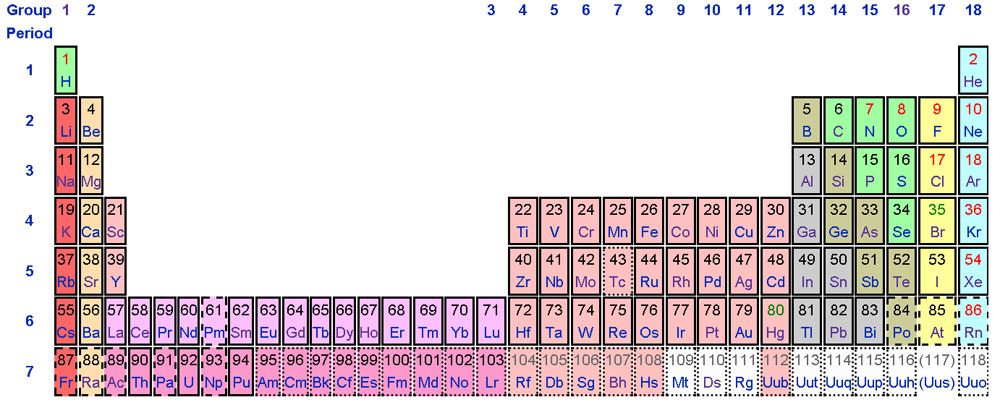
I think folding the periodic table like we do makes it much harder for children to understand valence levels. To quote Wikipedia (https://en.wikipedia.org/wiki/Atomic_orbital):
> The "periodic" nature of the filling of orbitals, as well as emergence of the s, p, d and f "blocks", is more obvious if this order of filling is given in matrix form, with increasing principal quantum numbers starting the new rows ("periods") in the matrix. Then, each subshell (composed of the first two quantum numbers) is repeated as many times as required for each pair of electrons it may contain. The result is a compressed periodic table, with each entry representing two successive elements:
...though, taking it absurdly literally, imagine a world where our taxonomy of "elements" was constructed like this, rather than by proton-counting. Hydrogen and Helium would be different isotopes (prototopes?) of the same element. Fluorine and Neon would be the same "element", too. We'd get a strong intuitive sense, even from first hearing about chemicals as children, that certain "elements" have volatile behaviors that can be explained by what they're paired with—Fluorine being so reactive because it's the -1 "prototope" of Neon and really wants to oxidize something so it can have Neon's full valence shell, etc.
Or, to go further, imagine we divided our chemical taxonomy by entire subshell—that we just had elements called "1s", "4f", etc. with "prototopes" for uranium, actinium, etc., with their distance from an empty/full subshell represented in their names. It'd be immediately clear what makes certain elements semiconductors: silicon's name would be "3p±4" and, well, that's all you need to know about silicon.
Valence levels pretty much become meaningless after the d block. In the d block, elements lose their electron configuration patterns I'm nontrivial ways that make periodic arrangement less useful.
That may be true, but even models can have a closer or less close relationship to the thing they model and modeling 3D orbits around a central nucleus is quite hard in a rectangular mapping, the spiral (even if this one may be flawed) seems to show more clearly that the space in orbits further out will accommodate more electrons.
What do you mean by "modeling 3D orbits"? Because that's not what the periodic table is doing. It's telling you which quantum numbers are in use. The rectangle is extremely good at that (with a couple minor simplifications). The problem with the spiral is that it will have the same discontinuities as the rectangle, because each angular momentum number has two more magnetic quantum numbers than the previous.
Or, in other words, the disadvantage of putting more space farther out is that you lose the most important property of the periodic table, which is the groups.