Hacker News new | ask | show | jobs
by jnwrd 3882 days ago
Africa was not blessed with the greatest geography for capital formation. The most interesting question is why Africa did not develop prior to the period of colonization, in the time period from say 1000-1500 CE when Europe when from a position of relatively inferior capital, to relatively superior capital: https://en.wikipedia.org/wiki/List_of_regions_by_past_GDP_(P....

At this stage in human development capital generation is pretty much completely agricultural, and thus the productivity of the land is the chief determinant of societal outcomes.

1 comments

In fact they did, Carthage and Egypt. These African powers at the time competed against the Romans and Greeks to the north.

https://en.m.wikipedia.org/wiki/Ancient_Carthage

Those are hardly "African" in any sense a modern American would think of. They're on the same continent, with different climate, demographics, and cultural affinities, across an extreme geographic barrier.

And Egypt never competed against Romans and Greeks to the north; at any point in history where the Romans and Greeks would have been relevant, Egypt was under Persian (Greek times) or Greek (Roman times) rule. Egypt competed with the Hittites, and with various Mesopotamian states -- although it was usually much bigger, richer, and stronger than the Mesopotamian states.

Those are hardly "African" in any sense a modern American would think of.

Really? "An african society is any society that grew in Africa, excluding the most technologically and economically developed ones, therefore African societies were undeveloped. This is true because technologically and economically advanced africans aren't africans in any sense a modern American would think of."

Last I heard, the Celts and Goths were barbarians during those times too. Those are true Europeans. Europe was undeveloped and backwards until the 10th century. Romans and Greeks were technologically and economically advanced but they live in a different climate, demographics, and cultural affinities across and extreme geographic barrier. It's the Goths and Celts who were really the forbears of today's Europeans. There must be something strange about Europeans that caused them to be backwards for so many centuries until the Romans civilised them, compared to, say Chinese, or Egyptians, who've developed advanced societies since before 1000BC.

Ridiculously biased, don't you think?

In a geopolitical and historical sense, Africa is usually taken to mean sub-Saharan Africa. Egypt in particular is historically bound up in fortune with the Middle East, but if you look at the general trend of political conflicts and especially technological diffusion in pre-modern eras, it's clear that the barrier between Eurasia and Africa is not Sinai but the Sahara.

Even France, Germany, and England were outside the Eurasian core, exhibiting lags in technological diffusion (although decreasing over time) until almost the eve of Early Modern. It's only in the Early Modern that European countries (and by the end of the Early Modern, this is mostly focused more on England, France, and Germany than Spain, Italy, or the Balkans) began to match and pull ahead of the rest of the Eurasian core.

At any point prior to roughly 1800, China was almost certainly the most advanced society on Earth. Statistics on historical world population are sketchy at best, but generally, you could pencil in between one-third and half of all humanity owing allegiance to whoever controlled the Yellow River.

What's a little bizarre is how a relatively poor, thinly-peopled section of western Europe managed to attain such an outsized portion of power on the world stage in the first place. I've read any number of different theories on how and why this occurred, but I haven't yet pieced them together into something that really hangs together. Nevertheless, it happened...

With regards to Carthage, power was almost entirely concentrated in the hands of the ex-Phoenician elites, so its not inaccurate to consider them a colonial Mediterranean culture, not appreciably different in kind from Syracuse, Massalia (Marseilles), or the Chersonese. It might be a stretch, but there could be some comparisons made between Carthaginian control of Iberia and Numidia with the British Raj.

Egypt is attached by all geographic, economic and cultural ties to the Middle East and Mediterranean, and always has been, aside from technically residing in the continent of Africa.

China was far less developed in 1800 than Europe so you probably want to push things back a few hundred years.

In terms of ocean going navigation they where significantly behind Europe starting around 1400. Of note, they sent few trade ships to Europe compared to European trading with China.

Europe had significantly more mathematical innovation.

Culturally it's hard to quantify, but while China had long had a printing press there alphabet made mass production of books significantly harder. So, by the 1600's Europe had far more books.

Things like nutrition and lifestyle are extremely hard to quantify. But, militarily Europe had significantly more advanced fortifications circa 1500's.

That's not really correct. Around about the close of the Qianlong Emperor's reign, China was possibly the most prosperous it had been, at least since the golden age of the Song dynasty. There was something on here not too long ago about the industrial revolution in Britain that went into this in some detail[1] - standards of living were a fair amount higher, per-capita, than in Western Europe at the same time.

There is very little that China would, or ever did, want to import from Europe. This was a major historical problem for Western traders in the China market - outside of bullion, and furs, to some extent, they had a real hard time finding products that they could successfully trade.

It's not as though China was bereft of the capabilities of fielding a large, powerful fleet - the Zheng He expeditions in the Ming dynasty were quite impressive, even if the accounts are somewhat exaggerated, and some of the biggest naval battles in history have been fought on Chinese lakes and rivers. But historically, the government was always facing serious threats from the interior of Asia, whereas coastal threats were generally little more than pirates. This has some knock-on effects - less incentive to study astronomy and geometry, when you aren't using them to sail ships around the world, different approaches to fortification - the Great Wall was more of a Ming thing, whereas the Qing, as an outsider foreign dynasty, tended towards assimilation of Mongols and other dangerous nomads into the ruling elite and the banners instead.

[1] http://www.csun.edu/~jaa7021/hist531/Goldstone%20-%20Efflore...

If you can classify a people who've lived in Africa for a thousand years as "ex-Phoenician", who came from Syria[1] and Lebanon, you can classify them as "ex-Egyptians" who earlier originated from Egypt from 3000BC[2], then you might as well call them "ex-East Africans", from another few thousand years before, who were really, in the end "ex-Central Africans" from another few thousand years before that.

Central Africa[3] => East Africa => Egypt => Syria & Lebanon, Levant => North Africa.

[1] https://en.wikipedia.org/wiki/Phoenicia

[2] https://en.wikipedia.org/wiki/Proto-Semitic_language

[3] https://en.wikipedia.org/wiki/Proto-Semitic_language#/media/...

Britain and Germany achieved outsized power as a poor people in Europe, but you forget Spanish already built a empire spanning between two continents in the 1500's. Before Spain (and the Ottomans), Mongolia was the dominant power, with China and Rome before that. I'm sure you know the Romans came from a small village. China too was borne of two small tribes[4]. Before Rome, it was Greece, and before Greece, it was Cathage, before Carthage, it was Egypt. It goes on and on, and on and on, and everyone has had or will have their turn in being a dominant power of the world[5].

[4] https://en.wikipedia.org/wiki/Yellow_Emperor#Early_years

[5] Fate of Empire - Sir John Grubb http://www.newworldeconomics.com/archives/2014/092814_files/...

You linked "Ancient Carthage" to support your point, so let me point out that the Carthaginians who fought against Rome were Phoenician colonists.

Africa north of the Sahara is part of the Mediterranean world. It shares population, culture, and trade with that world. It shares very little with black Africa.

Africa south of the Sahara is something completely different. If you say "Africa" today, that's what people will think of.

Black North African. An 17th century painting of Moors from North Africa, from Othello. He looks quite black to me. These are the Moors who conquered Spain, by the way. https://upload.wikimedia.org/wikipedia/commons/1/1f/Othellop...

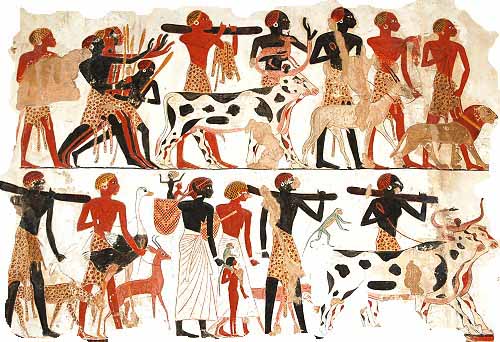
Black Egyptians. http://www.crystalinks.com/egyptfarming3.jpg

If you say "Africa" today, that's what people will think of.

Yeah, but our point of discussion is Africa in 1000BC. Plenty of black people there in those times.

And lastly, not only blacks can be African.

https://www.quora.com/Racial-and-Ethnic-Groups/Do-white-peop...

And according to a mainstream theory of human migration, and your perspective that people who live in Africa but descended from Phoenicians aren't "African", we're all Africans, because we are all African colonists of the entire world.

Which "people"? Certainly not anyone who paid attention in geography class. If we specifically mean sub-Saharan Africa then let's use that term instead of something more general.