Hacker News new | ask | show | jobs
by hellofunk 3884 days ago
This isn't so bad. The Netherlands is the most dense population of any country outside Taiwan and families dwelling in small spaces continues to this day. There is a 12-member family spanning 3 generations all living in the same small house next door to me. Our tiny 60 square meter home is considered normal for our area. By American standards, SF seems like tight living, perhaps. But by world standards, space is not the priority that you find elsewhere in the States.
3 comments

https://en.m.wikipedia.org/wiki/List_of_sovereign_states_and...

Netherlands is number 30. Admittedly most of the others are a lot smaller, but Bangladesh and South Korea are a lot bigger.

San Fran is also denser than the Netherlands, and AFAICS denser than any Dutch city (comparable with The Hague).

Hm I have a book right in front of me that says it is number 2 in the world, right after Taiwan. It's this book:

http://www.xpat.nl/product/holland-handbook-2015-2016/

Perhaps they taking other factors into account by excluding city-states like Singapore, Hong Kong, etc.

Interesting that in the PDF preview of the book on the page, which is a slightly newer edition than the one I have, they have changed the discussion of population density to say this:

>The Netherlands is in the world’s top ten in export volume and it ranks in the world’s top twenty for GNP, even though, in terms of square kilometers, it is one of the smallest countries of the world. Though it is true that, in population density, it is on a par with countries such as India and Japan, nonetheless this only amounts to a population of almost 16.8 million.

The ultimate problem is that SF is not really all that dense. It's ~7,000/km^2. (Amsterdam is ~4,000/km^2).

Seoul is 17,000/km^2. But living spaces are surprisingly reasonable, even by American standards.

It always blows me away that Paris has a density of 21,000/km^2, but the living spaces I've seen are pretty bad.

Like the article says, it just makes very poor use of its space.

Population density can be quite meaningless when talking about floor space to live in.

A city that has a height restriction of half of the other city can have exactly the same floor space to live in per person while ostensibly being half as population dense. And height is just one of many factors. Large bodies of water, parks, large open squares etc... they all can change density figures a lot without any change to the actual space per person in an actual house.

Paris certainly has tiny homes, I've been in more than a few, and they've felt smaller than Amsterdam (where I live) generally. But it's nowhere near the discrepancy that the density figures suggest (e.g. 21k vs 4k, but floor space per person is nowhere near 5x as big in Amsterdam, probably more like 25% or something). There are all kinds of reasons for this, one is that Amsterdam hasn't got nearly as many tall buildings as Paris does, and that Amsterdam's density is understated due to quite significant bodies of water (two rivers splitting the city vertically and horizontally), parks (Amsterdamse Bos is 3x Central Park), lakes etc etc, where nobody lives but that is part of the density calculation, making the actual places people do live denser than they appear in these numbers.

There are no other major countries from Europe on that list denser than Netherlands. Monaco is super dense, but consider that it's really really small.
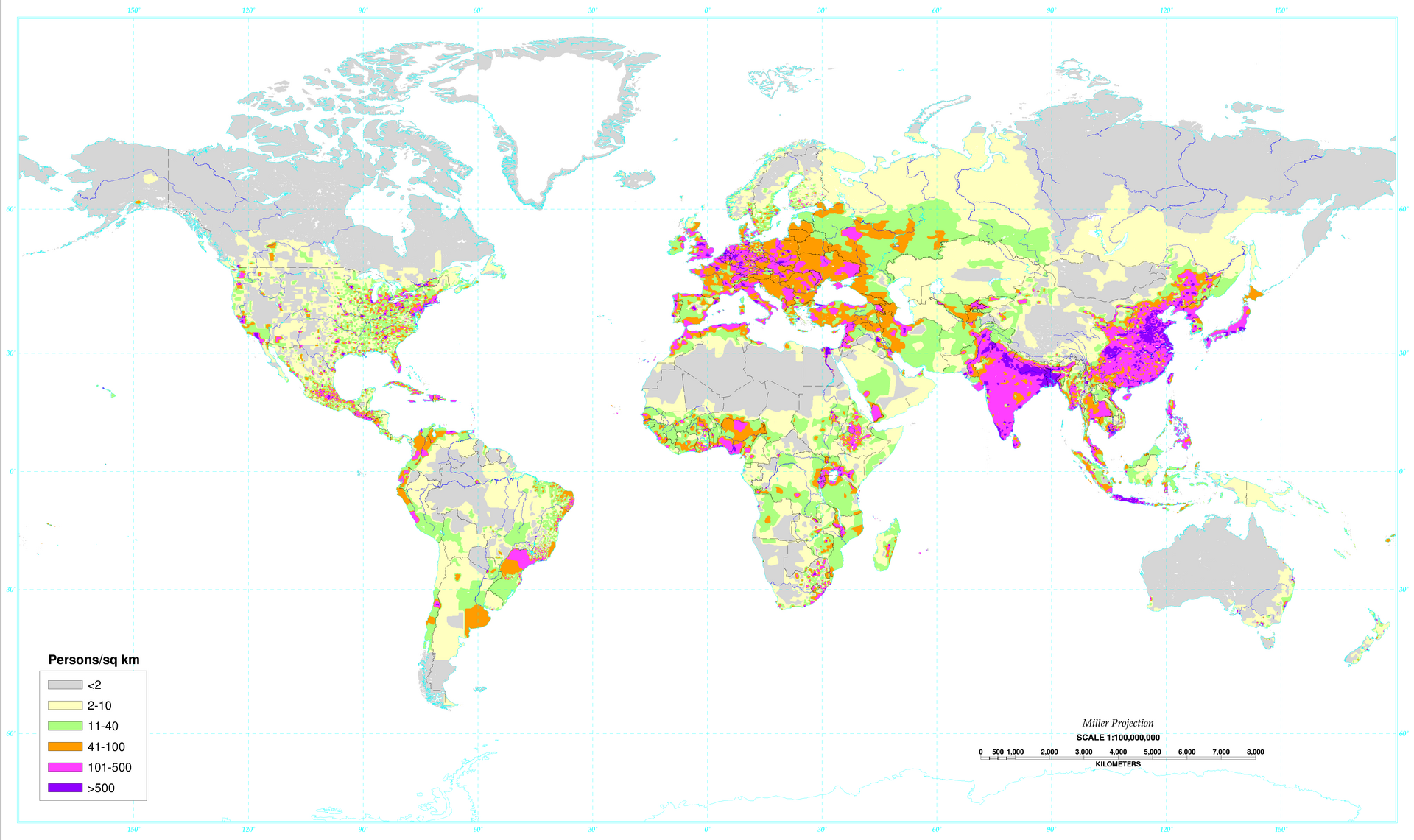
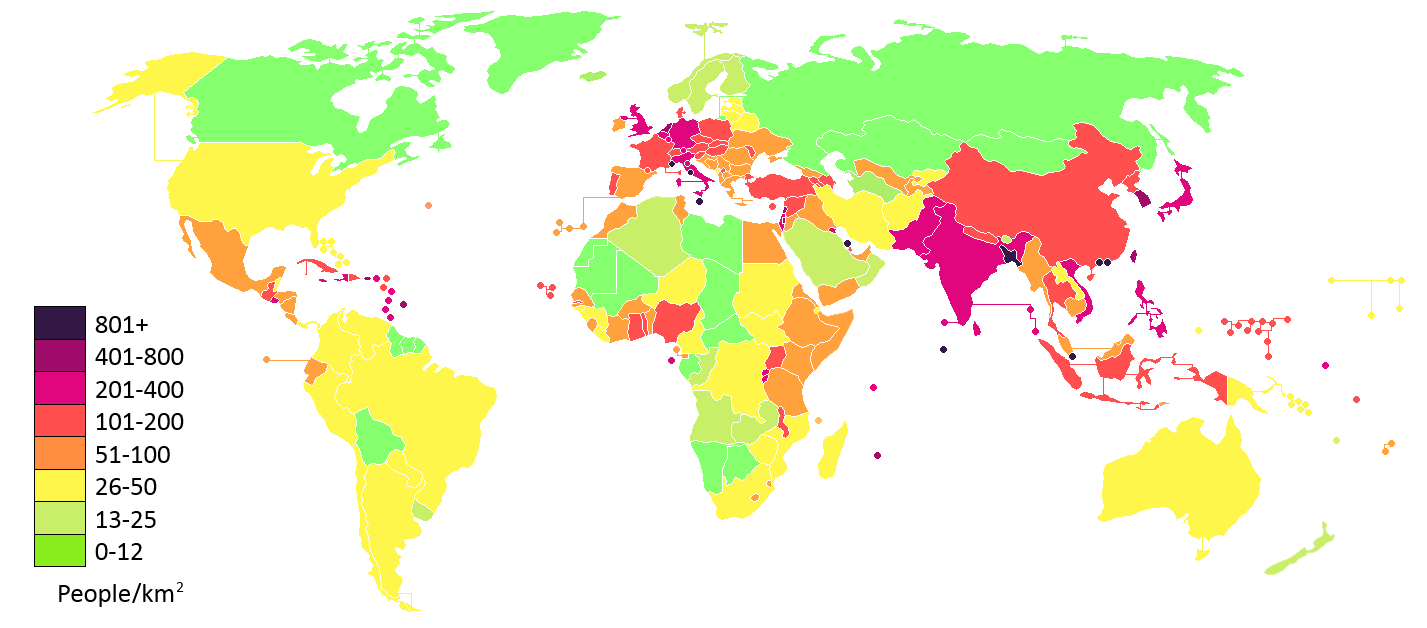
Just compare the US to other developed countries (e.g. the vast majority of Europe), high-density living (like SF) is pretty much the standard, that's really his point. [0] On population density maps the US as a whole is more akin to Australia. [1]

Beyond that, I always wonder about population density figures, afaik there is no standardised process for these calculations. You may think 'well it doesn't get much simpler than population within certain area over that total area', but when making comparisons, the statistics can be deceiving, especially as a proxy for 'living space'.

For example, I live in Amsterdam and we have quite a bit of water (from the Amstel river that divides the city east-west, the Ij river that divides the city north-south, or the Slooterpas lake that's more than a mile wide to the many different canals), as well as numerous sizeable public parks including just one of them, the Amsterdamse Bos, that's 3x (!) the size of Central Park... And if you're not familiar with Amsterdam, it's a tiny city with less than a million inhabitants. When you're outside you won't feel cramped, there's a lot of public areas, it's open, it's quite nice. But that doesn't mean that the density of actual residential space is like that. Especially when you consider that most of the Netherlands, including much of Amsterdam (a city mostly built in a swamp area!) has relatively low buildings and little vertical space as opposed to say Taipei.

Further, you may say the Netherlands is only nr 30, but there are only 4 countries with more than 10m people which are denser of which only 2 are developed countries. The US for context is number 177.

So the Netherlands is quite dense per total area for one. Secondly, vertical space is quite low, and thirdly many of its cities have large open areas (e.g. parks, bodies of waters, like Amsterdam) has ample open-areas where nobody actually lives. So while population density numbers are interesting to measure density, they can't simply be used a proxy for measuring density of housing space.

A better look would be at floor space per person. It's hard to find internationally comprehensive numbers for local areas, but take Germany and France. Germany has about twice the population density, but the floor space per person is pretty much exactly the same. Pop density would've been a terrible proxy for comparing floor area per person between these two countries.

Another example is Ireland and the Netherlands. The latter has 6x the population density. But floor space per person according to this source [2] is larger for Ireland. That's a striking difference that completely blows the popdensity statistic to irrelevance if a comparison between these countries was made for space in the home to live, even if the numbers are adjusted for errors.

I see pop density references pop up all the time in online discussions and it strikes me as a pretty bad statistic to pick for most arguments in such discussions. This particular discussion is about OP's tiny amount of floor space in his home, a popdensity stat includes much more and it may not be applicable when trying to make international comparisons.

[0] https://upload.wikimedia.org/wikipedia/commons/thumb/6/67/Wo...

[1] https://upload.wikimedia.org/wikipedia/commons/4/4d/World_po...

[2] http://www.entranze.enerdata.eu/

I take your point that floor space per person is probably a better metric than population density.

That said,

> high-density living (like SF) is pretty much the standard

I don't believe this. Yes, there are denser cities than San Fran, and yes, San Fran probably has more floor space per square mile than most European cities. Still, my default guess is that people living in San Fran have less floor space per person than average, for most reasonable choices of population to average over.

If you have statistics that show otherwise (don't have time to look currently), I'll gladly admit that I was wrong.

It's also not really relevant what the U.S. As a whole looks like.

> If you have statistics that show otherwise

No I don't, floor space per person seems to be one of those things that's barely registered or studied, it seems, on an international level. Some municipalities/cities do their own studies, and some organisations (EU, OECD) etc do run some country-level averages, but even here definitions are non-standard (e.g. they'll look at floor area per dwelling per capita, but definitions of dwellings range from houses to caravans to vacation homes and may include or exclude vacant dwellings etc, some count all area including outer walls, others count not the balcony, some count the balcony for half), but comprehensive solid international data that's standardised and available down to a local (city) level I'm not aware of. It's a shame because it's definitely interesting data! Who knows there may be a market for this kind of information :)

> Our tiny 60 square meter home

is over 50% larger than the one in the article?

It's the difference between a studio and a nice one bedroom, or maybe even cramped 2 bedroom.

That really depends on how the space is arranged. I'm in just about that size, but my place is wheelchair-accessible with room for attendant care, so the bathroom is huge compared to normal, the entrance corridor is nearly wide enough for, say, a Smart ForTwo (or a chair with a drip and someone alongside), so the basic living area works out to "small bachelor/studio". That's a bit extreme, but a bad layout can really eat into the usefulness of your floor space without a corresponding drop in cost.
Coming from the UK it amazes me that the vast majority of family houses have a small footprint but are high. Our house has 3 stories + a small loft.

The new houses being built have 4 stories. Footprints are around 13x6.

In the UK in a similar town the footprint is easily twice that but the actual livable space is often less.