|
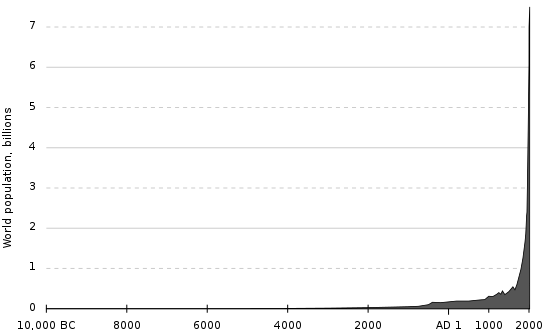
Hans Rosling has a documentary about it, check it out via Google, it's on youtube of vimeo or something. It's not so much that overpopulation isn't an issue, of course it is (that's why it's called 'over' population), but rather that the trend line is that population growth is very rapidly slowing, that people tend to overestimate population growth, are unaware of big population centres that are shrinking, that the average worldwide children per woman rate is < 2.5 (used to be > 5 just 50 years ago) and that population will likely decline after we add a few billion more. That's not to say that it isn't an issue, but traditionally we held some really weird views about overpopulation. Basically we looked at this graph: https://upload.wikimedia.org/wikipedia/commons/thumb/b/b7/Po... and extrapolated the exponential growth, and ended up with scenarios of doom, war etc. Food shortages for example are consistently predicted, but food production growth has outstripped population growth substantially and food security is better than any time in the past (yet far from perfect). Obviously there are huge sustainability concerns, but the biggest source is our level of consumption levels and patterns, not our population numbers, which comes in second. |
Numbers of fanatically religious people will double, relatively speaking. Mostly Catholics and Muslims. This is under the assumption that the current rates of conversions remain roughly the same. Trouble is, people turn atheist, don't have kids, and die out, the number of atheists we have today is a historical anomaly resulting from the baby boom. In other words, that effect will stop. This likely will have policy implications.
People in cities are growing FAR slower than people in rural settings. That means that it isn't just atheists that will drop, but everything you associate with city living will lessen. Most city populations are essentially replaced with fresh people from rural settings every 60 years or so (meaning that the number of new rural people in the city at year+60 is larger than the number of people in the city).
Numbers of black people and asian people (not Chinese) will grow a hell of a lot more than the other groups. Africa should have 3-4 times more people than today at least before it stabilizes. Same goes for some countries in Asia. This of course also means that Europe is going to look back to today's Syrian "refugee crisis" and wonder why people were worried about a mere 1 million people per year.
Truth of the matter is that there isn't much any political movement in either Europe or America can do. So it doesn't even really matter.