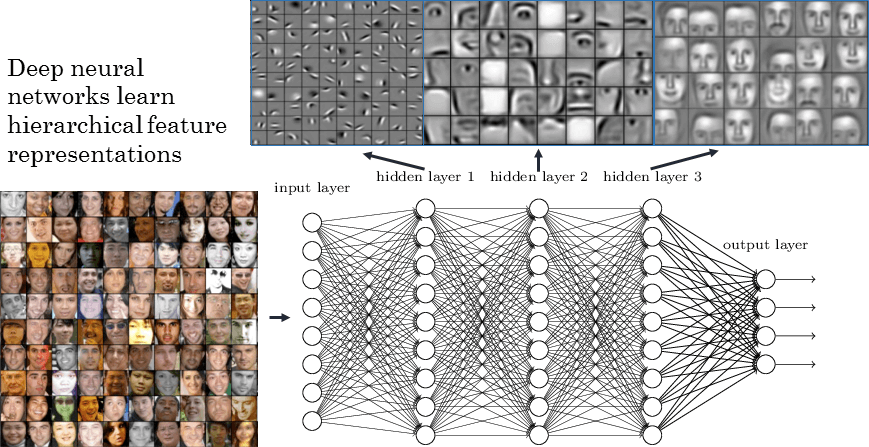
1) The evidence is that when you for instance visualize the features learned in the layers of a deep convolutional neural net, you'll see that these correspond to layers of abstraction, with each layer's features building upon concepts from the previous layer(s). I found an image [0] (on a site [1]) that illustrates it nicely.
2) Deep learning is really a term that denotes machine learning using models that attempt to abstract the data via multiple layers (popularly in artificial neural networks). Not all deep neural nets are unsupervised, but unsupervised pre-training [2] was an approach that was [3] very popular until dropout [4,5] (and its variations) appeared.
See, for instance, some of the standard datasets [6] of the field, on some of which deep neural nets achieved state of the art accuracy using supervised learning.