Hacker News new | ask | show | jobs
by TeMPOraL 3922 days ago
5-7 day battery life and always-on, e-paper-like color screen. This enables you to use Pebble as an actual watch, or in general as an information radiator - you don't have to interact with it in any way to see the data you need; you just have to look at it. They had these features (sans color) before Apple Watch / Android Wear even existed!

What personally made me buy Pebble over Android Wear / Apple Watch was not point-by-point spec comparison though, but the apparent philosophy of the company since day one. They went with practical (always on e-paper screen instead of touch) and hackable (Pebble is programmed in C, no stacks of Java bloat, no licenses to buy). From the beginning, they were giving off the utilitarian vibe, as opposed to the later Apple's strategy of building an expensive toy. It's a difference of mindsets.

Or at least it was, given that Pebble seems slowly going towards the mainstream.

2 comments

> 5-7 day battery life and always-on, e-paper-like color screen. This enables you to use Pebble as an actual watch

I'm not sure why the "always-on" aspect is an advantage. The Apple Watch display turns on when I raise my wrist to look at it. Always-on seems more like a vanity feature than actually useful. If you aren't looking at it, it serves no purpose to be on.

The battery life has never been a problem for me. I put the watch on it's charger when I get in bed, and take it off when I wake up. I don't think I've ever hit < 40% battery at the end of the day.

> Apple's strategy of building an expensive toy.

I don't believe that is the intention at all. I think Apple is trying to create a truly useful device, with a much broader scope than Pebble. Personally, the Apple Watch has been very useful for me. I would be very unhappy if I had to give it up. My Apple Watch watch feels significantly more utilitarian than my phone.

I also think you're underselling the fitness aspect. I've been much more active since I got my Apple Watch. The importance of physical activity is hard to understate.

Also, I visited my doctor recently and she was a bit worried that my pulse was high. I showed her the graph of my pulse over the last week, and she was no longer worried. In the future, when we can measure thinks like blood pressure and blood glucose, it will significantly improve people's health. That's clearly where Apple is headed.

I love Pebble as a company and I think they make a really great product. However, it's wrong to say the Apple Watch is nothing more than a toy. It's already had a decent impact on my life, and I think that impact will be exponentially larger in a few short years.

> The Apple Watch display turns on when I raise my wrist to look at it

This is one of those features that has to be 100% perfect for it to work in this form factor, and based on my colleagues Apple Watch (base model), that is not the case. In addition, I don't always turn my wrist to see my Pebble -- I don't need to. This is a small feature but saying its not actually useful is absolutely ridiculous in my opinion.

> This is one of those features that has to be 100% perfect for it to work in this form factor

As an Apple Watch owner, I can state that this is not the case for me, and thus it clearly doesn't have to be 100% perfect. Might it frustrate some people? Sure.

The tradeoff is that my watch can do many more useful things than the Pebble. The additional features are significantly more valuable to me than multiple day battery life and an always-on screen.

> This is a small feature but saying its not actually useful is absolutely ridiculous in my opinion.

I think we have different definitions of "absolutely ridiculous".

I'm curious, what features do you use in a smartwatch that require a high-refresh screen?
It works for me, except for when I am cycling and want to look at the time.
> The Apple Watch display turns on when I raise my wrist to look at it. Always-on seems more like a vanity feature than actually useful. If you aren't looking at it, it serves no purpose to be on.

Yeah... if you are wearing it. When I'm at my computer I don't like wearing a watch. So I take it off and place it next to my laptop (hate the band rubbing the desk/keyboard). In that scenario, always on is useful. Also when biking or motorcycling (especially far) I mount it to my bars because I like to be able to see it, again, not wearing it on my wrist. When biking (I bike a lot), the fitness function of an apple watch is <4 hrs. I take longer bike rides that that, so battery life is key.

> I put the watch on it's charger when I get in bed, and take it off when I wake up

yes... but if you don't have to do that for a week, it's much better. Just because you are willing to charge it daily doesn't mean it's acceptable.

All that said.... as an overall Apple fan and fitness fanatic, I would love an apple watch, if and only if, it allowed me to get 5+ hrs of fitness tracking WITHOUT bringing my phone along (so it needs GPS). So alas, I'll hang on to my Garmin which gets 24 hours of continuous GPS recording + my original Pebble until Apple Watch 2.

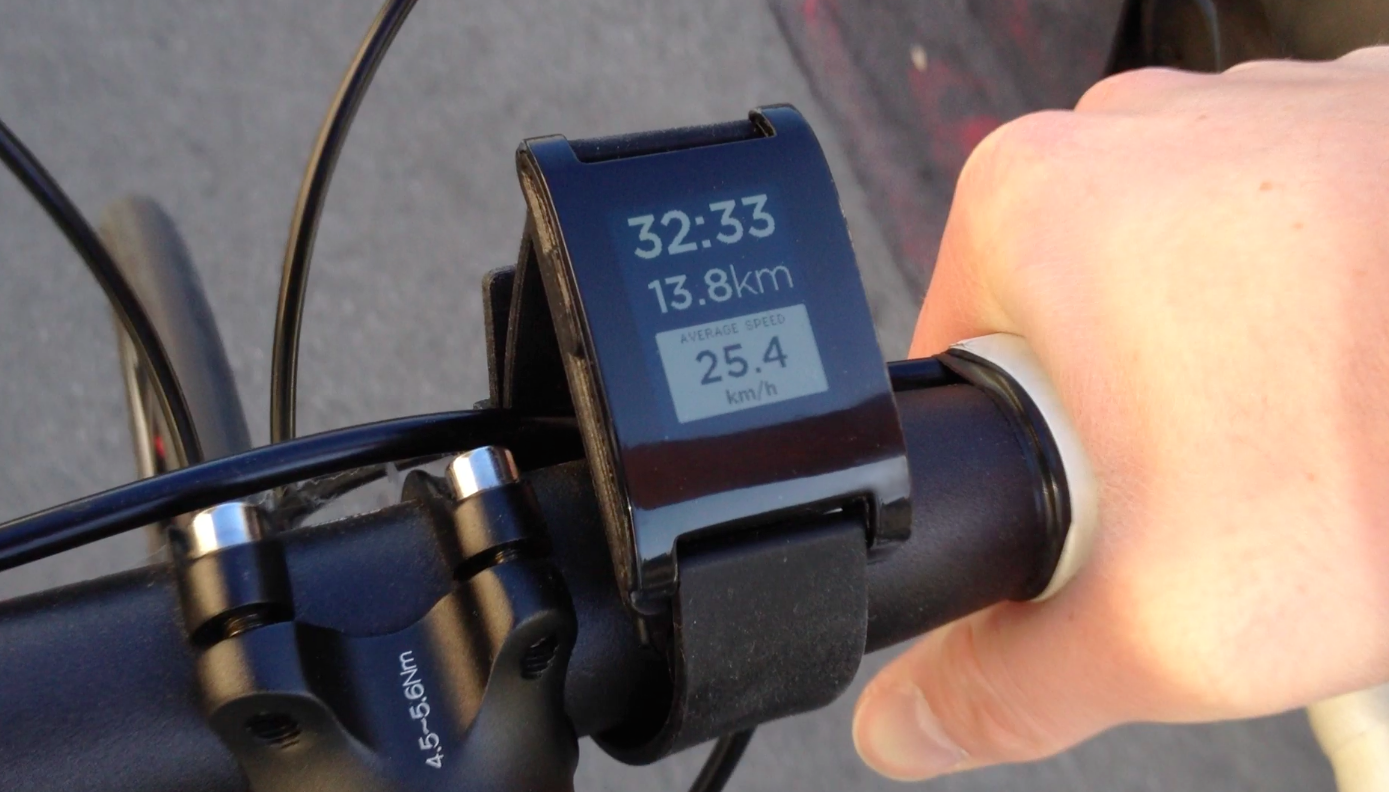
And to elaborate on the bike mount use, it's not just for "I want a clock on my handlebars." Paired with the GPS in your phone, you can use a Pebble as a bike computer, providing information like speed, distance, and elevation change.

The battery life and daylight visible / always on screen are requirements for this.

https://upload.wikimedia.org/wikipedia/commons/7/78/Pebble_w...

I think you're misinterpreting my original post. It's not a shot at the Pebble, or any other device. It's an argument that the Apple Watch is not a toy, and is actually quite useful day to day for many people. It was an argument against a generalization, not an argument for one.
> The battery life has never been a problem for me. I put the watch on it's charger when I get in bed, and take it off when I wake up. I don't think I've ever hit < 40% battery at the end of the day.

Compare that with my use case, where I wear my watch all the time and use it for sleep tracking, yet still I only need to charge it once every five days.

As for always-on, it makes the watch low profile. Depending on watch face it can actually fool people that it is a normal watch. I had a co-worker noticing after a month despite wearing it every day (when I received a message) that it is a smart watch.

P.S. Apologies but your comment about the pulse reminded me this: https://youtu.be/00V7NW2_nSg

>The battery life has never been a problem for me. I put the watch on it's charger when I get in bed, and take it off when I wake up. I don't think I've ever hit < 40% battery at the end of the day.

as a comparison, I can take my pebble to a very long weekend and not bring the cable and still be fine. The battery lasts 5 days in pretty normal circumstances

> The Apple Watch display turns on when I raise my wrist to look at it. Always-on seems more like a vanity feature than actually useful. If you aren't looking at it, it serves no purpose to be on.

There are lots of cases when you want to glance at your watch without doing an explicit, lively motion with your hand. For instance, as I'm typing this comment, I can look at my Pebble without moving the wrist. When a notification comes, I can read it without doing anything but moving my eyes downward. Since I spend 8+ hours every day in front of one computer or another, it's extremely valuable. Similarly, it applies when you're e.g. carrying things, or doing chores.

> I also think you're underselling the fitness aspect. I've been much more active since I got my Apple Watch. The importance of physical activity is hard to understate.

Probably. I admit I might be a bit biased against sports and fitness, for various hard-to-untangle reasons :).

> Also, I visited my doctor recently and she was a bit worried that my pulse was high. I showed her the graph of my pulse over the last week, and she was no longer worried. In the future, when we can measure thinks like blood pressure and blood glucose, it will significantly improve people's health. That's clearly where Apple is headed.

That's a great use of such technology, I admit. You communicated with a specialist and used your data to your advantage. That's how it should work. But generally, it doesn't. I dislike the whole quantified self movement (and fitness-oriented smartwatches are a part of it) for generally being a cargo-cult field. What you usually get is a device that measures something and puts the data in a completely unneccessary (but required to monetize you) cloud app, which then happily displays you some shiny graphs. The prettier the graphs the better thing sells, even though they're often pretty much useless. You can't export your data, you can't study your data, you just have some graphs. You're supposed to look at them and say "oooh, cool!".

There's a broader point here that applies both to QS enthusiasts and dashboard designers and people working on IoT - graphs are means, not an end. They exist only to improve user's decision-making process. Different graphs help with different questions, so it's important to allow users to manipulate the data presentation, and even more important to teach them the right questions to ask.

We have a technology that could really enable people to live smarter, healthier and better, and instead of that we're being fed shiny trinkets that monetize your data and lock it in so you can't use it for your advantage.

> 5-7 day battery life and always-on, e-paper-like color screen

When Pebble was the "InPulse" watch for BlackBerry phones it had none of these things. This feature set is relatively new compared to how long they've been working on watches. The InPulse watch was a lot closer to the feature set of current Android/iOS watches (including the terrible battery life).