Please don't make it intuitive, I know everybody says it should be but that assumes that all software is made to please the casual user. The best software is made to please the expert user, and makes them many times more powerful that the average user.
Why can't powerful features be done in an intuitive fashion? Smart UI design will allow for that. The more typical argument is one of simplicity versus functionality. But if you choose functionality, why not put in the effort to make the features as easy to use as possible?
The expert user was a casual or novice user once too...
If I find something unintuitive, then I will avoid using it. If I find something intuitive, then, provided its s\for a task I need to do, I willo use it and become an "expert user". I think software needs to be intuitive (or, more importantly, intuitive to the target user), yet still cater for the expert power user by providing shortcuts/macros/scripts/keyboard commands/advanced features etc.
I'm not a UI expert and definitely need to improve things with my site, but I've found that most non-tech users can't be bothered to do much of anything that requires a little thought. If you're not spoon feeding it to them, they don't want it. This is why drag and drop website creation is so successful.
I find this argument completely incorrect...
Was Google made for expert users? Were ipods made for expert users?
Providing an interface which allows users to accomplish a complex task and in the process users know what they are doing is the essence of the whole ui.
My project advisor once gave me a piece of advice that changed everything I've written since for the better. After apologizing for the forthcoming crudeness, she passed on this gem:
You're writing "Mary was fucked by John." You /should/ be writing "John fucked Mary."
I can say what I need to say in half the words now.
Somewhere along the line I learned that you make science writing objective by using the passive voice. I would draft "I analysed the data and found that murder causes death." Then I re-wrote mechanically to "The data was analysed and it was found that murder causes death."
Such a waste! I should have dropped myself from the story but stuck with the active voice and written "The data show that murder causes death." Notice the jarring effect of such forthright prose. Do the data really show that murder causes death? Atleast the writing lives up to the ideal of scientific objectivity: the focus is on what the data do or do not show.
I know you're trying to be correct but using data in this way is annoying - "the data shows", not because it is necessarily right (it depends) but because it sounds right. If it helps then just consider data the singular noun for a block of information.
"The data shows murder causes death" sounds fine to me, nothing jarring about that except that it's probably not true "the data shows murder is a cause of death" (murder doesn't cause all deaths usually depending on the locus).
Are you making the claim that the word "data" is singular? It's not. And when you use a collective noun, you use the singular form (datum, in this case).
Along this line, though, what does sound jarring to me is the recent trend among the tech lit (and maybe others) to use company names as plural, as in, "Microsoft are keeping quiet about their new product." This is totally non-standard. First of all, Microsoft is a singular entity, identified by its articles of incorporation. What these authors are doing is using a lazy shorthand for, "Members of Microsoft management are keeping quiet about their new product."
To pile on the pedantry: "data" is one of those words that can be used in either a singular or plural construction. The OED has references going as far back as this one, from 1807:
W. IRVING Salmag. xviii. 366 My grandfather..took a data from his own excellent heart.
I agree that it's a tough game to standardize usage, especially when different "experts" don't agree (I would guess that you could find writing by other authors circa 1807 that used "data" as a plural). Currently, you find the use of "gender" confused with the use of "sex." Over time "gender" will probably come be used generally for male/female, and sex for reproductive references. But the first such uses were non-standard.
Perhaps it's best to leave it at, "know your audience."
Strunk & White devote a lot of time to misrepresenting grammar and presenting rules that don't mean much. Both of these distract an author from writing with irrelevant questions of passive voices and adjectives.
The problem with The Elements of Style is that White flagrantly, persistently and delightfully violates his own rules. Given that his writing is unfailingly charming and enjoyable to read, I have to wonder about value of those rules.
The Elements of Style (which I personally dislike) isn't written for professional writers, it's written for non-professionals.
In today's culture people are barely capable of writing a sentence without losing half the vowels along the way, and god forbid you're American because you already lost half your U's before you were even born. Forget about adequate grammar, or even half-decent spelling.
White is a professional writers, and with everything there's one key thing to being talented and that's knowing when to break the rules. Breaking the rules when you know what you're doing can be amazing and produce awe-inspiring works, however breaking the rules because you're too ignorant to know they even exist certainly doesn't make you amazing and the only awe you'll inspire is stupidity.
The rules are very valuable, but any half-decent writer has already figured out the rules merely by reading.
> Btw, any piece about spelling contains at least one spelling error, yours is no exception ;)
I know! It's the irony of the world. No matter what, when you complain about a general lack of spelling there is always a spelling mistake, but you won't notice it until 5 hours later. It's like there's a frigging anti-spelling Nazi out there who hijacks your post just to screw with you.
God damn gremlins always plaguing English people :(
I constantly have the opposite problem -- for some reason freetards just luurve en_GB. If you really want superfluously coloured language, set your locale!
As someone mired in academia, I absolutely love that piece by Orwell. It's a good reminder that the writing I'm surrounded by isn't the type of writing I should emulate.
I keep a folder in my bookmarks of writing tips that I think are insightful. Here are a few:
Repost but Elizabeth Gilbert wrote the best treatise on writing (and by extension, creative expression) I think I've ever read. Here are some excerpts - I believe its worthwile reading the entire essay many times:
"I often hear people say, 'I’m not good enough yet to be published.' That’s quite possible. Probable, even. All I’m saying is: Let someone else decide that. Magazines, editors, agents. They all employ young people making $22,000 a year whose job it is to read through piles of manuscripts and send you back letters telling you that you aren’t good enough yet: LET THEM DO IT. Don’t pre-reject yourself. That’s their job, not yours. Your job is only to write your heart out, and let destiny take care of the rest."
"There are heaps of books out there on How To Get Published. Often people find the information in these books contradictory. My feeling is -- of COURSE the information is contradictory. Because, frankly, nobody knows anything. Nobody can tell you how to succeed at writing (even if they write a book called 'How To Succeed At Writing') because there is no WAY; there are, instead, many ways. Everyone I know who managed to become a writer did it differently. sometimes radically differently. "
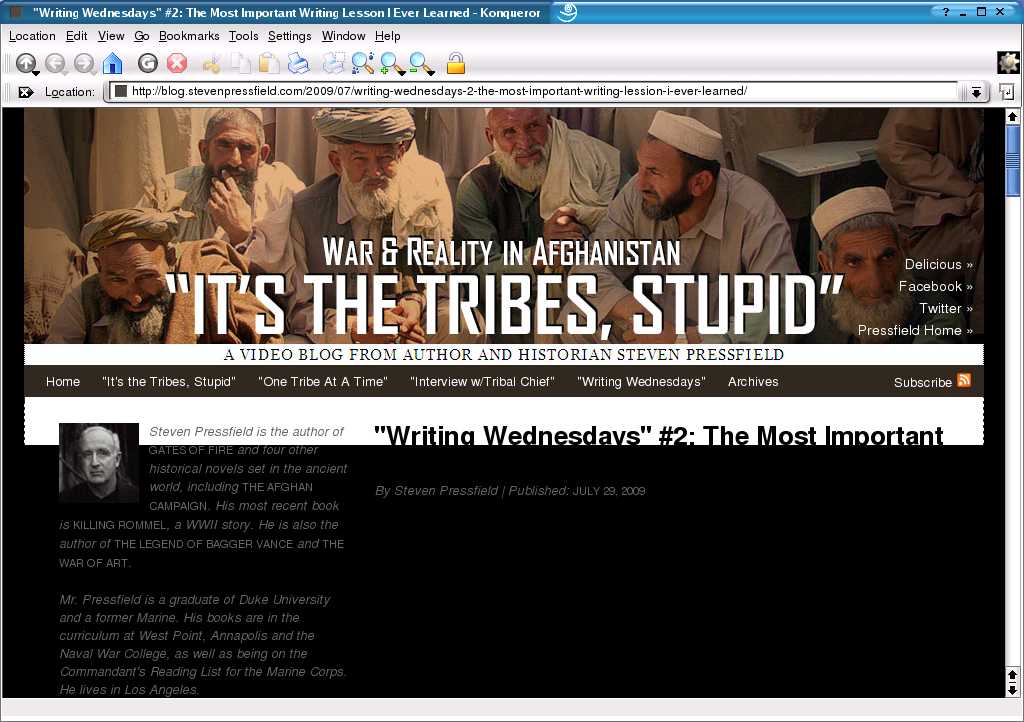
I can read it fine when I highlight the text. And the article is quite good - yes. I've up-mud it.
My point remains.
I'm actually technically fairly competent compared with most of my customers. If either of my companies served a web page like that, half my customers wouldn't be able to read it. Is that my problem?? Or theirs?
It's my problem. If you have a web page, you need to decide where the cut-off is. The author here either doesn't know that his page doesn't render correctly, or doesn't care. Either way, if I were a customer, I'd be less than impressed.
So the question remains: Can your customers read your web page(s)?
(In your specific case, jacquesm, I know the answer is "yes")
Give it another try. Sometimes loading a page doesn't work and refreshing fixes it.
Also: With all respect, supporting Konqueror is really stretching support. It's got practically no market share, and isn't even the most popular Linux browser. I'm surprised it isn't working, though: I thought it ran WebKit, and so wouldn't mess up.
I agree that it's infeasible to support all browsers, and mine, in particular, is almost certainly not worth supporting. In most other circumstances I wouldn't bother to say anything, but here I thought the observation was worth making.
Not everyone sees your web site the way you do. How do you check/test?
We have lots of browsers on hand in virtual machines, every major change gets tested in everything we can lay our hands on, we also ask our users to report problems through the help desk, and we work with them to get rid of bugs.
As for having every browser work with your site, sorry but that isn't always possible. There are finite resources for everything, and if you insist on using an out-of-the-ordinary setup with a miniscule portion of the users then you must surely agree that the minor discomforts of that are of your own choosing. Just like, for instance I will not support IE3, IE4 or Netscape 1.2 (and a whole host of other browsers that have met their end-of-life long ago) any more.
I've been a long time user of Konqueror myself, but right now I wouldn't know of any real good reason to continue to use it, Mozilla/FF/Iceweasel or whatever it wants to be called is available just about everywhere for the price of a free download.
Even Opera has a huge following compared to Konqueror, which is now below 0.08%, in spite of being the 'default' browser on a whole bunch of linux distros.
Chances are you're one of very few people that has ever tried to load that page using Konqueror, and chances are that the problem lies in (your old version of) Konqueror, especially since a newer one displays the page correctly.
If that's a reply to me, I'm not sure I understand you. The page does not render in a readable fashion in my (only slightly) elderly browser. I'm not sure what that has to do with email.
Have I missed your point? Could you expand on it a little? Thanks.
"The Most Important Programming Lesson I Ever Learned"
Nobody wants to run your shit.
Make it simple. Make it easy. Make it fun (to the extent that you can). Make it intuitive. Make it do exactly what needs to be done.
Your user is too busy for anything else.