2. Everything the Apple IIe did, the C64 did better. Better games, better high res graphics modes, dramatically better sound, and more software (because it was cheap, it sold more units, bigger market share, more third party applications).
Bonus reason: The case was a third the size of the Apple IIe, making it much easier to haul over to friends houses.
Based on your description of the Apple IIe, the Sinclair ZX Spectrum was better still. Better high res graphics, similar sound capabilities (on the 128k model) and more software (at least in the UK).
Bonus reason: The spectrum was a fraction of the size of an AppleIIe, about the size of a small book. But the rubber keys did suck.
As I recall it, the 128k model of Spectrum didn't launch until the 8-bit era was coming to a close and 16 bit boxes had been out for a few years. The first-gen Spectrum was horrid (1k, worse than chiclet keyboard), though the second gen was acceptable (but not comparable to either of the 64 k machines in question). One could buy a C128D or an Apple IIc by the time the 128k Speccy existed, and those machines were at least comparable, and the Amige and Apple IIgs (or Macintosh) would blow the Speccy away.
Not saying Spectrums weren't awesome (I don't really know; the only one I ever owned was that 1k first-gen model with a 16k expansion; it was miserable), just that you kinda have to compare Apples to...umm...not Apples.
And, of course, the C64 is the bestselling personal computer of all time.
(I should admit that you're arguing with an 11 year old SwellJoe here...I loved my C64. And, crazy as it sounds, I also bought some C64s on eBay over the past few months for use in composing chiptunes. Thus, evidence indicates I might be mentally unstable with regard to the C64. Backing away slowly might be the best option.)
Actually, what I owned was a Timex Sinclair 1000, which was a rebranded ZX-81. Apologies for the confusion. The rest of the Sinclair Spectrum line never made it to the states, as far as I know...so my knowledge is limited to what I read in magazines back then, and what I've read on the net since then.
I think he may have been thinking of the ZX-80, precursor to the spectrum. I recall reading a review of it many years ago - it came in kit form, and was a really primitive machine.
One interesting thing about C64 vs Spectrum is the C64 had a thriving 'warez' scene. For instance, there were tons of packers (eg, like a ZIP file) on the C64 (to save disk and tape space), and literally none on the Spectrum!
C64 had better graphics modes available. It had higher resolution and better color availability (same number of colors, but the C64 could use more of them in a smaller area). The C64 had quite powerful, for the time, dedicated chips for sound and video, including providing hardware sprites, which took a lot of load off of the processor (a very similar CPU was in both the Apple and C64), so the C64 could do more on screen at once.
Also, because of the popularity of the platform, developers knew it really well, and were able to utilize tricks to occasionally go above and beyond expectations (for example, it's possible to get a lot more than 16 colors out of the C64, particular in still images). These undocumented modes and techniques became pretty common knowledge through the several magazines that covered the platform, and through various demo/warez scene channels (like bulletin boards).
Built-in BASIC. That was key for me. No need to find the disks or install anything. You could be up and messing around with a small program within a minute.
"A personal computer (PC) is any general-purpose computer whose size, capabilities, and original sales price make it useful for individuals, and which is intended to be operated directly by an end user, with no intervening computer operator." (Wikipedia)
It's the fascinating history of branding. Apple invented the PC, but they poured their energy into selling the brand Apple rather than the term PC. IBM then came along with a machine called "the IBM PC", which sold a lot of units and was the subject of a lot of marketing. With the word PC as the actual name of the machine, the tendency to associate that term exclusively with IBM machines began.
(As I recall, the generic term for a non-IBM PC tended to be "microcomputer" or "micro" rather than "PC".)
That trend then leapt forward when Compaq started making PC clones. The clonemakers needed a word for what they were making. There was a time when you could call them "IBM compatibles", "PC compatibles", or "PC clones", but once IBM switched to PS/2 and OS/2 -- and proceeded to fade from dominance -- continuing to associate the word IBM with these things made little sense. Meanwhile, Apple wasn't trying to contest the term PC... instead they invented their own exclusive brand name, Macintosh, and sold the hell out of that.
So in the end the word PC ended up meaning a generic Intel box that runs Microsoft Windows or Linux.
Nobody bought the IBM PC because it was called a "PC". They bought it because it was IBM, and in the 1980s there was a saying: "Nobody ever lost their job buying IBM".
Yes, that's right. What I'm saying is that IBM successfully sold the term "IBM PC" because it contained the magic letters I-B-M. But then the magic slowly spread to the other half of the phrase IBM PC, to the point where PC eventually became synonymous with IBM.
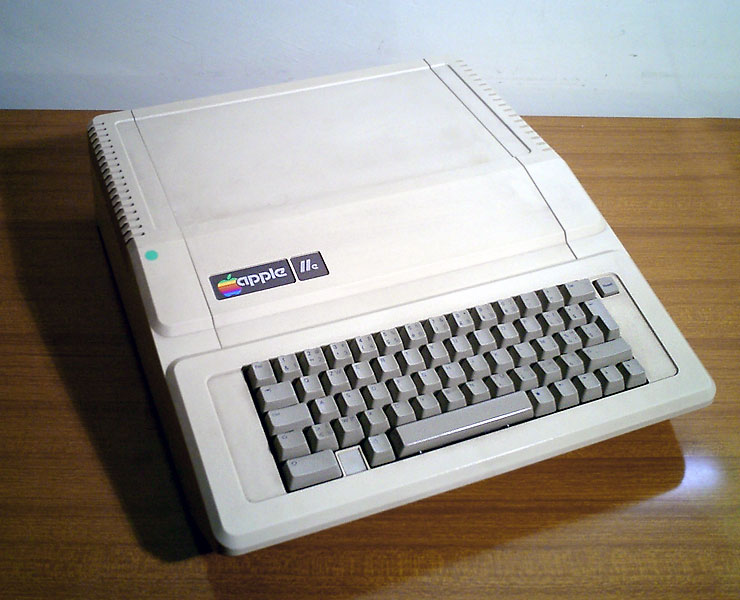
1. Us poor folks could afford one.
2. Everything the Apple IIe did, the C64 did better. Better games, better high res graphics modes, dramatically better sound, and more software (because it was cheap, it sold more units, bigger market share, more third party applications).
Bonus reason: The case was a third the size of the Apple IIe, making it much easier to haul over to friends houses.