We might as well drop the whole ?G classification. Since the US carriers started branding stuff 4G that wasn't anywhere close to spec its been a free for all.
Marketing aside, the tech might have merit in its own right though. I think the Ka band isn't available for use in my country though...
4G actually means something, it's just not enforceable. The trouble is, the trademark was not acquired in time before it became a "generic term" which means anyone can call anything 4G.
>4G actually means something, it's just not enforceable.
So? Its still entirely dead. More than that...they falsely claimed 4G and made millions off it. Yes its still means something from a technical point of view, but the concept in its true form is dead to the world - though very profitable.
>the trademark was not acquired in time
How do you propose trademarking a two character term that refers to a multiple of the gravitational constant? (It doesn't but in a courtroom many things are possible...)
Trademarks are registered for specific classes of goods and services, and don't apply outside of that class. That's why Apple could have a computer called a Macintosh even though McIntosh was already a registered trademark for a kind of apple. Also why they could use the term "Apple" without infringing the Apple Corps record group's trademark - until they started selling iPods.
Not to judge the Americans too harshly, but it seems to invariably be American companies who spin this bullsht. In other countries the carriers at least have the decency to call it LTE (with 4G sometimes mentioned in brackets).
As for the article linked - I wouldn't even call that "fooled by". That implies that there was a plausible case & the journalist was deceived via some active plot. If the reporter had done even vague research as to what 4G is (the topic of his article [lol]) then he/she would have smelled a rat. That to me is a straight up failure as a journalist, rather than "fooled by".
Your point is correct but I was actually speaking more broadly. Specifically, there is a friend of mine who has 3 CCIE certifications and actually works at Cisco. He knows more about wired and wireless networks than anyone I know. But his wife's iPhone 4s with AT&T showed a "4G" signal when it was connected so he just assumed it was legitimate 4G.
Data cap's are indirectly related to transmission speeds so you may always be able to burn though the data cap in under 10 seconds, but competition will still slowly raise the cap as technology improves.
IMO, the current 2+GB caps are not that bad, raise that to 20GB and you can watch a fair amount of hulu for example (~50+hours) without a problem.
competition will still slowly raise the cap as technology improves.
Has not been my experience at all here in Sweden. Data caps have been lowered across the board over the past year as data speeds and availability has improved.
That's been my experience in the US as well. On EDGE/EVDO or even early days of 3G, unlimited plans were extremely common and fairly cheap. When 3G became more established and 4G/LTE started rolling out, 2GB is now the normal with massive increases in prices as you add more ($10/GB is common).
My 3100mAh Galaxy Note II has 4G, and the battery life is noticeably worse than my old 1200mAh iPhone 3G.
Battery tech has long been one of the biggest limiting factors in mobile tech, and I'm not quite sure that advances in energy density are moving as quickly as everything else. Which means I think that batteries are slowly lasting less long as energy usage of new features consistently outstrips improvements in the tech.
Remember when phones used to last a week or a month? Now we're lucky to get a day, day and a half.
Brilliantly put. I see some tech bloggers go through "specs" of speed, only to forget the data cap. If money is not an issue, then maybe, but most people usage over the cap will truly bite.
I thought 28 GHz signals would be stopped by relatively small obstacles (thin walls). It's not a matter of detection; the signal is absorbed and there is none left to detect on the other side. How could they overcome this with an antenna array?
Edit: According to https://en.wikipedia.org/wiki/Ka_band this band is used for satellite communications, but it very susceptible to attenuation in rain. So it's very cool that a new antenna tech could improve on satellite downlinks, but it still doesn't seem practical for a cell phone.
Absorption is directly correlated with frequency, yes. Their 2km mile is probably a lab condition free-space number which will never even come close to being reached in the real world, especially in urban areas.
This could be useful to a telecom if they implement an expensive design that uses obstructions to their advantage. Essentially blast the radio waves down streets as if they are isolated tunnels. That would reduce interference to almost nothing, but require many more access points than they currently have. They would also still have the problem of penetration indoors.
With HSDPA and 4G a lot of people are using it to replace their home internet (not so much in the US, but elsewhere it's a big thing). Hence the current capacity crunch mentioned in the article
All these faster speeds won't do anything really for heavily populated areas. The most important thing is total available bandwidth (bytes/sec/hz), and it's unclear how better that will get. LTE itself doesn't improve a lot over 3G techniques, the thing that's making LTE faster in saturated conditions right now is that there's just more bandwidth compared to 3G.
> "In my opinion 4G achieves a decent speed and what we need to do is crack the capacity crunch we are facing."
Translation: "The theoretical numbers we sold LTE with are a good target, maybe this technology lets us deliver that in the real world to all the users who want it."
From what I can tell, this technology isn't about making spectrum more efficient, but opening up new parts of the spectrum (10+GHz) that weren't usable before. edit: nice map of radio spectrum. Being able to use 28GHz seems like a massive leap. http://www.telecomcircle.com/wp-content/uploads/2009/11/Spec...
Well, if you read the article, it's not actually a Samsung thing. This is university research that was partially funded by a grant from Samsung among others.

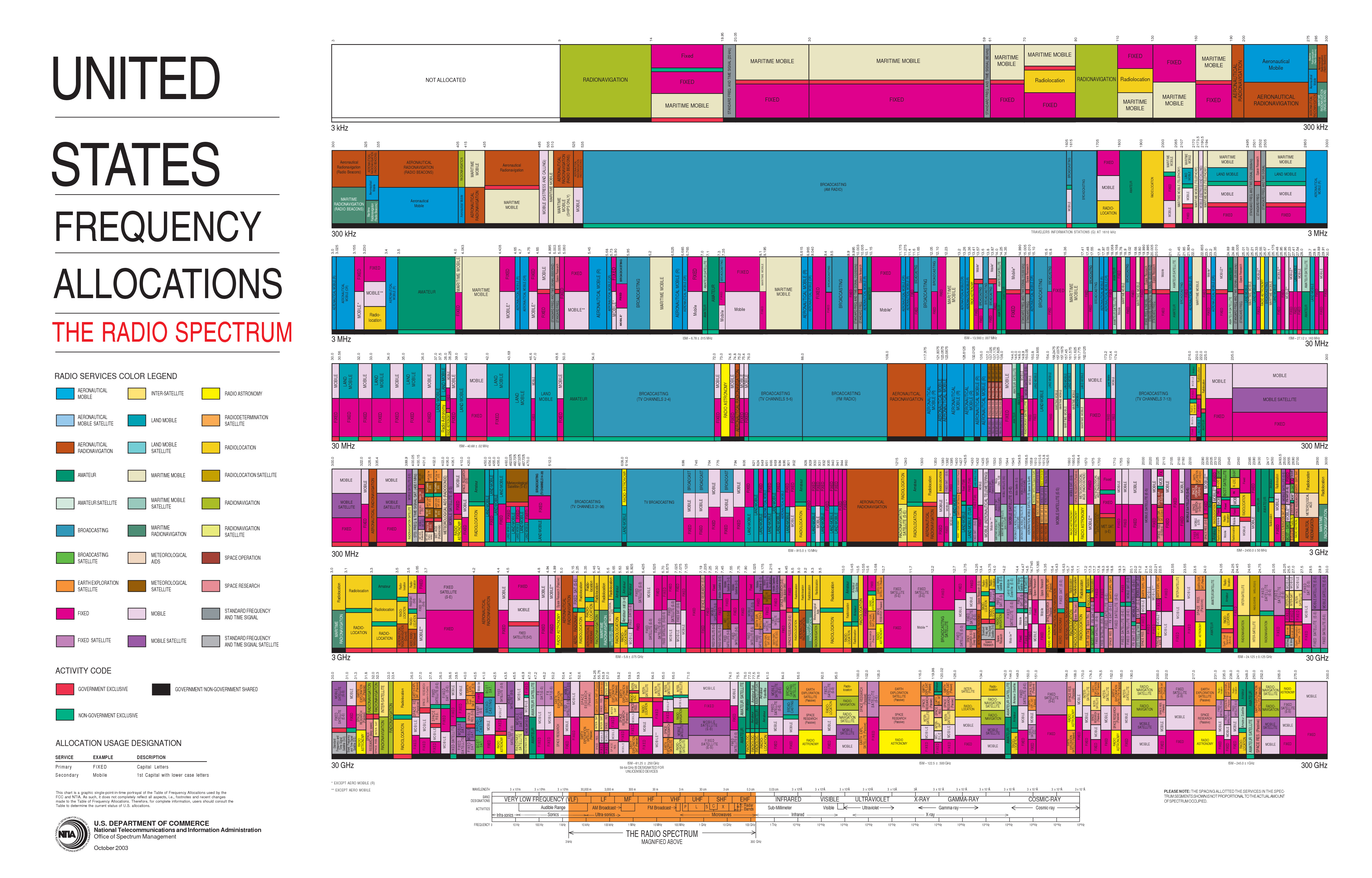
Marketing aside, the tech might have merit in its own right though. I think the Ka band isn't available for use in my country though...