The rebound effect he's decrying is a lot like a slippery slope argument. As things get cheaper you make more of them, which can counter-intuitively lead to more total spending on them. But this can't go on forever, almost nothing has unlimited demand even at zero cost.
“Techno-fixes” alone are unlikely to reduce our impact.
This later part of the document ignores the potentially for decoupling of energy use from economic output that he mentions earlier in the argument. The potential for true decoupling is the reason techno-fixes are so compelling, and there is a history of real progress here. For example, in places with sanitary plumbing, unlimited population density can be reached without corresponding increases of the chances of dying of cholera: this environmental problem has not just been mitigated but eliminated.
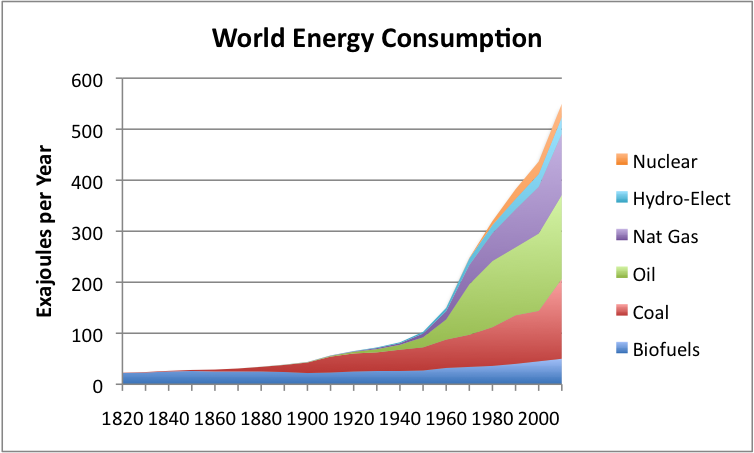
Thanks very much for the ideas. Well, you're right that the demand for resources isn't infinite, but it's certainly been growing exponentially, and it's already big enough to produce a host of negative side effects. All in all it's a very long way from total resource use reducing due to successful decoupling, even as efficiency has increased. Take energy for instance. http://gailtheactuary.files.wordpress.com/2012/03/world-ener...
I'm not trying to attack the goal of decoupling or the means of techno-fixes. I'm a fan of technology. I'm saying that on their own, techno-fixes are insufficient to deliver reduction in overall resource use.
The sanitation example you mention is interesting. I'm not sure land as a resource works in nearly the same way as resources flowing through the economy like energy, water, metals etc. I'll have to consult an economist.