These brokers usually don't pay the bulk sum - they sell access to nation actors and you get payed out over time as long as the bug is not patched to discourage reselling and burning it. I doubt anyone would confirm if they got the full payment or not for something similar.
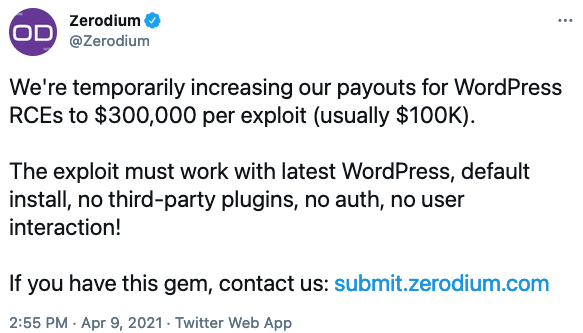
I work in the field and I just cannot believe anyone would pay that much for a Word Press exploit. People pay money for iOS or Android because there is valuable information stored on devices running those operating systems. There's absolutely nothing of value on any Word Press site. The only possible reason I can think of is for a watering hole attack, but that would require a second exploit that would be worth far more (and they aren't).
I currently work for a federal contractor including the DoD as their customer, using Wordpress as their main website. You would think there’s no sensitive information there, but some times all it takes is enough information about someone and their team to impersonate that person and gain access to an email thread, file sharing system or even an access card to a building. Never underestimate incompetence.
bink is correct. The people who buy exploits are governments. There is very little interest in Wordpress or indeed any target that isn't a browser or a mobile. Browsers and mobiles are the only things that are perennially useful to an intelligence agency. Those two are reliable access vectors for the vast majority of things that interest government organisations.
I'd disagree here. Still 41% of all sites use Wordpress [1]... and that means a lot of targets, and a lot of ways to target them. Your good ole' deface/ransomware extortion scheme, leaking data supposed to be confidential (such as account lists), trusted spreaders for exploits, or the latest hit, bets on "prediction markets" that have some Wordpress site set as oracle. People are willing to screw around with airport weather stations to manipulate bets [2], it's not that much of a stretch to assume such incentives would also apply for website hackers.
There’s a server running behind a Wordpress site. If you have RCE, you can run whatever arbitrary code you like there - mine crypto, run a botnet, all sorts of fun and profitable stuff. Hey, you can even make the site make the site’s users your unwitting hosts, too. You don’t go hack a Wordpress site, you go grab a few hundred thousand of them and do industrial scale crimes.
> There's absolutely nothing of value on any Word Press site
This is just 100% an incorrect assumption. Even just an e-commerce site running Woo has troves of potentially valuable customer data. Not to mention whatever else might be on the server, or what that server is connected to...
How long do you figure a criminal reputation typically needs/wants to last? I have always been skeptical of “black market credit ratings”. If you happen to build one up, it’s likely only in order to rip someone off at a higher price and cash in the value of it. It’s not like you’ll need that good rep for your retirement.
ShinyHunters has been "in business" since 2019 and it is their reputation that resulted in eg. Canvas paying their ransom this year. Without that reputation, it is unlikely a large-scale ransom would have been paid, because the reputation is what gives them credibility that paying the ransom will actually result in the promise being upheld.
What do you think the venn diagram looks like for people willing and able to find things like that prior to LLMs and also sell them to a broker, and are also stupid enough to flaunt a massive flashing "arrest me!!!" sign
Closest you're going to get is something like those kids in florida who just got wrapped for putting malware into steam games and draining peoples accounts. They were going to get caught anyways but it would have taken a lot longer to build a case against them if they weren't flaunting it on socials
Pre-1990s Macs (Mac Plus, SE, etc.) in good condition are actually worth a decent amount nowadays as collectors items. Not $5000, but quite a bit more than $25.
I actually found a 1999 iMac set out for a special rubbish pick up day. The owner of the house was there so I chatted a bit, asked her if she minded if I took it.
It had last been booted on it, complete with working hard drive an; MacOS X 10.3. So $1.299 -> $0.
It's just because they don't want to break anything in existing sites, sorta like how Microsoft doesn't generally want to break programs on Windows. So, changes are fairly incremental, and the quality is about what you'd expect from a piece of software that's decades old with no plan for what happens if it got this far.
But what do you do in that situation? If they change the structure too much, then either they make it impossible to upgrade an existing site, or potentially break a whole bunch of things said sites depend on (mostly themes and plugins). And that ease of upgrading is likely what stops a lot of people just migrating away to other solutions.
Even just introducing emulation layers for the old parts and making the new parts opt-in would be better than just giving up and keep on going. Plugin authors can choose the new subsystem as they publish updates or new plugins and themes, and in return they get speed and security guarantees.
And since the WordPress foundation controls the extension marketplace, they can reliably determine which parts of the API surface are in use, or even invest a chunk of money every month to send AI-written patches to plugin maintainers to ease the transition.
There would be so many ways to improve the situation (to the benefit of WordPress maintainers, customers, and ecosystem vendors alike, mind you!), but alas, they are stuck to their ways and will not.
> And since the WordPress foundation controls the extension marketplace, they can reliably determine which parts of the API surface are in use, or even invest a chunk of money every month to send AI-written patches to plugin maintainers to ease the transition.
Fair enough. The way they added Gutenberg was a complete mess. Like yeah, the idea is a good one, and the editor can be pretty good if used correctly. But the way it was built was certainly not ideal, and was probably the worst of all worlds. Felt like someone saw SquareSpace and co, thought WordPress was falling behind and decided to push for those features to be added as quickly and inefficiently as possible.
If the existing at-risk functionality is a security issue I feel like that’s a good time to throw the proverbial flag on the play and make it an issue. Letting consumers play host to malware and phishing portals is the worse move.
Is it? I did a project with WP a very long time ago and was kind of baffled. Like it's nice to have an good rich text editor, I got that part. But the absolute monstrosities people developed to extend WP, when they could have just used MySQL and PHP directly, astounded me. Like I couldn't figure out what WP was offering? It was just like a blog that you could painfully hack into something else if you wanted to. But even at that time there were already loads of great, batteries included PHP frameworks like Symfony or Cake. Why not just skip the painful part and code what you want directly?
Anyway, I probably shouldn't comment as maybe WP has progressed but it doesn't sound like it.
I'm convinced it's by design so that the community that build little businesses around wordpress still stay in the eco system. A client needs new functionality? That's be a week of work because god help anyone who wants to look into themselves.
WordPress is actively degrading the security and quality of the web I general. Has been for many many years.
Everything I've used from Automattic has felt that way. If you ever want to torture an engineer, just make them change the layout of WooCommerce checkout.
As a junior I am glad I happened to start working with PHP on version 7. I had some peeks at our legacy PHP5 stuff (all killed now thankfully) and it looked very different. I am sure it would suck to work with.
I've done it multiple times but no one's gonna use my off the shelf blog when there's a bagilian WordPress plugins they wanna use. But with AI you kinda sorta should just build your own blog. Doctrine with slime framework. You can even throw a WordPress plugin at the LLM and ask it to implement the same thing.
I don't think PHP is a beautiful language. If it was Laravel wouldn't need to rewrite every function from standard library. And, I see no reason to use it compared to Typescript.
I never really understood these complaints about the standard library, that's not what makes a language really. Yes, it's ugly, yes, it carries 30 years of baggage, but it's PHP the language that allows you to interact with a much more convenient abstraction layer provided by Laravel.
PHP can run the same code fully dynamically typed or with very strict type annotations, depending on your requirements. It has runtime reflection APIs that are so cheap that you don't really have to think about using them. You can do OOP or FP with PHP, or even procedural HTML-interleaved-with-PHP if that's your thing. It has late static binding, so you can defer to child classes from their parent class. There are generators and fibres as first-class language constructs now. Property hooks are an extremely clear pattern, way better than in many other languages.
Generally, there have been tons of new syntax extensions over the years, and they all slot in gracefully. With PHP 8.6, we're going to get partial application for functions, which will make PHP 8.5's match expressions one of the most ergonomic implementations I have seen yet!
Ecosystem? The JS/TS ecosystem approach is to use as many libraries as possible for the sake of it, exposing you to a massive supply chain risk. PHP doesn't suffer from that because there are barely any libraries for it.
> PHP doesn't suffer from that because there are barely any libraries for it.
You don't need many libraries in a typical project, because PHP is batteries-included and if you use a framework it does all the rest for you, that is true. But there are still hundreds of thousands of packages with billions of installs:
PHP is a proof that you don't need elegant or good technical solutions to be successful. You can literally pile up slop together and still be successful.
Yeah; the common idea of dignity and self-respect is to replace the duct tape with proper engineering once you're successful though, instead of just taping ever more of it on top and pretending SQL injections aren't really a problem.
What they do is put lipstick on a pig! There is no need to "reduce" the risk of SQL injections when you can use a safe API that eliminates the entire error class. This is a solved problem for the rest of the world!
One usually uses "query builder" pattern for that.
Also, regarding placeholders, historically many DB and frameworks do not support passing lists for a value in a placeholder (like "WHERE id IN(?)") so users of such software fall back to string concatenation.
Not user code, no. Someone eventually has to, but virtually every ORM under the sun allows you to construct dynamic queries without having to concatenate strings yourself or resort to string interpolation.
$results = $wpdb->get_results( "SELECT * FROM {$wpdb->prefix}options WHERE option_id = 1", OBJECT );
> Some of the methods in this class take an SQL statement as input. All untrusted values in an SQL statement must be escaped to prevent SQL injection attacks. Some methods will escape SQL for you; others will not. Check the documentation to be sure before you use any method in this class. For more on SQL escaping in WordPress, see the section entitled Protect Queries Against SQL Injection Attacks below.
It does not however prevent $wpdb users from NOT binding query parameters, which leads to this vulnerability.
It seems that wpdb doesn't support placeholders for comma-separated lists, like in "WHERE id IN (?)". So the developers have to fall back to string concatenation.
A few months back, Cloudflare used AI to make a Rust rewrite of WordPress, but I doubt that they would have found or corrected issues like this on the way?
https://blog.cloudflare.com/emdash-wordpress/
I am so done with FOMO writing. Sure man, you found one with $25. With $25 plus your entire industry domain specific knowledge of where to look, of how to probe, of what else you may have accumulated and collected over the years of working within this industry. Let's stop with the gambling narrative and the illusion that we are all missing out.
The surprising (and possibly untrue) thing is the high price of canned vulnerabilities. WordPress is known as the remote root shell with a blogging feature.
I still don't understand why, for a blog, a static page isn't enough - especially since most of the WordPress issues are "solved" by adding caching.
I do understand it from an user perspective (it's easier to tell the average user to drag and drop rather than committing to a GitHub repo and letting hugo build the website), but from a security standpoint WordPress is really just waiting for a vulnerability (either in the core or on the thousands of plugins) in order to unlock its RCE-as-a-service functionality.
In many deployments, Wordpress started out as just a blog that is easy to edit right from the web browser, but then grew into way more. Most commonly, people end up retrofitting all kinds of e-commerce features onto it, and that's how you really get into the whole plugin mess. At that point, for better or worse, the Wordpress instance is serving important business needs that are not addressed by a static page.
People like having a WYSIWYG editor, being able to update their posts in the browser, having comments and being able to use plugins. They're also not particularly skilled with the terminal/commands, and a lot of hosts provide a one-click install setup for scripts like WordPress.
Like you said. It is a product for people who are not technical and don't code. A product that you would have to use git for, wouldn't be used by the 90 percent in the first place. And there are such products. There is a reason WordPress is the most popular platform. Most people are not technical.
And people like to be able to extend from Blogs to various other non static features which WordPress allows for.
Its so funny… our wordpress started off as simple blogging thing but now is not only using 99% cpu but also no one knows how to edit/deal with all the plugins etc. Wordpress is the worst choice. Always
- Less training; org probably has someone who’s used Wordpress before. (Yes, training. You must deal with the reality of the typical user.)
- In the developing group or agency, anyone can work on the theme if you install a theme builder. An agency can put a cheaper content marketer or designer on it, rather than a developer.
Propably untrue, the only way to know is to do threat intelligence, and inflitrate those telegram groups where these brokers operate, I doubt the writer of the article did that. Maybe he conflated any vulnerability with a 0-day one?
some statistics point to almost 50% of all websites on the internet running on Wordpress, $500k for an undisclosed 0day unauthenticated RCE doesn't seem so unrealistic to me
I've got it at 38.32%. I'm looking at the 'front-door' of the web, active sites, no subdomains, from Crux user experience data.
Will be publishing a report on www.theweb.report soon - if you're interested.
That's a seed of about 13 million domains - pretty sure WordPress would be dominating the even longer tail.
( Also worth noting it's sooo easy to detect a site is WordPress, it screams it across every signal we gather, where-as some sites are just well made and have limited information leaks ).
Interesting write-up and I do think LLM assisted/powered exploit disclosure is a real concern (I've been able to get models to create container breakouts from Linux LPEs relatively quickly).
One thing I'm surprised about is that GPT-5.6 didn't block that prompt due to guardrails. My experience is that GPT-5.5 and up does not like offensive security work (similar to Opus 4.7+/Fable).
I didn't notice it but I'd assume that the authors have some level of cyber approvals from OpenAI to relax the guardrails a bit.
I feel like I've seen plenty of non-AI, pre-2020 SAST tools catch SQLis like the one mentioned here, and if nothing else, then a code review ought to catch it. Is WordPress not using code reviews and/or SAST?
There is likely thousands of such SQL concatenations throughout the codebase. The issue with traditional SAST tools is that they can't readon about context.
The author lost me at the last bit where they started using weird names for the posts. Why would you make one ID O and the other ID 0? Why single letters and not EMBED_01? Why seemingly random letters instead of ABCDEF? Does OCPDST stand for something?
They are placeholders, their meanings are spelled out in the post:
    O: publish/oembed_cache, empty content, stale timestamp with parent C
    C: future/customize_changeset, changeset JSON with parent C
    P: draft/page, with parent D
    D: parse/request with itself as its parent
    S: publish/post, for providing embed data
    T: publish/post, containing the outer embed
This is not a simple y/n question. Computers have been superhuman at playing chess for decades now. Reading this article, I guess they are superhuman at understanding code now as well.
Then why didn't we see the same writeup earlier? If you look through the writeup, you still need the skills to go through what the LLM gives you and actually create a valid proof of concept.
I've been using LLMs to find security vulnerabilities and there is no way I can just submit what I found and call it a day (many try).
Historically, a lot vulnerabilities in PHP projects were because of PHP itself.
Things like register_globals, remote includes/reads using functions that supposed to read local data and so on.
That was an incredible writeup! Chapeau to the author - thanks for taking the time to do a writeup.
When Anthropic claimed Mythos chained 4 or 5 bugs to achieve sandbox escape and found bugs in core software, it sounded like bs. But here we are 2 months later seeing what they meant.
Cybersecurity was always a hard sell; security flaws were invisible - by contrast a fence with a hole is visible to everyone - anyone can ignore the locked gate and walk through the fence hole. With cybersecurity a hole in the fence may go unnoticed for years, maybe forever.
LLMs level the field. We will all benefit from more secure systems, a few people will get a lot of egg on their faces, and it will end the malpractice of underinvesting in software security to get a product out the door.
I might be missing something, so perhaps someone can explain: Why are the steps in the middle of the exploit chain necessary? The writeup describes getting a SQL injection, then going from there to cache poisoning to exploiting various logic bugs, to eventually creating an admin account (and WordPress grants RCE to admin accounts by design). But if you have a SQL injection, why can't you use that to just create an admin account directly, by inserting it into the users table?
This one is both awesome and scary. We are living in a black mirror episode, where one well-crafted LLM prompt can get you $500k or the ability to hack into 500M websites :)
The market will quickly adjust to the point where spending $50 on tokens will on average give you a vulnerability valued at $50. Maybe $100 to account for your edge in having a better prompt and the risk of prison time you take in selling the exploit
In fact that may well be true today. OP didn't try to sell it to discover the true price the market is willing to pay. And we all know that "somebody paid $$$ for something similar in the past" is no guarantee that somebody else is willing to pay any significant sum for your thing today. If it was, startups would be a lot easier
The cost of business nowadays? At what point does it become apparent that in today's world software needs continuous pen testing and scanning? If you don't your attackers will.
I like the idea of not crediting the person who posted the bug but to the LLM that found it. People who find exploits using LLMs should never get a reward or credit.
I agree! We should go all the way though and credit the authors of the data the LLM was trained on. People who just run LLMs training scripts should never get a reward or credit.
On another note - who needs WordPress in the age of Astro and LLMs?
I mean, it's not a taunt, but a serious question - do people keep WordPress because it used to be the easiest solution to set up years ago, or are there still clear use cases where one can argue it's the best solution?
I have not yet seen an alternative for Wordpress + woocommerce for a simple e-commerce site that is not more expensive. I am open for alternatives tho if anyone knows any
Given that the article says that prompts are modified like they are holy scripture, perhaps sell the prompt for $500k.
The author works for https://www.assetnote.io/ , which has AI products for automated scanning.