There seems to be no reason given for why this would be good, nor does it address the reasons why enlargement has not happened.
Would people in the EU be generally keen on the largest EU country being a not quite white enough Muslim majority country? Would they like EU borders with Iran, Iraq and Syria?
He implies its the threat posed by Russia. The EU is not a military alliance. There is a reasonable argument that Europe needs a military alliance that is not dependent on the US, but the EU is not it.
In many ways enlargement weakens the EU, as does "ever closer union". Both create more internal division. The UK would not have left if the EEC if it had remained the same organisation it was in the 80s.
I had to upvote this, even though I'm loosely connected to various people involved in Australia being part of Eurovision :)
You do know Eurovision Asia begins this November and was announced as part of the telecast? And that Canada is expected to be part of Eurovision next year?
(Yes, I do know you were making a joke and don't particularly care! ;) )
Knowing when to stop is a non-trivial virtue, unfortunately politicians love to build empires.
It would be more natural to add Turkey than Canada, provided that Erdogan dies or otherwise loses power. (At this moment, I don't believe in him losing power peacefully.) At least it is contiguous with Europe and even though majority Islamic, the population isn't fanatic about it and there is a clear cultural continuity with Bulgaria, Greece and Cyprus.
Canada as a EU member makes as much sense to me as Australia or Argentina, so much less.
> It would be more natural to add Turkey than Canada
Yes. In fact we would not be the first to call Turkey “Europe”. In ancient Greece they used the name “Europe” to refer to part of Thrace that is now in Turkey.
Turkey is a failed experiment of having an islamic majority nation that is modern and democratic. Ataturk made a really good effort, but I don't think it's coming back from the brink, not until there's an enlightenment in islam or islam just fades away.
So the alternative is not a disaster, where we have no rights, our privacy is constantly violated and we live a surveillance world where major companies can do whatever they want in the name of money, without caring at all about you?
So the alternative is not a disaster? We have no rights, our privacy is constantly violated and we live in a surveillance world where major companies can do whatever they want in the name of money, without caring at all about your privacy in any form?
I'd take the GDPR burden any day.
And people don't know how GOOD the EU is for warranty.
Picture this: you have "costco return" on amazon and for 2 years instead of one. And this is valid for every shop actually.
No, it's just a bad piece of legislation that follow the pattern the EU almost always follows: Take a good idea, and then figure out the most invasive, costly and imprudent way to implement it, drastically raising everyone's costs. It makes business less likely to happen in the EU, lowers growth and protects incumbent oligopolies because they can afford to throw lawyers at it, while upcoming competitors can not, especially the organic kind fixing real problems (and the kind I would argue is the most valuable to a country vs the weird PE driven ones).
Of course you would take the GDPR burden. The direct cost isn't to you and the way it extremely negatively affects you isn't directly obvious immediately, it happens slowly over time with much larger effect than you realize. The mechanism is less quality company growth, more large company stagnation, lower pay over your life time and higher taxes because the tax base doesn't grow as much as people choose to develop the next big thing elsewhere and don't create as many competing companies in the other economic areas.
The EU's problem isn't that it's too small--its population is larger than the US already. Its problem is that it's not unified. It can't act as one country the way the US and China can.
The EU works by consensus of its member states. It does not have a strong executive that can, hypothetically, drop bombs on Iran without a vote in parliament. But it also can't defend Ukraine as fully as it needs to.
Russia is economically tiny. If the EU wanted, they could flood Ukraine with enough firepower to reverse Putin's invasion, even without intervening directly. They don't do that because not all member states agree, and without consensus, the EU cannot act.
In some ways, America is the opposite: it acts before it has consensus. One administration invades Afghanistan; the next one pulls out. One administration signs a treaty with Iran; the next one bombs it. It's the move-fast-and-break-things of foreign policy.
China and Russia are dictatorships. They pursue their interests and they act consistently. Despite their economic disadvantages, they get their way internationally because they are not afraid to act.
As an American, I would rather have a strong EU that sometimes disagrees with us, than a weak EU that cedes the field to China and Russia. But a bigger EU isn't the solution. The EU needs to act as one, or it will become irrelevant.
Actually, the EU has lots of (probably) intractible problems. For example the closest thing it has to a constitution is the TREATY OF LISBON (the constitution project having fallen apart), which begins HIS MAJESTY THE KING OF THE BELGIANS (https://eur-lex.europa.eu/legal-content/EN/TXT/?uri=CELEX%3A...). Compare that with the US constitution that begins "We the People of the United States" and you start to understand how bad the situation for the EU is.
"America is the opposite: it acts before it has consensus. One administration invades Afghanistan; the next one pulls out."
From my perspective, the US has a remarkably consistent foreign policy despite some occasional initial wobbles when a new president comes in (which usually ends up being all or mostly talk). Obama talked about closing Guantanamo Bay and pulling out of Iraq, but he didn't do that, did he? And it was obvious for a long time that Afghanistan was a quagmire. Ultimately, the US only pulled out of Afghanistan two presidents later... conveniently freeing up resources for the big war in Ukraine that had been threatening to start for years, but only somehow really got going once Afghanistan was no longer a major drain on resources.
No, it seems to me that even a president as volatile as Trump is unable to just do what he wishes. I remember how often in his first term he announced and even ordered that the US would leave Iraq, but ultimately that didn't happen, and everyone who buys Iraqi oil still has to pay the US Treasury for it, which then sends some percentage of the money to Iraq, higher or lower depending on how happy they are with the Iraqi government.
The people who run US foreign policy long term seem pretty good at persuading the temporary occupants of the US White House not to do anything "too rash". As for what the methods of persuasion are, who knows? Perhaps they're just very good at making the political case, or maybe there's more to it.
At least in the case of the recent Iran War, there might be "more to it".
There's a lot of ways the EU is more strongly federated than the US.
Also the US rarely ratifies treaties. There have been six since the year 2000.
Economically, the Soviet Union and China were historically dictatorships, with command economies, but their modern operations are fascist, with the state exercising ownership or control over organizations operating in competitive markets.
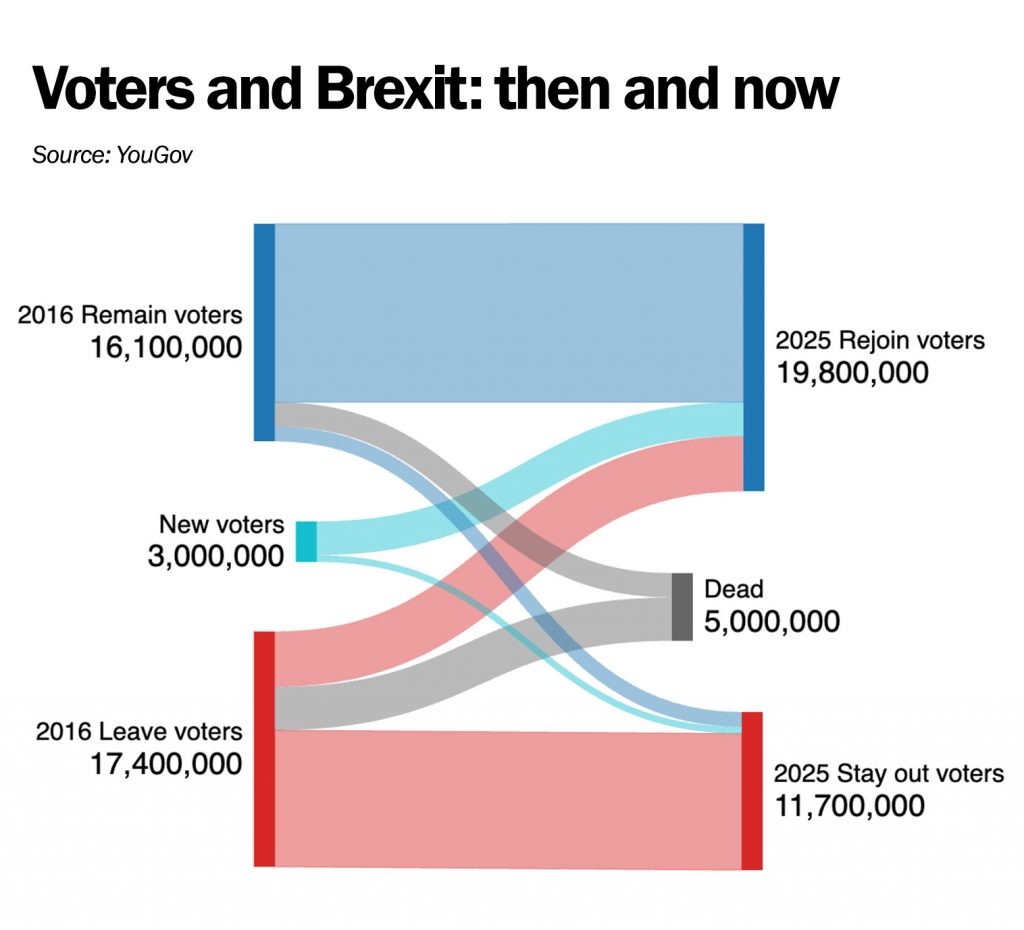
Didn’t the UK not six years ago vote to leave the EU? Is he suggesting that there’s demand from Britain to reverse that? Or is he suggesting they be forced to rejoin?
The problem the UK has had is that although the British people voted to leave the EU, most MPs we're against it and there was a very concerted effort to not honour the electorate's wishes. Brexit happened in name and by default. It was the worst possible outcome, but probably predictable.
It was a bit more nuanced than that. Each politician was trying to leave in their own image and failing to get anything through parliament, until Boris Johnson got a majority party.
What would have been better is if the politicians who started the whole thing to settle party politics didn't bugger off the moment things didn't go their way and instead did a follow up referendum with the options for leaving. I don't necessarily think the eventual deal would have been different, but it would have stopped a lot of the bickering. And maybe have exposed what leaving meant to a greater number of people.
I don't live in the UK any more, but I do enjoy reading the stories along the lines of "I voted for brexit and now my business has gone to shit" of which there are a surprisingly large number. The whole "we didn't want them telling us what to do but didn't think they'd apply rules to us like we weren't in the EU" crowd.
Just before the referendum. The lead at the time the referendum was called was much wider. One poll even had 66% remain in June 2015, while the Referendum Bill was in parliament.
Well, I just assumed that when you said "polls before the Brexit referendum" that you mean polls that were made before the referendum, and not when the referendum was called.
"Political" content is the only kind of content for which civility and quality standards aren't applied - such posts are often flagged as a matter of course, simply due to the title alone.
Maybe they should focus on putting their own house in order first by not making constant self-sabotaging decisions that hurt themselves, benefit the United States, and alienate their other neighbors. The European Union has declined from 30% to 17% percent of world GDP from 2008-2025, three times faster than China's analogous decline at the beginning of its "Century of Humiliation", which took it 50 years from 1820-1870:
https://xcancel.com/RnaudBertrand/status/2062096610239082912
But I fear the worst is yet to come, because what's happening has not sunk in yet.
So, despite liking various countries in the EU as places to visit, I have to ask what benefit would Canada get from joining such a structure at this point?
Would people in the EU be generally keen on the largest EU country being a not quite white enough Muslim majority country? Would they like EU borders with Iran, Iraq and Syria?
He implies its the threat posed by Russia. The EU is not a military alliance. There is a reasonable argument that Europe needs a military alliance that is not dependent on the US, but the EU is not it.
In many ways enlargement weakens the EU, as does "ever closer union". Both create more internal division. The UK would not have left if the EEC if it had remained the same organisation it was in the 80s.