I have a QPSK & BPSK packet radio link to several other stations via the QO-100 satellite narrowband transponder, using a couple of Pluto SDRs and in some cases a mix/match of RTL SDR dongles and 70cm radios with transverters.
Only a small group (4 so far) doing it, but we can be heard on the WEBSDR hosted at Goonhilly Earth station[1]
Due to small dish sizes on RX (10GHz) we are keeping it simple and open at 1200 BPSK and QPSK 2400 with IL2P[2][3] for FEC+RS robustness, and not even close to the 2.7Khz max permitted bandwidth.
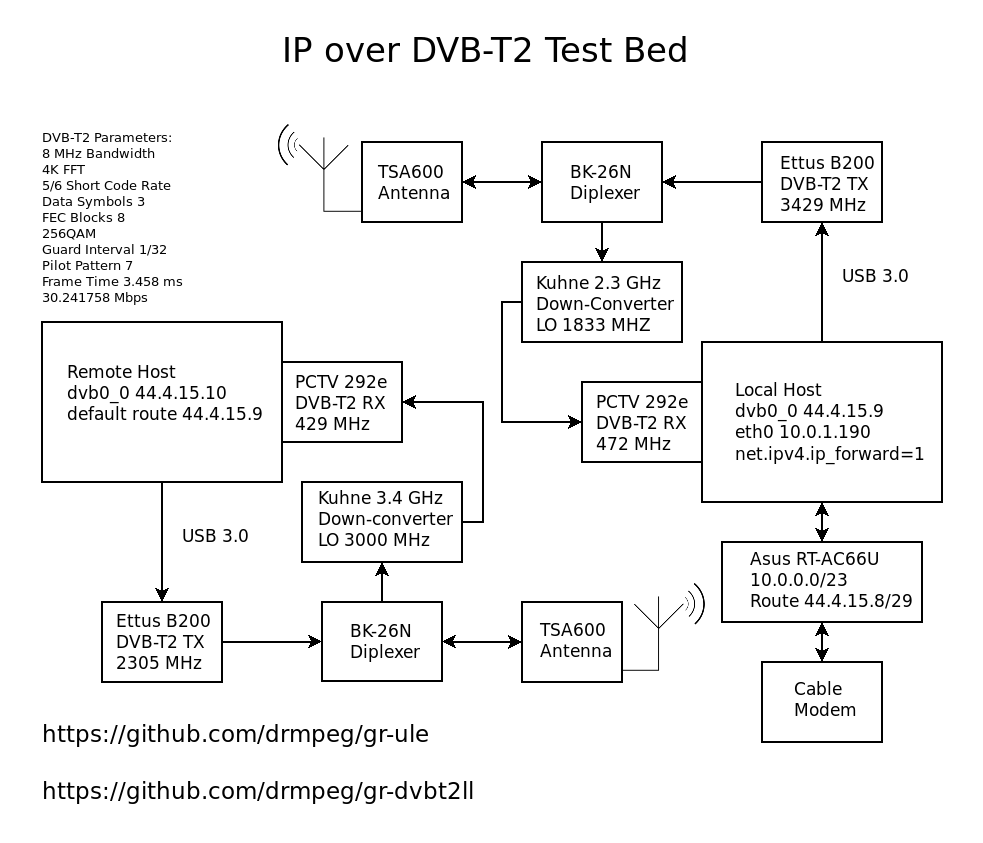
This is a project to connect two Linux machine's network stacks via the amateur radio bands. It uses Linux's TAP interface to read & write packets at layer 2 to/from the kernel. QPSK modulation is used at the RF layer.
For now experimentation has mainly been done in a Ramsey box. The next step is to add a callsign field to the QPSK frames so the data can be legally TX'd.
I recently got back into amateur radio with an SDR (listening only, my license has lapsed and I need to renew it)
I found that using the FT8 protocol, I can pick up transmissions from up to ~6000 miles away, using a very cheap magnetic loop antenna mounted indoors in my apartment. My building is made of concrete slabs and I was pretty shocked that I was able to receive such distant transmissions.
I think I've invested maybe $70 into radio equipment for this capability. I've listened to a lot of other signal sources, but so far FT8 is the most interesting. I can run a companion app that maps out all the contacts, it is pleasing to watch on a nice slow evening
I got my license about a month ago and ordered a QDX to try FT8, but they're super back-ordered. The orders page shows that they're just now fulfilling orders from May.
No I don't, do you know if you can buy the truSDX pre-assembled, or does it just come in a kit? I'm visually impaired, so soldering is difficult for me. But I'd like to try getting on HF.
For listening, you can pretty much just throw some wire up and you'll hear stuff. When I first started, I got an RTL-SDR, and with alligator clips, added some random wire I had to the dipole antenna that came with the RTL-SDR. I was able to hear some FT8 signals from overseas. Helped that I lived in a top-floor apartment, but still :)
You basically just need any sort of wire to receive. FT8 is a very weak signal mode so I wouldn't be surprised if you string up some speaker wire inside and still hear signals.
Wow! That surprises me, and I probably never would have checked, so thanks. I think of FT8 as deep magic at this point, so it wouldn't surprise me if that's enough to reach pretty far
Interesting. Also interested in getting into this. I have played with SDR, not FT8 though. Maybe you can point to a site that helped get you started with FT8.
I don't recall any specific how-to sites, I was all over a lot of them. There are three applications in my 'pipeline': SDR++ (a standard SDR client, any should work as long as you can choose your audio output device), WSJT-X [1], and GridTracker [2]
I'm on Linux, and I'm using PulseAudio. I need to route audio output from SDR++ to WSJT-X. I do this using these commands, which I found somewhere online that I can't recall:
This creates a virtual device that I can select in the respective applications' options dialogs.
Connecting GridTracker to WSJT-X involves using the options dialogs in both programs, there is a UDP socket option, the details of which I don't immediately recall. My setup is different because I've written a one-off python script to log contacts for my own edification (sometimes I leave it running overnight to take advantage of the solar weather conditions)
WSJT-X is written by Joseph Hooton Taylor Jr. [3] He is an astrophysicist and Nobel laureate. It is well-documented software, but not very intuitive. Joe Taylor was also part of the team that developed the FT8 protocol. I recommend watching some videos about it or reading the documentation, as per your preference.
Also, a few more items that I recall being difficult to figure out-
1. FT8 uses a standard frequency setting on each band. The presets are built-in to WSJT-X, or you can find them online. WSJT-X and your SDR client should be set to the same frequency.
2. To decode FT8, your radio should be in USB mode, and your system clock needs to be very accurate (By which I mean, you need NTP)
3. FT8 signals are practically invisible on a normal waterfall display
I had everything hooked up for a few days of head scratching before I realized that I hadn't setup NTP on my PC for reasons that escape me. As soon as my clock was synchronized, messages started pouring in. I have the most luck on the 20 and 40 meter bands.
HackRF One is an option. There are a number of others. Legality varies by country/frequency/power level.
Can also make a Raspberry Pi act as a transmitter (https://github.com/F5OEO/rpitx), which could hit the zwave frequency but not the zigbee one. (Also, make sure to put a low pass filter on it.)
Doing zigbee or zwave stuff is a lot easier with zigbee and zwave than with SDR. Just use homeassistant with something like zigbee2mqtt, and you can control your LIDL light with an Ikea light switch and xiaomi movement sensor without any issues.
Note that you're not allowed to use encryption or engage in commercial activities on the amateur bands. (In the USA but probably in other countries as well.)
An important distinction is that what's not allowed is "messages encoded for the purpose of obscuring their meaning", not encryption altogether, which means things like digital signatures can be permissible, if the public key is available through well-known means or included as a separate part of the transmission.
Only a small group (4 so far) doing it, but we can be heard on the WEBSDR hosted at Goonhilly Earth station[1]
Due to small dish sizes on RX (10GHz) we are keeping it simple and open at 1200 BPSK and QPSK 2400 with IL2P[2][3] for FEC+RS robustness, and not even close to the 2.7Khz max permitted bandwidth.
[1] https://eshail.batc.org.uk/nb/ - 10489630 USB
[2] https://tarpn.net/t/il2p/il2p.html
[3] https://eindhoven.space/il2p