I don't get the fourth one, the one with the different colored crocs. I put a color meter on the images and the mystery pair is definitely not the same color as the pink pair.
it’s not the same in the photo, the lighting changes the actual color. If you put a red object under green light or vice versa, it will physically appear grey. But it doesn’t really work as an illusion in a digital video.
Very cool. I looked back at the 2020 finalists, and the first video from that list truly boggled me: https://youtu.be/5DYeAkx2IBo. At around 16s in, my vision of the stair case suddenly and completely changes to being upside-down to rightside-up. I know what's going on physically, but it feels like my brain is doing these behind-the-scene calculations and at a certain moment feeds my conscious mind a brand new image. Pretty neat how some optical illusions can put you at odds with your own brain.
quick edit: It doesn't always happen for me when I let the video continue to play, but if I pause it at 16s, then as soon as I hit the pause button, the image completely flips for me. Pretty wild. I think it's probably because I let my eyes drift away from the staircase for a brief moment, and when they return the image is sort of reinterpreted.
It's also interesting how with most visual illusions, you can sort of convince your mind to interpret it one way or another if you try hard enough. I think the simplest example is the necker cube, where you can convince your brain it's either pointing towards you to the left or towards you to to the right [1], seemingly just by visualizing those orientations. In case I'm not the only one who interprets it this way, I'm wondering, is there a name or academic description for that phenomena?
The wikipedia article mentions:
> There is evidence that by focusing on different parts of the figure, one can force a more stable perception of the cube.
Which is pretty interesting by itself, but I think it implies the need to physically move your eyes. What I'm curious about is the ability to alter your perception without moving your eyes physically. It seems like evidence for or against that could lead to some interesting conclusions.
Yes, a bit slow to load but worth it. Ten videos of visual system illusion that work well.
The last illusion “Phantom Wiggle” is probably caused by time base differences of rods and cone photoreceptor systems.
The wiggle and movement of the strobed light is caused by ineffective calibrated of the bright and fast neural signals relative to the darker and slow (mesopic) signals of the large surrounding field of vision.
Timing differences between retinal subsystems (rods and cones mainly) are misinterpreted as movement.
Easy to see (expose) this temporal-spatial error effect between the slow rod photoreceptor system and the fast cone system.
Here is how: Just after dusk look at a bright light or even a star low on the horizon that ALSO happens to be near the trunk of a dark tree. Close one eye and then look at the bright light while gently rocking the corner of your open eye back and forth with your finger. The light and tree trunk will move relative to each other. In fact, the light may appear in the tree trunk. Time and space are also relative in the brain.
The brain has no clock or oscillator and has to create its own unifying timing system. The near-synchronization among brain subsystems is a key role of the thalmo-cortico-thalamuc feedback loop (imho).
I remember discovering this phantom wiggle when looking at LED clocks as a kid. Look at an old clock (or microwave) and vibrate either it or you (hum) at various speeds.
Some of them actually work quite well in real life. Even when looking with two eyes (thus giving your brain information about depth) and from a non-perfect angle. I've had exhibitions with these in the physical world, and no one can avoid seeing the illusion, even after picking up the objects and seeing the secret. The brain is stupid!
In "the double ring illusion" I'm unable to see them as 180° rotations. I see all rings in the video doing constant 360° rotations, and I don't care if they intersect.
Maybe I'm too used to see virtual 3D animations where objects can intersect and do whatever they want without any physics involved.
Yeah, same. Maybe we've learned too much to expect stuff to go through other stuff from 3D graphics, but that seems a bit dubious. It's probably just not as reliable as the authors say.
The crocs illusion is just plain wrong. It says "the correct answer is <pink>". They then contradict themselves by saying it's green-gray. It's green-gray.
You need to make a distinction between color of the shoe (under normal lighting conditions) and pixel values of the shoe in the photograph.
The shoe is pink under normal lighting conditions, but the pixel values are green-gray in the photograph, where the lighting has been manipulated.
So, if you were to use a color-dropper tool on the photograph, you would get green-gray values for those pixels.
But some people are able to do color-correction in their minds and determine that the underlying color of the shoe (under normal lighting conditions) is pink. Indeed, the automatic color correction that occurs as they visually process the image is so strong that they find it hard to recognize that the actual pixel values are green-gray.
Yet when the color of the socks is changed to white, but nothing else about the photograph is altered, the visual cue that prompts them to do color-correction in their minds disappears, and they perceive the shoe color in the photograph to be green-gray, just as others do.
I'm still not convinced. They said the answer is pink. But...it wasn't pink, even to their own admission. A pink shoe, when placed under pure-green lighting is no longer pink: at this point we're out of illusion territory and into lighting trick / semantics territory.
If they'd have said the answer is green-gray, then fine, this would be an illusion for those people who incorrectly thought the shoes are pink, but their answer is still wrong.
I wasn't too impressed with this one, either. In my mind, this illusion is much more straightforward demo of a similar effect (color perception being relative to surrounding colors):
Ah, the “phantom wiggle”: I’ve witnessed this so often in my rear view mirror from certain vehicles (usually vans). I thought I was going mad, but now I know! I didn’t realise LED lights strobe.
Majority of the illusions seem to be 2D object projected as 3D object, they still get me every-time though. Definitely would recommend a game called Superliminal if this kind of stuff gets you.
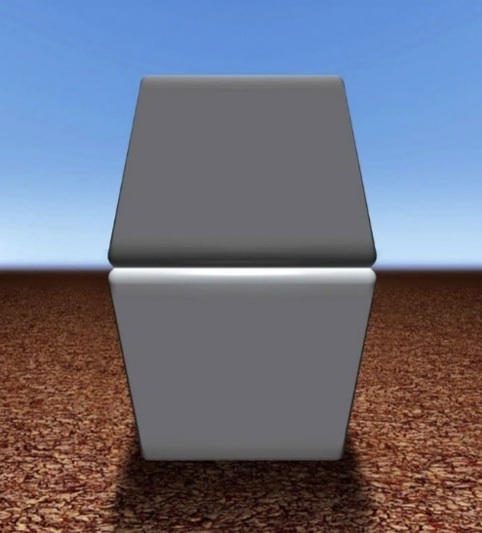
https://youtu.be/i4p_x0S5bmQ
https://youtu.be/TXk-Oc35oN4
https://youtu.be/bVbPmFpspXc
https://youtu.be/q_JqmwwbtpA
https://youtu.be/yC5kHTsmXqQ
https://youtu.be/zWr63p3gsM0
https://youtu.be/LFvOzXUMXwM
https://youtu.be/jb29X2SrgDM
https://youtu.be/CePZ6vwYOYQ
https://youtu.be/a7LUNyMvGqU