I feel like investing in market pathologies has become too common and modern democratic governments are far too slow at doing there roles and curbing such behaviour.
Bitcoin is the obvious example of something that should have been banned years ago (and all proof of work crypto), but there are so many examples coming up daily, if there was ever any faith in institutions it's eroding quickly, and once you remove that you accelerate the pathologies (people start acting like anything goes) and society starts to destabilise.
> Bitcoin is the obvious example of something that should have been banned years ago (and all proof of work crypto)
not that i would invest in bitcoins (or any crypto), but i don't see it as an obvious ban. The only reason i can deduce from your "obviousness" comment is that proof of works "wastes" energy. But then it is hypocritical to argue this when other modern conveniences also "waste" energy, and yet you don't call for a ban.
It wastes entrepreneurial energy too, since it doesn't actually provide value to anyone.
Not the way a car, a phone, a hairdresser, a movie or Google maps does. The economy is just what everyone does/make. Think of the opportunity cost of all that human resource being wasted on a pyramid/ponzi scheme, which does not produce any value. It only redistributes it, poorly. Yeah thanks. We really need more gambling infrastructure with even less oversight.
If we would make a list of important things we want to explore further, how would crypto be on it? Why?
It's ok as a storage of wealth, but the amount of investment money and energy wasted on this stuff. And in the end it's going to bankrupt gullible idiots that put their pension in dogecoin. Maybe in the US you just let these morons starve, but in the most of the world, you wouldn't. So it makes sense to protect society against having to bail out suckers from a completely useless and pointless economic exploitation.
So I can imagine banning on on the sheer notion the existence is a net loss for society.
There was no value to WWW and HTTP in 1990's. Yet hackers tinkered with those technologies just for the sake of doing something cool and here we are 3 decades later. I see the same spirit with DeFi, NFT, dApps and Crypto in general. And just like there was a crazy boom in the late 90's (pets.com anyone?), history is rhyming again (dogecoin anyone?).
What is sad is that some of the top comments on hacker news are dismissing this cool new tech by choosing to focus only on the negatives.
If the problem is co2 emissions, banning is not really the solution. The solution is co2 cap-and-trade, with a yearly dropping cap. We have it in EU, and it's very effective at dropping the co2 emissions of electricity production and industry. What is needed is carbon tariffs, or carbon club:
To beat the rest of the countries into submission. If all co2 emissions are under same cap-and-trade emissions system, from climate pov it doesn't matter that bitcoin is energy inefficient. The bitcoin miners will simply have to buy their emissions rights or use clean energy. Even if bitcoin energy use would skyrocket, the co2 emissions would continue to drop at the same rate as the co2 cap drops...
The root of the problem goes deeper - why haven't developed nations such as USA and Australia have co2 cap and trade? I'd blame fox news and its ilk, which have figured out which buttons to press on people to make them dumb. Despite the immense damage to environment and society they have created, democratic societies have not figured out how to fix that problem. Come on, we have had decades of time to monitor and learn of Murdoch et atll, and the problem has only got worse...
What is the utility provided by crypto ? Money laundering, avoiding capital controls, financial speculation ? All while burning insane amount of energy and hoging up limited chip making supplies.
It's clear cut that o the whole crypto is a huge negative for society.
The use case of crypto is to purchase things online without the knowledge or permission of your government. How you feel about that probably tells you more about how your feel about your government than anything else.
Are computer games also a huge negative for society?
With your reasoning, they provide no utility, waste an insane amount of energy, mostly involve violence, etc.
I don't want to live in a country that starts banning things for those reasons.
The utility of cryptocurrencies is not decided by governments, or companies, or you. The utility will be decided by reality. I like living in democracy and capitalism, but it seems you prefer a dictatorships.
>The utility of cryptocurrencies is not decided by governments, or companies, or you. The utility will be decided by reality.
No the utility is determined by you me and everyone else collectively. The problem is financial mechanisms that allow inflating these bubbles are not market driven, central banks are flooding the markets with low interest rates, if they want to direct the markets they need to react to negative distortions they cause.
Crypto is no different but instead of central banks you have a shadowy network of large investors at the top artificially moving the market. It's like a continuous pump and dump scheme.
> not that i would invest in bitcoins (or any crypto), but i don't see it as an obvious ban. The only reason i can deduce from your "obviousness" comment is that proof of works "wastes" energy. But then it is hypocritical to argue this when other modern conveniences also "waste" energy, and yet you don't call for a ban.
While other activities may be wasteful, proof-of-work is waste distilled almost to its purest essence. It's literally a race to see who can waste the most. There's really no comparison.
It's the scale of the wastefulness of bitcoin that matters.
If a car burnt through a months worth of electricity for your home just so you could drive to the shops to get groceries and come back, then that would quickly be banned. Bitcoin and other currencies have a lot of money being pumped into the system by people who refuse to account for the wastefulness that is crypto and instead, want to drive up their investment.
There's no replacement of traditional digital payments by cryptocurrencies.
Going back to the article, I'm glad China priorities it's people (funny to say that given the Xinjiang situation) over the profits of big corporations.
Bitcoin uses energy without providing substantial utility unavailable from other vastly less wasteful alternatives.
Additionally it provides a place for the rich and ruthless to prey on the weak and gullible with endless washtrades and exchange scams. It should be banned.
The utility is hard to measure, but brushing it off being valueless is subjective. It should be clear to you at this stage that not everyone agrees with you.
The governments of the world are one of the driving forces behind the pathologies. The reason asset prices are crazy is because the government has figured out that if they print money and give it to asset holders then they get stock market growth but are still able to call inflation low.
If they didn't have their thumb on the scale, interest rates would be higher and boring, stodgy savers would be in control of the money instead of the sort of people who think Bitcoin looks like a good idea.
If they don't want people putting money into insanely risky ventures they should stop punishing people who invest in low risk ventures.
I don't disagree, but I can see why they want high growth. But if you choose that path you need to actively manage the pathological cases, especially the ones you create.
* If the US Congress were capable of identifying pathological cases, would the government go through the ceremony of shutting down every couple of years just to remind everyone they can't balance budget?
* If the Chinese government could identify pathological cases, would we have error bars of +- 15 million deaths around their 60s-era economic policies when they tried to rush improvements through central planning?
Those are my top two favourites, but there are others. The approach the government has to climate change also springs to mind. You're calling for something that we have fairly solid evidence that they can't reliably and safely do. They can kill off things that are novel, sure. They aren't reliable at making sweeping judgements about what technological changes are good or bad. Government's are very marginally competent at identifying value for money.
It is far safer to let something like Bitcoin run than risk, eg, a government nipping the next internet in the bud because people are using it to look at dirty photos. The only thing to complain about here is that they've disabled the extremely reliable capitalist incentive structure that would stop people doing things they know to be a waste of time and money.
How exactly would Bitcoin be banned? Do you think governments would rather ban Bitcoin or Tor first? Or how about blanket “banning” ransomware? Or the other unpopular foss flavor of the month?
I can't imagine Xi is thrilled with this. More likely: zealous deputies, looking ahead to next year's National Party Conference, are looking to curry favor and build their resumes. When everyone is simultaneously dialing it to eleven in a zero-sum game, fuckups are almost assured.
Honestly I don't think they care, since they are playing the long term game (probably in decades, if not 100+ years). Not only that, but China just has too much momentum for any of this to make a big dent.
I think it was Warren Buffet that compared the US economy to a fast moving train, and that a stick or a stone in the rails won't make it derail. We also have to acknowledge that China is also a massive moving train at high speed, and it won't derail.
That's why they can make these decisions. Remember that companies are apologizing to China on a monthly basis, I haven't seen a single Chinese company issue apologies for anything related to offences to western countries.
This was true ten years ago. It hasn't been since Xi became more...permanent.
The headline case is Hong Kong's accession, where a territory that would have--without much controversy--reverted to Beijing within a generation was accelerated to meet a 68-year old man's timeline. This not only cost China internationally, not only cost it in Hong Kong, it also neutered support in Taiwan for peaceful reunification. Bad for China. Good for Xi.
> haven't seen a single Chinese company issue apologies for anything related to offences to western countries
Corporate apologies to governments have zero value in the West. One could argue its pragmatism. One could argue we're jaded. But a Chinese company doing something wrong and apologizing for it could be seen as possibly more insulting than paying the fine and fixing the problem.
Similarly, if our companies can save money or gain advantage by issuing apologies, power to them.
I feel a bit too far removed from this, so my comments might be a bit too curious without considering other perspectives (aka I am a bit naive on this topic).
With that said:
Global investors are getting squashed. But there must be global investors who shorted these stocks or bought put options. Why aren’t they covered in this article?
I’m missing nuance on the investment side. From a political standpoint, I want to follow this more closely. I can imagine that the west might take some inspiration on how to deal with big tech.
Armchair investor and my political pedigree is “I vote” (aka a total commoner).
Intelligent shorts can look at factors like - is this company an outright scam (Wirecard)? is this company in a market which is likely to shrink? are its competitors on the verge of a breakthrough technology? They wouldn't necessarily have inside knowledge that the government of the country is going to force companies to turn into non-profits (like happened recently with Chinese school tutoring companies). That's like having an asteroid hit.
If you think about it from a macro perspective, we're talking about Chinese companies generally suffering an investment hit. It is unlikely there are very many people "shorting china".
But even so, shorts "dont make the world go round". They are a necessary mechanism against exuberance, but companies selling shares and using those to invest/grow -- that's the heart of the promise of shareholder capitalism.
In America, politicians are controlled by billionaires. This comes at the cost of national interest, given that winner-takes-all systems are gini coefficient maximizers.
In China, politicians control billionaires. At least in theory, especially given how much the Chinese political establishment is attuned to the needs of the Chinese commoner, this does protect the national interest.
> There is no altruistic motivation to better the lot of the common person. The only motivation is to maintain control.
I don't take it even as a control maintenance. They are now literally back to years when they were taking it as an insult for anybody to be more rich, and successful than a village party head.
It's 100% truth. Heard stories of people having their houses demolished for building them more fancy than the house of a party leader nearby, and that was not in the cultural revolution era, but barely 3 decades ago.
The problem is when said politicians are a small faction of fallible people with unlimited power and no procedure of being peacefully replaced. Such a setup strongly hints at the fact that they really don’t want to give up control, which implies any policy is bound to protect their position first. They might act selflessly or benefit the nation at some particular point in time, but blindly counting on it being consistently so seems foolish.
“ They might act selflessly or benefit the nation at some particular point in time, but blindly counting on it being consistently so seems foolish.”
I think you’re right. But Chinese politicians are yet strongly motivated by nationalistic impulses, which are long dead in the thuggish political establishment of the West where nationalistic impulses are long dead (the GOP does performative nationalism very well, but they’re always ready to jump into the next war that’ll kill tens of thousands of Americans).
In America politicians are influenced by actors and forces that affect their election prospects. This includes companies, billionaires, and yes even voters.
Has nothing to do with the needs of the Chinese ppl. Its just about survival.
Once you accumulate enough wealth and/or power unintended consequences just keep increasing. They never decrease. And the 6 inch chimp brain everyone has dooms it to blunder.
The East India Company did hand over ownership to the Queen after 200 years of raking it in. Why? And look at the state of the Queen today.
Xi and the Billionaires are trapped by their own hubris.
Am seeing a lot of pushback against this take. There are two things to keep in mind:
1. On execution: The track record of the Chinese political establish in bringing hundreds of millions of Chinese out of poverty is arguably the greatest political achievement of the last four decades. Their track record here gives them legitimacy as a national-interest optimizing function (despite admittedly terrible human rights abuses for minorities). The contrast with, for example, the neocon-military-industrial complex that jumps from one failed international adventure to the next is astounding!
2. On planning: They’ve demonstrated a phenomenal understanding of key issues that the nation currently faces and expects to face, and has prioritized them appropriately — often using Western failures and failure modes as data points to inform their strategy. The contrast with the constant bickering in American politics is astounding. How can America succeed if there’s no general agreement even about what the problems are?
It's a great political achievement bringing people out of crushing poverty and starvation caused entirely by the last authoritarian in charge? 'Hey maybe we shouldn't turn all our farms into factories', its simplicity is what makes it so brilliant I guess. It's an achievement to starve millions to death then decide to give them something to eat and a job.
This is an incredibly generous take on the situation.
In China the corruption of government officials is several orders of magnitude higher. We’re talking wholesale theft of govt assets in the billions of dollars.
Chinese leaders also have a much more tenuous hold on power. They aren’t smacking down Jack Ma because they are looking out for the Chinese commoner (though they might benefit), their top priority is looking out for themselves.
To put it this way is too much of a simplification. There is good and bad.
For now their priorities intersect with the chinese commoner, ie. Protecting themselves via serving the chinese commoner. Another bonus to this is the ability to make harder decisions now for the sake of the future.
The fact of the matter is that with this 'aligned interests' dictatorial style you can more done and plan for the future - so long as that future is aligned with your population.
I'd say the standoffish bipartisan politics of the US is far harder to get things done, but hey, as I'm sure some of you would say, it's better to have the freedom.
Authoritarian decision making is great until the authority starts making the wrong decisions.
The bipartisan politics of the the US is not a bug, it’s a feature. It was entirely intentional that power was split and broad consensus was required to get anything done.
Categorizing it as either a bug or a feature is thinking at extremes and is indicative of the influence of the media on your minds, leading to poor decision making. It's a feature with weaknesses.
As another example, the NRA preventing gun control laws in spite of school shootings. The path the US has chosen is both poison and boon. The trouble is who gets to suffer from the poison?
nobody disputes if it was (broadly) by design, it's whether the design is outdated and needs modernization.
by the way, i actually really disdain founding fathers veneration, but two-party deadlock was infamously _not_ intentional. neither was our increasingly corporatocratic government.
i actually really disdain founding fathers veneration, but two-party deadlock was infamously _not_ intentional
It absolutely was.
Canada, where the majority party can pass whatever they want (their majority practically guarantees it), the unelected Senate almost always rubber stamps it and the head of state is one and the same as the ruling party, it's clear that the US design is intentional.
Nothing gets passed in the US unless: 1) House approves it, 2) Senate approves it, 3) President signs it. All three bodies are independently elected.
It was clearly intentional to be much more challenging to pass legislation in the US. What you call gridlock, I call the system operating as designed.
This is the first time I have ever heard the claim that the CCP's hold on power is anything but rock solid. Unless you mean that specific leaders within the party have a tenuous hold against their party rivals.
When the USSR collapsed, the USA lost its primary ideological competitor, and proceeded to turn inequality into an unspoken national growth industry. Let's see if vigorous competition from those other commies can feed a USA course correction.
Pretty much. Deluded people who think Xi and politburo fears tech billionairs when actually dangerous rival factions and unreliable military brass have already been managed / purged. And TFW all of these supposedly desperate moves for survival just happens to meet needs of commoner or improve comprehensive national power. Generic whining about Xi being authoritairan overlooks possiblity of him also being a generally benevolent dictator. Complaints of Xi's CCP is generally not mutually exclusive with the fact that his actions are mostly benefitial to PRC interests.
Governance priorities and development generally going right under Xi. Crack egg to make omelette etc. Incidentally, political executions also way down after his reforms, customary executions now "death with reprieve" sentences, where death is suspended. Way things are going, Xi's hagliography is going to be 10% bad and 90% good, especially if he can avoid war with US. Otherwise, hard to argue he isn't resolving or trying to resolves some of modern PRC's most entrenched problems across many domains.
interesting that the lifting of the children number restriction coincides with the attack on the "three mountains" - education, healthcare and housing costs - which are significantly related to the size of the family.
It is so interesting to see the CCP try to navigate the dichotomy between state planning and free markets. Trying to make diametrically opposed systems play together. I would even be rooting for them if it wasn't for the complete disregard for human life, personal liberties and all the fucking genocide...
Markets are nowhere free since they are always defined narrowly by state and international laws. What china doesn't allow is capitalism but handling a state-planned market doesnt seem to be that hard.
> 22-year-old motorbike courier Mr. Tang complains about the lack of medical insurance. “There’s nothing I can do about it if Meituan doesn’t pay for it,” he added. “The wealth gap between people in this society is too big”.
People should stop calling China a communist state, when isn't.
If they we are truly communist, not will be medical insurances or a "entrepreneur" driving it. It would have a public medical system that cover everything, and the business would be driven by the workers of it.
However, that they hit hard on private education, it's a good step. Private education never should allowed to exists. Only a quality public education system can give access to good education to everybody.
A communist state is merely a state that wishes to achieve communism, a stateless (classless) society.
There is no such thing as communist state that has achieved communism because at that point in the world states no longer exist because classes no longer exist. Such a world actually existed for hundreds of thousands of years as technology didn't allow one set of people to produce so much surplus so that another set of people could live without directly producing, a requirement for a state.
There are no known steps to "achieve communism", so there is no laundry list of requirements that make a communist state. In practice however some kind of liberal market is required because the world is currently dominated by capitalist ideology which will destroy any obviously communist state and a destroyed state cannot achieve communism.
These, as each is usually understood, are not even approximately the same thing, and any theory which posits that they are identical has either adopted nonuseful definitions of at least one of them to make that true, or is simply logically wrong.
> Such a world actually existed for hundreds of thousands of years as technology didn't allow one set of people to produce so much surplus so that another set of people could live without directly producing
Sets of people that don't directly produce have existed throughout all of human existence.
> a requirement for a state.
It's a requirement for the continuation of the species; infants aren't direct producers. How many total (and total-equivalent composed of part-time slices of sometime-direct-producers) non-direct-producers a society supports is a product of productivity, sure.
But at almost any level of that where one can have continuity of the species one could also have (and, indeed, human societies have had) a state; agents and decisionmakers of the state can, after all, be direct producers as well, and historically largely have been.
That's the point of the article, no? That outside of specific areas, since Deng Xiaoping China was somewhat capitalist, but that is now changing - Xi is "remembering" that China is meant to be a communist state. The article builds the case that whilst maybe in the past some nuance and complexity could be found in the "how communist is China really" debate, Xi is ending that and bringing it back to its Maoist roots, rendering that debate increasingly moot.
China is a communistic state precisely for that.
You would also say that Venezuela or Cuba is not communistic.
The only communistic country that had a moderately good public medical system was German Democratic Republic, and it was because the constant influx of help and resources from the West.
The more communist a State is, the more miserable it is. You had China with Mao making tens of millions of people die of Hunger. Was Mao not communistic?
At the start of the 20th century Russia population was bigger and richer than the US of A.
Lenin destroyed the economy and made millions of people die from hunger, way more than on WWI. Was he not communistic?
Let's not talk about Stalin or PolPot.
>Private education never should allowed to exists. Only a quality public education system can give access to good education to everybody.
You are confusing education with forced indoctrination and propaganda.
I can educate and think for myself. Just repeating a mantra or dogma ignoring History like you do is not education.
I don't think you're arguing the same thing - the "idealised" version of a communistic state is what the OP is referring to. The "actual" version of a communistic state is what you are.
They're correct that a state built on communist principles would have free healthcare for all, and would have proper free education for all. However, the reality is markedly different, and all the so-called communist countries are anything but.
They failed to realize the root cause of all these after school tutoring.
There are just not enough proper schools for them to attend. They have to compete for the spot to get an education. And all these elite colleges/high schools are located in Beijign, Shanghai, etc. They usually take in local students first.
So you see the problem. They will always be some form of private tutoring as long as there are immensive competition for basic education.
China needs more young people to be happy to be factory workers forever, instead of seeking out white-collar jobs.
But many young men and their parents are convinced that a University degree is essential to find a wife.
If the situation reverses to more women than men, by simple microeconomics the dating standards of women will fall and more families and men will be content in lower-status (but economically important) roles.
China could incentivize more women being born by allowing 'bride prices', paid to the bride's family instead of just being used for the wedding. Another option could be to encourage excess males to emigrate, as seems to be occurring in India.
But why are people so set on getting a fancy "educatiom" at all? I mean, I'm not against it by any means. Education has dome alright by me. But maybe part of the problem is also a divergence in quality of life for the educated or a rampant credentialism whoch tells people their worth is tied to credential attainment?
Obviously educating citizens is good for a nation. And if it is really what people want to do, that's good. But it would also be good to ensure people can make a good living and self actualize without a formal education.
> But it would also be good to ensure people can make a good living and self actualize without a formal education.
How? Wanting magic to be true doesn't make it possible. If your economy is already strong enough to provide a good living to anyone who wants to be a noncontributing poorly educated self-actualizer, then OK, let them enjoy that. But what if it's not? Who supports them? Even developed countries with good social welfare usually make it hard to be voluntarily unemployed and receiving welfare just because you'd rather play on your hobbies than work for others' benefit. It's meant for people who want to work but can't, not those who don't want to but can.
We don't organize into socities solely to eek every drop of value out of people economically that we can. The goal is to create a more stable and less miserable life for people. Some people are never going to be happy spending years in formal education. And creating an incentive so strong that even people without the slightest interest or compunction towards it creates its own inefficiencies.
You twisted my comment into a false dichotomy. Societies obviously cannot fully subsidize people to enjoy a life of the most self indulgent or pretentious interests. But a society can acknowledge that not everyone is going to grow skills, discover talents or develop interests in the same way. Perhaps the most efficient thing is to shrink agriculture work to the bare machine assisted minimum with a dichotomy of skilled labor at the top and a balloon of grunt workers at the bottom. On the other hand, growing a wide professional class of ag workers with more stake in the system may lead to happier workers and perhaps a more sustainable and durable ag sector. If a society needs to subsidize that or create a pipeline that carries workers out of primary education into that kind of work it may be preferable for less tangible reasons. It's absurd that we should drive forward with efficiency no matter how much it emiserates people. And to insist upon it with so much of the reward for it accruing at the top is downright feudal.
Even still, it's not necessarily true that funneling everyone into the knowledge economy is in fact better. If someone would be happy and productive farming five acres but they go to the city, get half a degree, crash out and end up in a very low value labor market, society has probably lost out. It is my opinion that economists view labor markets aa far too fluid. They don't account for the fact that people are more like bits of rock, sand and clay than they are like water. They clump together, break apart and get stuck.
There's a whole spectrum of agriculture lifestyles available around the world for people to choose from. People who get more satisfaction being an owner-operator farmer or more professional employee farmer can do that by migrating to a country where it's readily achievable. Same for many different types of work.
But people mostly seem to want to be richer and are happy to forgo that kind of lifestyle in exchange for a higher paying job. Who are we to tell them that what they want is not what they should really want?
I understand that. And I'm not opposed to creating rewards for educational attainment. But we as humans have to realize that cognitively people come in many shapes and sizes. And we should consider that it's possible that a certain amount of people are going to flunk out of the modern world. The more homogenous and narrow we make the singular way in which we expect people to live, the more some will fail to find their footing. So far, modernity has widened what it accepts from people in many ways. But in one key way it has narrowed. We expect virtually everyone to become employed and pay rent. And we paint a pretty singular path to better employment, formal education.
The native citizens will come to HN and offer some rationalization. The non citizens will offer others. The reason is very simple. The dictator is paranoid about losing control and getting killed. Simple as that
> "Activity that is harmful to the economy?" I think they get much more glaring issues to care about if it comes to this.
> What about their wrong simply being "getting too rich, and successful," and causing somebody a burst of jealousy?
> Becoming richer than a partyman in some small village is very much a challenge to the party. What changed now is that the entire China has become that village.
> I keep the claim that the explanation is even more simpler: whomever becomes a big man in a country like China eventually goes down, and that's the whole story.
> There can only be one "big man" in such system, and he tolerates no competition.
> This consistently held true through the whole 40 years of modern China: whomever attains too much of the social, political, economical, cultural, moral, or even genealogical prominence consistently gets taken down. This is why most mainland Chinese have that fear of publicity, and standing out almost bordering on panic disorder. And this is why people attaining any level of prominence there keep leaving the country for the West.
> After 40 years of allowing the market to play an expanding role in driving prosperity, China’s leaders have remembered something important — they’re Communists.
China isn't a true communist state and hasn't been for a while. Yet the author feels the need to dunk on this straw man and defend capitalism and venture capitalists who lost money in the tutoring crackdown. The muddy Shanghai construction photo is a nice touch too.
you are quoting the subhead; headlines are not written as part of the article by the author of the article, they are added in at a later stage by a different person
I can see why hackernews was (is?) banned in china. You guys see nothing but negatives in any policy decision that comes out of there. Sure there are some power struggles, sure there's a powerful cadre of billionaires who own the politics of the country but aside from the pretty disgusting issues with the Uighurs I would consider china up there with Norway in terms of country development.
If you just contrast what Xi is orchestrating vs what's happening in the US with open eyes, you'd see that maintaining the status quo is impossible. We're too fat and complacent and there are too many leeches on government spending. This is the holy shit kind of article that made me realize we're going to lose our place on top. I don't even know how to help stop it.
I've always used it as a way of testing my internet connection there since HN loads quickly and has been ignored by basically every filter everywhere. I haven't been to China since borders were shut down, but HN worked there last January.
And to address everything else, I wouldn't say China is Norway-level, but they're definitely on a very clear upward path of development and accelerating. I think a lot of other countries have gotten comfortable with their place somewhere near the top and assume it's an intrinsic trait their country holds, and not something they need to work for.
e.g., As an American, loads of people I know say America is the absolute greatest place on earth (maybe it is in some aspects). But mention that it's falling behind in some ways (crumbling infrastructure, etc) and some people refuse to acknowledge it. Say some countries (especially any country in Asia and particularly China) do any single thing better than the US, and a large number of people get absolutely enraged. It's wild. Even people who a couple years ago would've proudly shouted about how much they hate nationalism and especially jingoism seem to be falling into that trap.
It's hard to improve your country when people think country development is an immutable trait, and not something you need to constantly work for.
In the era of wiki/scihub/libgen, the whole tutoring industry is worthless. They are just making easy money taking advantage of information asymmetry. Generally, easy money will not be allowed in China.
Edited: I'm talking specifically about Chinese tutoring industry. One comment below gives a very detailed description, which perfectly explains why I think it's worthless. We are all in the process of a revolution initiated by wiki/scihub/libgen. Whether agree with me or not, you are welcome.
Only if you don't understand what the "tutoring" industry in China truly does. They are all test prep, not general teaching or education but cram schools for scoring better on a specific test.
For example they are not allowed to teach calculus, despite calculus making the tests easier, for the exact reason public schools do not introduce it in the standard curriculum. Instead the schools are places to drill test taking and memorize tricks to be used on said single exam.
It is an entire industry geared to a single once per year test. Every dollar spent targeting said test is an economic loss. It is the exact sort of economic loss one should expect from perverse incentives. Banning this industry papers over the symptoms of a broken system, it is an obvious move but not a brilliant one.
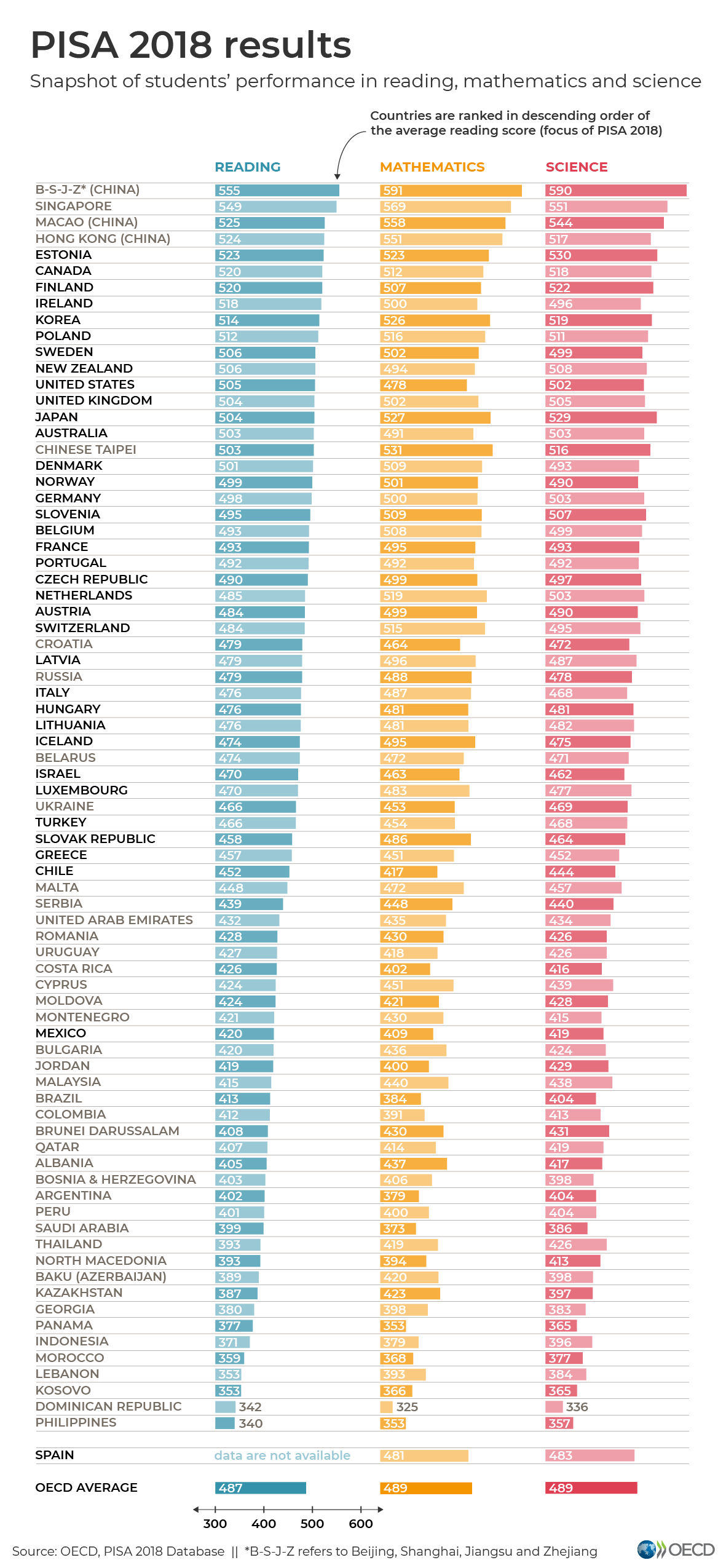
Shanghai was leading the way. They gave individual teachers more freedom that allows move away from rote learning (taking lessons from Nordic countries). They also increased teachers’ pay. The results have been amazing. Shanghai ranked first in OECD PISA 2009 and 2012 assessments.
In the latest 2018 assessments Bejing-Shanghai-Jiangsu-Zhejiang areas ranked first. Rest of the China is still behind.
Something doesn’t add up. It’s not like there is a shortage of challenging material to learn and test on. I don’t know why tests are easy and then the people who can’t ace the watered down tests compete amongst themselves for the less less able titles. why don’t they just put some general relativity, quantum field theory, regular expressions, group theory, Elliptic curves, taxes, sec regulations, emacs, vim, options pricing, portfolio risk management, reinforcement learning, go, chess etc on the test…
> I don’t know why tests are easy and then the people who can’t ace the watered down tests compete amongst themselves for the less less able titles
The tests are not easy, and the "passing score" is set by the sum of competition. The techniques allowed to be taught, and which get tested are obtuse. Instead of allowing brilliant students to progress into more difficult subjects the tests funnel the entire country into the same testing flow. It would be like trying to score everyone based on arithmetic.
Yes arithmetic is easy, but given enough volume of overly complex questions even easy skills can be tortured to create a grading curve.
This generalized pronouncement may be a bit premature. A lot of people do not work well doing self study. A lot of people need to ask specific, difficult to anticipate questions before understanding a topic. A lot of people lack the self discipline to study without the accountability of another person. There are a lot of reasons to hire a personal tutor beyond using them as a living breathing codex.
That's not what teachers and tutors are for. The personal human interaction motivates you to do work that you wouldn't bother to otherwise. Some schools even call them "facilitators" or some other word to remind you they're not just a firehose of facts.
If wikis were enough, the information asymmetry would not exist unless these people were unaware of wikis and other sources of information like textbooks, which I find unlikely.
Wikis are enough. They are just not enough to ace testing. The goal of testing here is not to check if a person knows/can do a thing. It's a gatekeeping mechanism to filter out people from entering a course/university.
Eventually this is a lazy mechanism to select prospective students to a course. The purpose of the course is to prepare people to build an air plane or be a good doctor, historian, architect, journalist or whatever. Not be good at exams and interviews.
When you make testing all about gatekeeping, wikis don't help, because the questions are not about test of knowledge of skill.
If you have a pervasive cram school culture in your country, eventually you have to import/buy from other people because your people are considered on-paper geniuses but are not good at any thing apart from acing testing.
I guess for where China stands now. Making chips, airplanes and space stations needs the real engineers not just the ones who can score well in exams.
Bitcoin is the obvious example of something that should have been banned years ago (and all proof of work crypto), but there are so many examples coming up daily, if there was ever any faith in institutions it's eroding quickly, and once you remove that you accelerate the pathologies (people start acting like anything goes) and society starts to destabilise.