These days I'm on a 5k monitor and when having a more direct conversation in a meeting, I make a point to place my Webex video window at the top and center of my screen. (I never run it maximized, only 1/4 of height & width, so 1/16 of my screen realestate.)
I tested this setup with PhotoBooth and compared when I look at my own face vs. the actual camera. The difference is minor.
Bonus, it signals to whom I'm speaking whether I'm looking at some other window or at them. This is useful for empathetic listening.
With so much multi-image computational photography and video processing these days, I've been wondering whether we could have a multiple camera system (with cameras on the top, bottom, left, and right of the screen) and a processor that can simulate a camera in the center of the screen - or even dynamically moved to the eyes of the caller.
I know there's a bunch of research on viewpoint interpolation, but how close might we be to a dedicated processor to be able do this in a laptop, or at least specialized VC monitor?
Apparently all current attempts resulted in very, very uncanny valleys. This thread mentions some current attempts (searching hn.algolia.com for 'gaze correction' will return additional threads).
Seems possible. If the user is actually looking at the center of the screen then we only need to shift the view, not digitally move their eyes. That seems very doable with some GPU code.
This seems about as hard as digitally moving eyes.
I think the main source of artifacts is going to be lighting and reflections. Specular color or reflections are only possible to see when light, surface position and normal, and observer are arranged in a specific way. If you have 2 or more cameras positioned elsewhere, there's no way to find out what color is visible to another camera in the center.
Modern AI can try to guess, but fundamentally there's no that info anywhere in the video. It can assume the object surface is made of small count of uniform materials, and extrapolate materials across picture and across frames, but this gonna fail too often for biologicals subjects like people.
Moving eyes means making decisions about human behavior, which is hard. Any weirdness will be very detectable. Just doing a 3D reconstruction with multiple cameras is more established field.
I was wondering what happened to it! Makes sense, weird uncanny eyes might be ok in a work conferencing tool but I think FaceTime is used for too many personal and intimate calls for it to be acceptable.
Tracking speakers is best done via audio already linked to camera control. Now face tracking by camera's in VC was something I first encountered late 90's - can't recall kit, but Sony was first on that - which was good for presentations in which the person speaking was standing and moving.
As for perspective shifting based upon multiple inputs - processing wise look at raytracing as would need to map each camera input to extrapolate the suface details and then map that out to the virtual visulisation. Basicly you would need to 3D map, including textures and re-render that viewpoint required.
However, do you need the whole face - you just really need to fix the eye's IMHO and eyeline contact.
But that is down to how we interact in meetings with people - try doing a video conference in which everybody is wearing dark sunglasses - that is insightful as you find people focus more upon what they hear more then.
That doesn’t work right if you wear glasses with any significant optical distortion. In fact, the current takes on this make it significantly worse since they can’t figure out (or accurately simulate) eye position behind the lenses.
It's funny how videos such as this, which are optimized for engagement over learning, explain things in a backwards fashion. Instead of explaining how the thing works, and then showing you how to make the parts to build one yourself. They show you how to make the parts, and only explain what it is you're building at the very end.
He never said the video was supposed to be about learning. The entire channel seems to be based around technology crafts. It's not my cup of tea but that doesn't mean no one else shouldn't enjoy it.
Oh, I didn't say no one would find it enjoyable. It's quite the opposite, actually: videos optimized for engagement tend to be more enjoyable for most people. You don't get to 2.4 million subscribers by making videos that no one likes to watch, after all.
It depends on the video. Other projects on this channel have more descriptions upfront. Overall it's a general interest channel, not purely about the mechanics of how things work.
The general idea of what he's building is explained ("a system that allows you to retain eye-contact with whoever you're talking to over the internet"), but how it works is not covered. He dives straight into how to build the collapsible shrowd while saying "this is super important for the whole system to work, as you will see", and only covers its purpose much later in the video.
It's also annoying when they don't show how the finished result works until the very end. This video is also guilty of this (you see the device, but the video call where it's being used is at the end).
Why waste 10+ minutes watching it being built, then finaly get to the end and discover it you don't like the result. Of course smarter people will just click to the end at first, but I'm guessing much less than half of people do that.
Sidenote: Does anyone know why these videos all seem to be at least 10 minutes long? Is there better monetization after a certain threshold?
There's a couple factors going on. One is the fact that Youtube's algorithm recommends videos based on a set of engagement-related metrics. Hitting Like/Subscribe is a big measure of engagement, but according to people do this for a living, the most important metric is watch time. This is true both for the video _and_ your channel, so having a lot of long, fully watched videos will cause your channel and its videos to be recommended more often.
The second factor is that one factor you get paid on as Youtuber is video length. Getting people to watch longer videos makes your revenue go up.
!0 minutes allows multiple midroll ads. These videos were also recommended over shorter ones, although the lift is no longer as significant as it used to be.
It has ever been thus. Back in the day, when film still ruled the world and B&H's main claims to fame were grey market and East European cameras, they were widely known as Kosher Kamera in the enthusiast world. Back then, you needed to be careful about the day and time you posted a mail order as well. (The prohibition extends beyond working to causing work. While they didn't consider mail in flight to be their responsibility, any order postmarked between sundown Friday and sundown Saturday was, in a sense, their fault.)
I always recall an Apple patent[1] from years ago that posited interspersing the camera pixels with the display pixels. I wonder where they got with that...
Well, I really hate eye contact and never look people in the eyes, so this wouldn't be something interesting for me. I wonder if I am alone or if this is common.
That's actually an advantage in the remote work world, because you can stare at the camera and people will think you are looking them in the eyes. They'll trust you more thinking you are, and if you can't read their face anyway, there's no loss to you due to looking at the camera instead of their face.
I've found I trust people less who are staring at the camera, because they are prioritizing building psuedo-webcam empathy over actually looking at and following along with/understanding our shared screen.
I dunno. But at some point you can tell who's faking it. Sort of like someone who read How to Win Friends and Influence People and follows it to the letter- they use your name too often shoehorned into conversations and ask about your dog a little too early and enthusiastically with feigned interest.
Perhaps this is a cynical viewpoint brought on negatively from too many zoom webcam meetings!
I had a coworker who (pretty obviously, mind you) kept a One Note tracker of EVERYONE at the company's dogs, cats, and children. Wouldn't have a meeting with her for another 15 months? She'll ask you how Doja and Steve the chinchilla are doing. When she could get them, she'd also store photos of them. She considered herself a "networking genius."
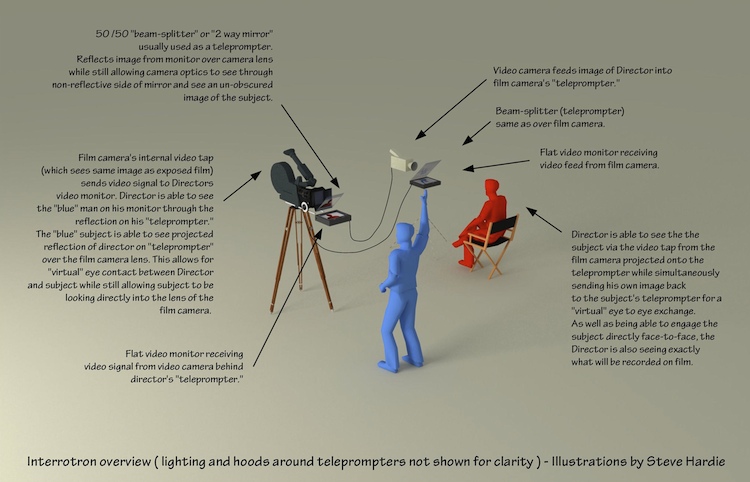
Errol Morris famously uses a two-way mirror contraption for his documentaries so that when he interviews his subjects, they are looking directly into the camera as if they were talking to you. It definitely gives a more intimate feel when the subjects are talking.
I've found if people are just a lil bit further away from their camera they appear to be looking at me anyways.
A conference call should be like a conference table wrt how big their head should appear, once you reach that distance I really can't tell you aren't looking directly into the camera
The setup is to use an iPad hosting Sidecar wireless display from your Mac. Use Moom or similar screen management app that detects kicking on the new display, and pops your meeting video windows onto it at full dimensions (but not ‘full screen’ mode).
If the other person is both on video and sometimes sharing content, you need to flip the video horizontally, which isn’t obvious. There are three options:
1. Check if your display can flip the video.
2. Use SwitchResX if your graphics card can do it for that particular monitor:
How this works is it screen captures the original window, and plays it back flipped over top of the window. That means actual buttons / icons are not moved, only the rendering of the window is flipped. If you need to navigate the window, unflip it first.
Note that 12.9” iPads only fit in this GlideGear if you re-shape the mirror brace, but the mirror is large enough for a 12.9” iPad and it looks fantastic.
I like coupling this with Logitech Brio (best) or Logitech Streamcam (good).
I‘ve used it extensively with WebEx, Zoom, and Teams.
Couldn't you lie the screen completely flat and build it the other way (reflecting the screen and passing through the camera), avoiding the keyboard problem?
The tutorial is already suggesting harvesting a web cam from a laptop, why not just extract the screen instead? Lots of info and equipment out there for repurposing laptop screens.
Why not use an iPad. IPad on a flat surface and a webcam or any other camera behind the mirror. You can even build a custom mirror-camera using a raspberry-pi, a rip webcam and a small lcd screen. Sounds like a nice DIY project.
> but that means you aren’t looking at the camera and, thus, you aren’t making eye contact.
But that's what I love most about video conferencing: You don't have to make eye contact. The only thing better is voice-only with a shared presentation space.
Working on a similar set-up myself; got a proof-of-concept running using Duplo bricks [1], the quality of good teleprompter glass is really impressive.
1.) I find if you put the video conference window top and center of a monitor--preferably a larger one--it works pretty well so long as you make at effort to keep your eyes towards the top of the screen. This is especially important (and takes some discipline) if you're presenting from slides.
2.) The general recommendation, which is my experience as well, is that the webcam should be up at eye level or maybe a bit above. So if you are using a laptop, it should be up on some books or other type of stand.
If you have a multi-monitor setup, make a slight gap between two of them and put the camera behind the gap. Then position the video window so the camera is central to it.
This trick has been used for a whole in VC studio's for decades and I first encountered this in the 90's. Being able to get eye-level contact with the camera when people will want to look at the screen - this just solves that. Just not cheap.
Though lighting was always key and with the two-way mirror set-up, you will want a few more lumens to compensate for loss of that mirror in front of the camera.
Side note: that channel (DIY Perks) has tons amazing projects. I'll never actually do any of them but the project breakdowns and assembly are fun to watch.
An avatar. You really don’t need much else to get a superior experience to a video call. Being able to turn towards the person who is speaking, see the posture they are holding and have 3D audio is far better than 2d faces in little boxes. It’s also lighter on bandwidth so you don’t wind up talking to laggy robots.
cool idea. but a picture is worth a thousand words. would've loved a simple image of the setup instead of reading 5 paragraphs describing it, found it really hard to parse in my head.
Well, when I do video calls at work (and thats more than 90% of my video calls) I frequently find myself needing to look up something or edit tickets in Jira. Or showing code. So I would argue, some people do.
I haven't actually had a single video-conference since lockdown started. Plenty of audio-conferences with 50+ people for show and tells, and if two people turn their cameras on it's suprising.
Personally I'm very happy with this. Means you can tune out and keep working on stuff that matters to you when the call starts going off-track or out of your area.
These days I'm on a 5k monitor and when having a more direct conversation in a meeting, I make a point to place my Webex video window at the top and center of my screen. (I never run it maximized, only 1/4 of height & width, so 1/16 of my screen realestate.)
I tested this setup with PhotoBooth and compared when I look at my own face vs. the actual camera. The difference is minor.
Bonus, it signals to whom I'm speaking whether I'm looking at some other window or at them. This is useful for empathetic listening.