> It was narrated from Abu Hurayrah (may Allaah be pleased with him) that the Messenger of Allaah (peace and blessings of Allaah be upon him) said: “The Hour will not begin until the land of the Arabs once again becomes meadows and rivers.”
When I was a teenager, I was interested in what people used to say about the future in the past and this was the one thing that ever stuck out to me in my readings.
I guess it was common knowledge among the knowledgeable at the time that this was true but I was never able to corroborate it.
That would not have been about the Sahara, but about Arabia.
If you look at some Sat photos of Saudi Arabia you will see some crazy large circular meadows. They have greened the desert. Almarai is one of the world's largest dairy farms.
More broadly, the Middle East in general was once extraordinarily bountiful, but the cumulative effects of natural climate change and thousands and thousands of years of saltwater irrigation have unfortunately desertified much of the region.
Well yeah, and also considering that natural climate change was the most significant issue. Since the Pleistocene ice age ended around 11 thousand years ago, and ever since then the equatorial regions have changed dramatically. Coincidentally this is about the beginning of recorded history, or at least the parts recovered from antiquity. The regions around north Africa, the Arabian peninsula, etc... they all would have been ideal habitats for hominids given the climate of the Earth back then, most of the habitable zones were near the equator during the last ice age, and began expanding north/south as the Ice melted. Likewise the grasslands of north Africa, and Arabian peninsula began to slowly change into arid deserts while the other places thawed.
It's a pity the cradle of civilization turned to sand, but at the cost of Earth becoming more habitable it's a fair trade.
Changes in the earth's orbit known as its orbital precession, a change in tilt that cycles every 25,000 years, forced the African monsoon rains southward, and the Sahara became drier.
Because of this precession ("wobble"), it turns out that the "North Star" has not always been Polaris. Back when the Pyramids were built in ancient Egypt north pointed to Thuban.
The Hoover Dam actually has a monument that gives the year it was built using this astronomical fact:
Um. Cut down all the trees and a forest has a hard time recovering. The Sahara is likely man-made. Like almost all deserts on Earth except Namibia and Australian which are millions of years old, the rest are mere thousands.
Familiar story. America's Southwest used to be treed grasslands until overgrazing turned them to sand and wasteland.
I call bullshit. Where in the American Southwest was it treed grasslands until it was overgrazed? I've been through the whole region from west Texas to Arizona, NM, Colorado and the Oklahoma panhandle. There was certainly problems in some of those regions during the Dust Bowl, but your general statement reeks of fiction. Phoenix was never the Serengeti in any times where humans were grazing animals.
It's not just a lack of trees. It's a lack of soil as well. And the temperatures are really unforgiving. Heard about al rub al khali, ie most of saudi arabia? Who cut down those trees you think?
I'm not saying overgrazing never happened, bit it was not nearly enough to explain the current desolation.
Also, on the otger hand, check out the al bayda project in saudi arabia, the site of which was a forest just 100 years ago (according to the villagers)
And just 2 millenniums ago, around 140 B.C., when Romans conquered Carthage (now Tunisia), it was a fertile land and its wheat fields produced enough food to feed the Rome.
Is this suggesting that modern civilization started with climate change? At the end, he points out that the occupants of these areas moved towards the coasts during the desertification. This would have been immediately preceding the establishment of the first Egyptian dynasty.
It's worth remembering that civilization was independently invented in several different places, at least in Mesoamerica, Peru, Egypt, Mesopotamia, Indus River, and China. Possibly more, as anthropology has tended to assume that cultural innovation is imported (or at least adapted) from elsewhere in the absence of evidence one way or the other.
Climate change is presently believed to be a major catalyst to the development of civilization in Egypt and Mesopotamia. It also thought to have led to the collapse of the Indus River Valley civilization. But it is not thought to have played major roles in the other developments of civilization.
At least for the Eurasian civilizations, the term 'independently invented' is easily falsified:
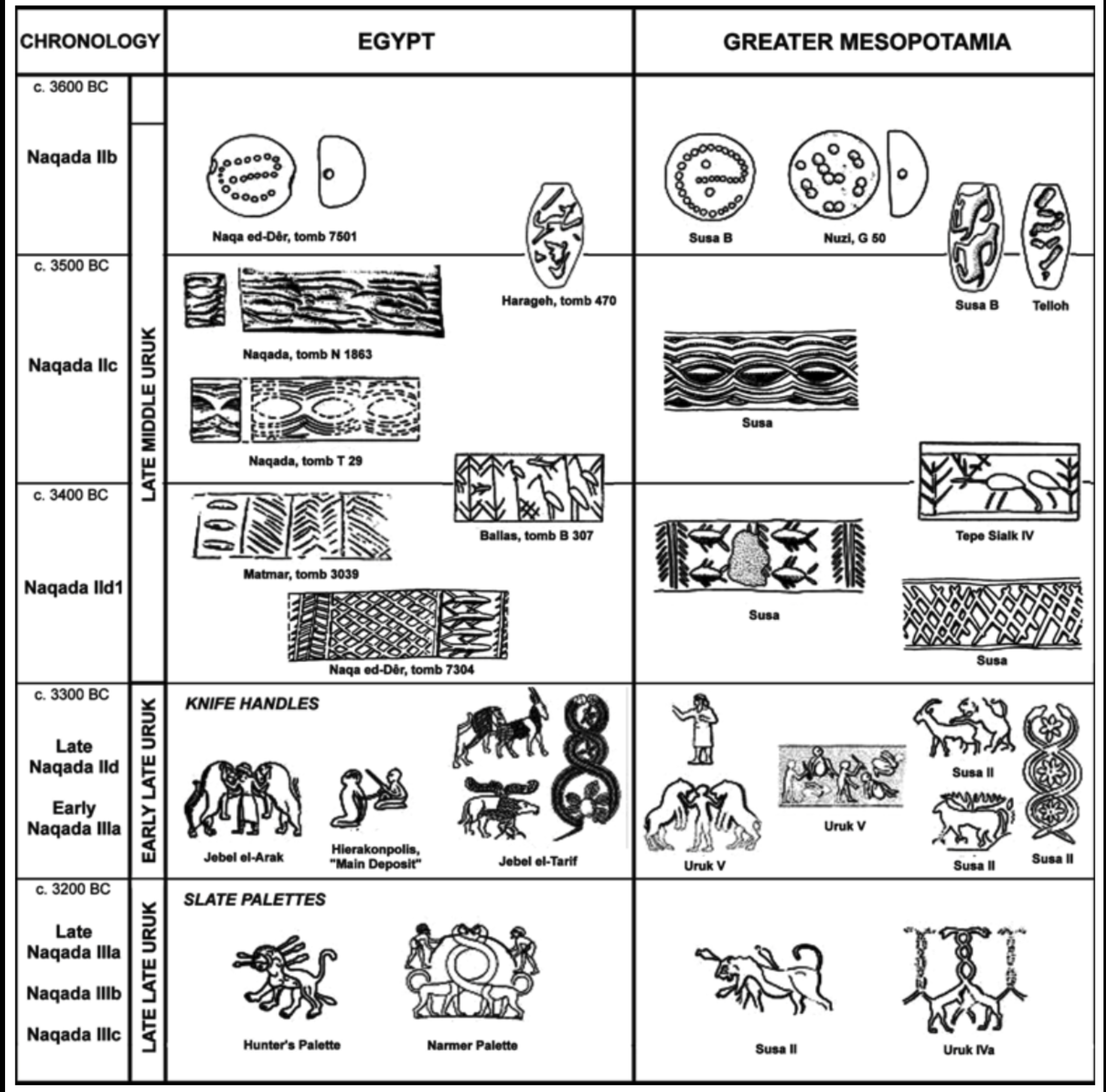
Metallurgy and chariots arrived in China from the west; Mesopotamia, Indus and Egypt were in very close contact. So much so, that the cultural artifacts of the epochs preceding the first dynasties are near identical (including building plans!) :
https://raw.githubusercontent.com/wiki/pannous/hieros/susa-e...
Your comment does prompt the reply that there is a wide variance in the definition of key words on the subject, particularly as applies to popular interpretation.
In the anthropological context, "civilization" is usually meant to refer to the most complex form of societal organization. Civilizations don't start appearing until about 6000-7000 years ago. By contrast, the Younger Dryas (a sudden climatic shift in the Northern hemisphere that reverted temperatures back to the last glacial maximum) occurred about 12000 years ago. The Laurentide ice sheet probably completely collapsed by about 11000 years ago.
With these definitions, you can see that the distance from the end of the last ice age (collapse of the Laurentide ice sheet) or the end of the last big climate change (Younger Dryas) to the beginning of civilization (~Uruk period in Mesopotamia) is around the same magnitude as the distance from the beginning of civilization to the present day. That's not exactly "soon."
> Climate change is presently believed to be a major catalyst to the development of civilization in Egypt and Mesopotamia. It also thought to have led to the collapse of the Indus River Valley civilization. But it is not thought to have played major roles in the other developments of civilization.
Are you sure about that? From what I have read, climate has a pretty big influence on society, and therefore changes in climate would play major roles everywhere.
> Auferre, trucidare, rapere, falsis nominibus imperium; atque, ubi solitudinem faciunt, pacem appellant.
Longer quote from The Agricola translated:
> These plunderers of the world [the Romans], after exhausting the land by their devastations, are rifling the ocean: stimulated by avarice, if their enemy be rich; by ambition, if poor; unsatiated by the East and by the West:
the only people who behold wealth and indigence with equal avidity. To ravage, to slaughter, to usurp under false titles, they call empire; and where they make a desert, they call it peace.
You beat me to it. I find this subject interesting but the platform of Twitter is incredibly ill-fitting for this. I've noticed recently more and more people doing long-form content on Twitter - I hope it's not a trend that catches on.
Being able to link and pass around the most interesting sentence (and associated media) as a unit separate from the rest (but keeping the original context attached) makes it much easier for things to spread. How often have you wanted to share an interesting paragraph from an article and been unable to link to it? Twitter threads are an awkward solution to this, but they're the best available.
You could do this on Twitter if you stay within the character limit but for material in the link, that requires 5+ tweets to cover completely, it simply seems that the amount of scrolling and clicking is a waste. This sort of stuff is not always so neatly presented as it is on this particular link within Twitter. On your timeline, you might notice the "part 3" tweet first. Then you gotta click it to try to gain a larger context to see if its actually interesting. Then, if it is, you have to click to find the "part 1" tweet. Sometimes this will be simple because you can show the entire thread. Other times it seems like you cant. It is a lot of manual overhead to consume two paragraphs or so plus a link to the actual podcast that the paragraphs are describing.
Twitter is obviously a broken system for trying to share interesting links then. I don't see why we should ruin publishing for everyone else because twitter doesn't allow sharing text properly.
> How often have you wanted to share an interesting paragraph from an article and been unable to link to it?
Never? If I’m linking something and I want to show some text copied from the article, I copy and paste it. Texts and email and HN and Facebook all support this...where are you sharing things outside of Twitter where this isn’t possible to do?
The title of the podcast, and the experience of googling some of the names in the diagram and getting sites that don't scream credibility, makes me wonder:
Does anyone know the validity of this? Can any archaeologist/historian types recommend sources?
Some time ago I read that there was a time when the Amazon wasn’t all jungle. I don’t know the veracity nor timeframe but I’m guessing within the last few thousand years.
I see it as a little of science mixed with a lot of speculation, and good amount of crackpotoplogy.
The part where he tries to show that the old map of Herodotus (c. 484BC – c. 425BC) is somewhat similar to the map of rivers and basins, but they don't even look similar. (Also note that the dates discussed in this articles are about 5000 years ago, something like 2500 years before Herodotus.)
You’re being downvoted, but there’s actually something to this theory. The spread of Islam throughout the African continent brought with it a cultural taboo against pork; pigs were mostly displaced by goats, which will frankly eat anything down to its roots.
> It was narrated from Abu Hurayrah (may Allaah be pleased with him) that the Messenger of Allaah (peace and blessings of Allaah be upon him) said: “The Hour will not begin until the land of the Arabs once again becomes meadows and rivers.”
When I was a teenager, I was interested in what people used to say about the future in the past and this was the one thing that ever stuck out to me in my readings.
I guess it was common knowledge among the knowledgeable at the time that this was true but I was never able to corroborate it.