Guatemala numbers are less because they only count it as homicide if someone dies at the scene. If you manage to get into a hospital then die, it's not in the stats.
There's no "fine tuning" of police operations in Guatemala. Everyone is incompetent, and the UN and other "human rights" groups fuck it up even more. Average citizens are afraid to even kill thieves and extortionists due to court prosecution. Said criminals continue to run gangs from inside prisons. Most "good" people just leave as soon as they can. My ex finally called it quits when Telefonica, the multinational phone company, got extorted. Someone calls them up, tells them they owe $X/week, and then just starts shooting employees. It's getting worse, not better.
The only hope I've had here in recent times was several people, including young women, talking fondly about Rios Montt and how they wish a leader would come clean stuff up. Even a semi-indigenous person told me that (despite him supposedly being genocidal). Unfortunately GT has a preference for electing nitwits that can't even steal without getting caught. That's how incompetent they are. So it's unsure if we'll ever see a strong ruler come back in. But now more than ever are people ready for that.
Turns out, when you can't safely walk around, when you can't start a business because any day you'll get a phone call that means either bankruptcy, death, or exile, yeah damn right you start preferring a military rule. As one woman told me, "at least I could walk anywhere, anytime with my purse and no one ever troubled me".
The implicit idea is that the courts uphold the letter of the law (an unnatural death is always somehow murder, prosecute impoverished people with a blanket policy of lenghty jail terms for any manslaughter at a minimum) without considering the spirit of the law (maybe some murders should be counted as self-defense, given that the constant ambient background noise of implicit corruption and disorganized chaos creates an environment of death by a thousand small cuts, making it profoundly difficult to obey the rules perfectly while keeping one’s head above the proverbial water).
It is a good thing in countries that are fairly low crime. In places where the criminals operate with impunity, we need a bit more reactive violence. If the police are useless, criminals should at least be worried about being summarily executed during their attacks on other citizens. Instead, it's backwards. Law abiding citizens have no recourse.
Civil liberties aren't worth much when you can't freely travel and live in the first place. Sure, a few innocents will lose out with an abridged justice system. But that's already happening at a high rate.
And sure, they could also just turn the country around. Get foreign countries to run ministries, get a whole new police force, increase resources to the justice system 10-fold. But tell me what's more probable, that, or just taking a hard stance, have swift summary justice and giving citizens strong defence rights?
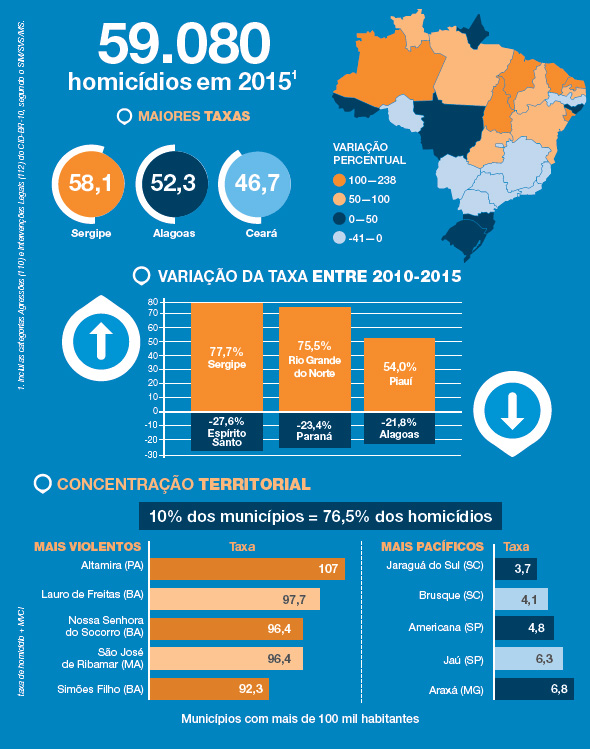
Both in Portuguese but I think it's not hard to make sense of the numbers (rate is 1/100k, map colours describe increase/decrease in violence, bottom lines show current top/bottom rates in cities with 100k+ residents).
There’s a strong negative correlation between latitude and crime. One hypothesis is that people further away from the equator spend more time inside annually, and thus have less opportunity for crime.
Alaska is next to South Carolina. DC tops the list. Both of these are relatively small populations, but then you have Michigan and Indiana above New Mexico.
If there's a correlation there, it doesn't seem obviously strong.
Some of that list is ordered how I'd expect, but I wouldn't have guessed that NY has significantly lower than US-average murder rates, and Alaska significantly higher. Interestingly both CA and TX are pretty much exactly at the US average, despite fairly different politics/policies.
NY has restrictive gun-controls, is quite urban/dense and has the 2nd highest gdp/capita by state. They're all correlated with lower murder rates, that helps explain things a bit on NY.
The one thing NY does have is high inequality measured in gini, the highest of all states. That usually drives crime/murder rates. But it's probably because of rich outliers (extreme upper capital class), rather than a big gap between lower-uppermiddle.
Canada has far more restrictive gun control than NY, yet we are already on track to beat NY state in shootings this year with some cities having a 94% increase in violent gang offenses involving illegal handguns according to StatsCan. The difference must be policing and whatever gang strategy NY state has developed to get kids not to join them.
Could you reference me? Canada's murder rate is about 1/2 of the NY rate, and about 1/3rd of the US rate, and is about half of its peak 40 years ago. Canada has roughly the same amount of murders as NYS but the latter has 54% (let's say half) the population.
It's true that the rates are rising for a few years in a row, but this is nothing new. If anything, Canada's typical pattern is to see a rise a few years in a row, followed by a stronger drop. [0]
It's also true that gang related offences were part of the recent rise. But let's also note that they entail about 100 of the 600 murders in Canada, 15.5% in the last year for which I can find data. (2016). The vast majority of murders are done not by strangers but by friends or family, not related to gang violence.
About 95% of the world (not counting the US) has a lower per capita income than the poorest US cities.
Arguably the poorest US state, West Virginia, has a typical murder rate of around 3 to 4 per year per 100k.
Vietnam has been extraordinarily poor for the last half century, only recently beginning to climb economically. Its murder rate is typically 1 to 1.5 or so.
Per capita income probably only has a correlation in regards to the resources you have available to deal with crime problems if such presently exist, rather than being the defining characteristic of whether eg murder will be prevalent in a nation.
> So how effective is that alone? It seems per capita income would be the prevalent factor.
It isn't, alone, in a cherry-picked example. But ceteris paribus it's a explanatory factor.
I mean, one could also use your argument the other way around and question whether income is effective as a factor by itself. Cherry pick some country with similar levels of median wealth and a wildly different murder rate and gun laws. Like say the Netherlands and the US. Doesn't really prove a point, it'd be silly to now claim income isn't an important factor.
Here's one take-home message: if you made up a country which was 10% like Venezuela and 90% like Germany, then it would have murder stats double the USA.
It would also have a GDP much like the USA, and would qualify for the OECD.
Obviously this is just about how averages work -- the high violence stats of the 10% can completely skew the average, but their low income stats can't. But it's worth remembering, every time someone tries to tell you what an outlier among rich countries the US is. It's a large, diverse, country... and often different averages are telling you facts about completely different people & places.
Amsterdam has a murder rate commonly as high as the whole of the US. That isn't a rational comparison and isn't indicative of the murder rate of the Netherlands.
Yet millionaires sit having tea in St Louis right now with zero fear that they are in any danger. City metrics are as useful as state and country. Some places are safer than others. Usually determined by how much mONEY is available in that place to pay for armed force to keep it safe.
The Puerto Rico data does not tell the whole story. My island is 100×35 miles in size. It has a higher rate than Mexico.
But numbers don't tell the whole story. I remember waking up and laying on the floor of my bedroom because there was a drug gang shootout with automatic AK-47s in front of my home. Seeing the blood stains of victims on a neighbor's walls (someone was executed against a wall). The sound of weapons always being a part of the night.
The color scheme here is really poor. It took me too long to realize that bright orange was not a step down from bright red, but in fact dark red, pink, and dark orange were between them. So the brighter red indicates more violence, but the the darker orange indicates more violence? Just use a single color gradient and spare us all the headache.
I could not find official data yet for 2017, but they're missing a big one on this list and that's the United States Virgin Islands. 2015 brought 32.9 murders per 100,000 and they are consistently ranked as having one of the highest murder rates per capita of anywhere in the U.S.
That's a U.S. territory with a higher murder rate than Brazil.
This includes St. Thomas, St. John, and St. Croix.
I lived there for only a few years and experienced the loss of two friends due to homicide in that short time, on an island that is only 13 miles long, and 32 square miles.
Many of these crimes go unsolved despite such a small population, in such a small place, due to corruption, fear, and lack of resources.
There are a bunch of interesting ways to break down homicide rates. I find by cities to be the most interesting, I think correlates stronger to how safe I "feel" in an area compared to national rates.
I was surprised by the apparently high per capita homicide rate in Nunavut, Canada, but apparently it's mostly due to just how low the population is there:
You get into all sorts of radical variances when you dig into locational data eg across the US.
The common US murder rate where ~95% of the population lives, is closer to Canada typically, at around 1.5 to 2.5. Then you have extreme murder rate areas in the worst parts of eg Baltimore and Chicago that blow the scale up (Baltimore hit 56 per 100k for 2017, with more murders than NYC). Several dozen neighborhoods in those cities account for a truly incredible share of the US murder rate. People outside of the US commonly make the mistake of thinking most of the US has a 4.x murder rate, when that isn't the case; in the US murder is hyper concentrated.
It is like that in almost all countries though. Most countries have towns or cities with much higher than average rate. That is natural. Except e.g. the most violent city in Sweden has the same rate as the average in the US
It's not like that in most countries in fact. The US variance between high murder parts of high murder rate cities and the murder rate for the other 95% to 97% of the population is several times greater than other countries with comparable murder rates.
The murder rate among Sweden's largest cities does not consistently vary by ~20-30 fold top to bottom. That's the gulf between New York City and Baltimore, or Honolulu and St Louis, or Detroit and Austin TX. That extreme of a variance, is very unusual for all but a few countries.
Argentina for example, which is at least somewhat similar to the US in per capita murders in a given year, in their major cities you do not see Baltimore, Detroit, Chicago type examples of extreme outliers vs the ~6 national rate (eg Buenos Aires is typically around 5 or 6, as is Cordoba). Rosario, which saw a large murder rate spike in 2012-13, was considered shocking, because the murder rate went from ~10 to ~22 over a few years. So the US national rate is lower than Argentina, while having drastically higher outliers like Baltimore and Detroit versus eg Rosario (their bad case example).
There's no "fine tuning" of police operations in Guatemala. Everyone is incompetent, and the UN and other "human rights" groups fuck it up even more. Average citizens are afraid to even kill thieves and extortionists due to court prosecution. Said criminals continue to run gangs from inside prisons. Most "good" people just leave as soon as they can. My ex finally called it quits when Telefonica, the multinational phone company, got extorted. Someone calls them up, tells them they owe $X/week, and then just starts shooting employees. It's getting worse, not better.
The only hope I've had here in recent times was several people, including young women, talking fondly about Rios Montt and how they wish a leader would come clean stuff up. Even a semi-indigenous person told me that (despite him supposedly being genocidal). Unfortunately GT has a preference for electing nitwits that can't even steal without getting caught. That's how incompetent they are. So it's unsure if we'll ever see a strong ruler come back in. But now more than ever are people ready for that.
Turns out, when you can't safely walk around, when you can't start a business because any day you'll get a phone call that means either bankruptcy, death, or exile, yeah damn right you start preferring a military rule. As one woman told me, "at least I could walk anywhere, anytime with my purse and no one ever troubled me".