The algorithm works on a large variety of handwriting (currently only support English).
It's a NN that was trained on ~100k different handwriting examples, and it's pretty robust to cursive / sloppy handwriting. Haven't tried European vs American numbers yet but I'll definitely give it a try now that you've piqued my curiosity
Thanks for the reply!
The European 1 often looks like an upward facing triangle without a bottom line. Surprisingly frequently it has caused European's in the US to have issues with the IRS/Taxes because the European 1 is often interpreted by Americans as a 7 (because Americans do not use a bar across the center of the 7 or Z). A household size of 7 instead of 1 can be a real back breaker!
No, I mean G precisely because it has that loop at the bottom. I see it near universally in Poland, and 100% in Germany but with a terribly small sample size.
After signing up for the Beta, it hit me. Every single bit of this could have been staged without having done any coding at all!! Brilliant!!
I'm not sure if that is actually the case, but theoretically it is totally possible. This is a great example of the classic MVP pitch: validate interest before building.
Honestly, this wasn't calling you out at all. I think it is great. It is a very well done presentation. You did a good enough job that it made me interested in the product.
Hey! We wanted to show how the product works if notes are delivered instantly - vs. the current 10-30 sec lag time we experience between note being snapped, and the transcribed copy you receive.
Definitely didn’t mean for it to put a damper on the tech - sorry for the mistake.
I think that although handwriting won't be going away for some time, I've come to find that I'm using digital mediums for note-taking more often and it's becoming more popular (see Apple Pencil, Surface Pro Pen). If this service were coupled to an app that supported writing with a digital pen, it would be more appealing to many; it would mitigate the need to snap a photo, mitigate the need to have paper, and still allow for someone who wants to jot out their ideas by hand to have a digital text copy in the end. Any ideas for going down this route?
I mean, taking photos and rendering paper notes to digital has definitely been done multiple times already. This other approach would become a must-buy app for anyone who uses their ipad pro or surface pro for notes.
Adding digital handwriting support is a great idea. I actually think other companies do it pretty well, which is why we didn't go down that route. The reason is that they use a different type of algorithm that learns, in part, from the handwriting velocity, and gives you edit access on the go, which is not possible if you've taken the notes in a normal notebook.
We decided to start with plain notebook text mainly because it seemed like no one else had solved this problem to our satisfaction yet.
No.
I'm working for a company that offers DMS and OCR services.
A big business atm are cheques. I .. don't understand what they're for, consider them weird. But there is a huuge number of places that use them, the US is a part of that for some reason.
A lot of those are filled in by hand.
Say, you're doing a census project. You send out forms that WILL be filled in by hand.
That said, I don't believe in silver bullets here...
Love the idea and really wish you already supported other languages!
By the way, you have a problem with your demo video: around the 2:10 mark of the video you can see that the first phrase of the .docx file has a lot more content than the written note... While the note contains: 'The plan is simple', the document contains: 'The plan is simple and brilliant. Here are the steps'.
I'm not questioning your tech, but if your service isn't really running on the demo, maybe you could make this explicit somewhere in the video?
I've been keeping a physical dev diary and have been trying to keep up with transcribing it to digital, but would love any shortcuts to that process as I'm pretty bad about keeping up with it.
My handwriting is kind of messy but I'm eager see how well your algorithms can handle it. It doesn't have to be perfect anyway, as I don't mind going in and cleaning up afterwards. Should still save me some time and some typing.
Thanks for the comment! We had the same use case when we decided to build it.
It's currently not perfect but handles a surprising amount of bizarre handwriting styles (cursive / messy notes). Looking forward to hearing your thoughts as we onboard to the beta,
Nice! Maybe I won't need to implement this myself then.
Now if only someone would release designs for an affordable, reliable, non-destructive robot to do the physical data collection... My backlog of notes is way to big to stand around snapping cell phone photos at all of it manually.
There are a bunch of services that do this and return OCR'd documents and images, perhaps it could be interesting to partner with one of them? I assume they're already paying for OCR licenses.
Care to share some details on your technology? On whose handwriting was this trained, did you use any public datasets for this? And of course, how well will this perform on writing styles it hasn't seen before?
We did two things to train it (1) scraped the web for photographs of handwritten notes with known transcription to build our training dataset (2) had our university friends / students write out training examples by hand to get more realistic data on what modern handwriting looks like
Scribble currently only supports English, so it does poorly with other languages, but is pretty robust to poor handwriting in English (such as my own).
It gets about 85% of my handwriting correct (my handwriting is abysmal), so there's definitely room for improvement.
We don't have a developer facing API at the moment but it's in the roadmap. Once our algorithm is accurate enough that it "just works" in an enterprise setting, we may open up an API so developers can build applications for their businesses.
Currently, it's a combination of the two, mainly because people often take notes hastily so word-based recognition coupled with spell check allow you to fix things on the fly. However, this also results in bizarre outputs sometimes so we're still figuring out what an optimal output looks like.
This is awesome! I have notebooks full of very messy stuff which I've kept waiting for a service just like this someday. I hope it gets really good. Can't wait!
Cool idea. Could see this being useful with something like Evernote. It's got a great note capture feature as well but doesn't covert to text you can't edit.
Agreed re: Evernote. I actually really like that feature, because it makes handwritten notes searchable but found the same problem you identified with the lack of transcription.
My hope is we can integrate with players like Evernote / OneNote who already do a great job at centralizing notes.
Can you elaborate on how does it improve on traditional OCR?
Other than that, pretty neat that it keeps (or even improves) on the existing formatting on the note.
Traditional OCRs are good at transcribing typed notes (e.g. pdfs) to editable docs, but do poorly with handwriting. The best OCRs I've seen can make a handwritten note searchable (e.g. Evernote) but still don't transcribe it editable form.
A lot of academic work on transcribing images of handwritten notes into text has surfaced over the last couple of years (mostly regarding using neural networks), and we decided to apply it
I was at LensCrafters the other day and had to fill out a paper form that someone input into a computer by hand, so definitely see the need there.
Our goal is to get a high enough accuracy for handwriting OCR to work in enterprise settings. 90% may be good for consumers, but I wouldn't want to put anyone's health on the line due to a transcription error
We don't have a developer facing API at the moment but it's in the roadmap. Once our algorithm is accurate enough that it "just works" in an enterprise setting, we may open up an API so developers can build applications for their businesses.
Or the Remarkable tablet (paging user @sandsmark)? They're looking for a digital handwriting transcription solution to consider augmenting their focused writing product.
ML / NN have been around for a while, but there are a few reasons Scribble is only possible now:
1) Although classifying MNIST digits is the "hello world" of ML, doing the same with notes is substantially more difficult. The algorithm has to figure out sentence structure, punctuation, paragraph breaks, lists, and tons of other features that are hard to train. This problem is still a major research topic academically.
2) As a corollary to (1), while OCR has been around for a while, handwriting OCR has never worked due to (1).
3) Computing power has never been so cheap, training the algorithm would have been very expensive before AWS / Azure / etc abstracted hardware and made it inexpensive
Do you need links or proofs if I tell you the sky is blue ?
OCR has been around for decades. This approach is only interesting if it improves OCR via NN. Would love to learn more about this process (the improvement, not the training...).
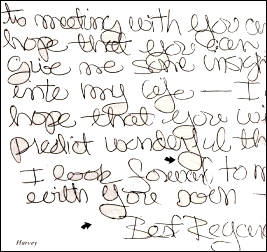

Cursive?
European numbers vs American numbers (the 1 especially)?
Doctor (or other badly rendered hand writing)?
Seems like this technology isn't really all that useful if it doesn't work on various inputs, especially 'unclean' or 'sloppy' inputs.